

By Maimona Saleem
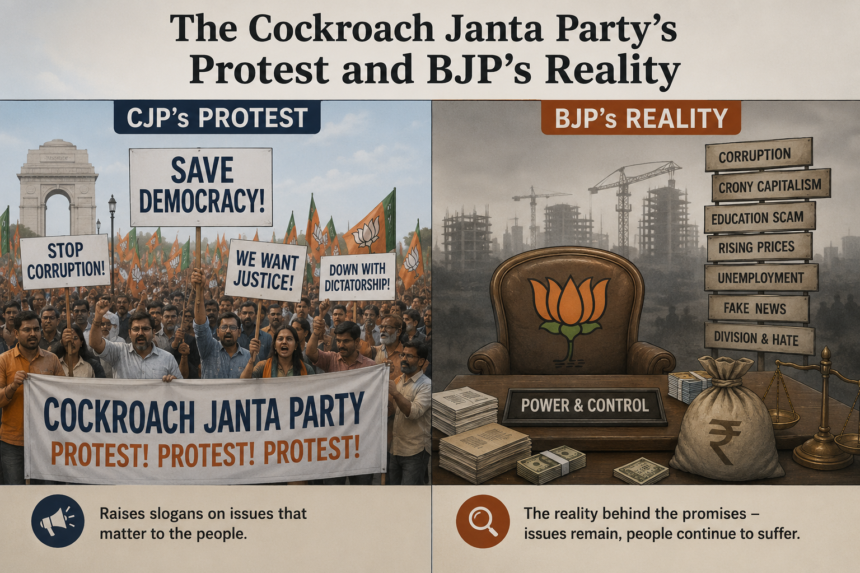
The Cockroach Janta Party (CJP) is a political movement that emerged after Indian Chief Justice Surya Kant sarcastically called the country’s unemployed youth “cockroaches”. The CJP found impetus on social media platforms where Abhijeet Dipke, the founder of the movement, created an account as a parody in response to Justice Kant’s comment. However, what started as a joke soon became an organised movement when millions of people started following Dipke’s account and commented on their experience with regard to the government’s inefficient policies. Consequently, CJP’s followers grew exponentially, and it decided to advocate for the education and employment rights of Indian youth.
Although the CJP didn’t intend to carry out physical protests, the leak of the National Eligibility Entrance Test (NEET) medical entrance exam elicited outrage among students and parents. Besides, the severe corruption and mismanagement charges against Education Minister Dharmendra Pradhan aggravated the grievances and conversely paved the way for CJP’s march on Parliament.
According to the 9th of July’s announcement by Dipke, a formal protest had been planned for the 20th of the same month, to which thousands of people agreed. However, on the day of the protest, the police used tear gas and rubber bullets to forcefully disperse the “peaceful protestors.” Subsequently, a lockdown was also imposed in certain localities of the capital to prevent people from re-gathering.
The violent action by the state proved counterproductive and was unable to attain the desired objective. The infuriated youth continued their protest on the second day by overrunning barriers and obstructions that were set up by the police. Besides, the violence inflicted on the youth also resulted in condemnation of Prime Minister Modi’s unwarranted use of force and called for his resignation. The intensity of the protest has grown, and its duration has been extended until the government accepts the demands put forth by the CJP.
The ongoing protest highlights the inefficiencies of the incumbent government. For years, the country’s literacy rate has remained significantly lower in the Bharatiya Janata Party-led states. Most of the top ten most literate states of India are those where either the BJP is not in government or is less influential. Young men are also dropping out of higher education to support their families, knowing the fate of their university-educated counterparts. Despite being in power for nearly 12 years, the Modi regime failed to address unemployment. According to reports, 20% of graduates aged 25-29 are unemployed. This is alarming for the country that is home to the world’s youngest population with a mean age of 28.
The CJP’s protest for a better future for Indian youth is commendable. It highlights the nefarious governance style of the BJP, which has always carried out efforts to undermine its rivals, even by resorting to the use of force. Therefore, it is an opportunity for the opposition parties to support this youth movement, like the Indian National Congress, in order to reform society. Otherwise, these efforts will be wasted, and the BJP will continue to rule by oppressing the voices for change and betterment of the country.
The author, Maimona Saleem, is a senior researcher at CDS and a PhD scholar in Peace and Conflict Studies. Her research focuses on terrorism and extremism. Her work also focuses on peace-based approaches to economic development, growth, and regional cooperation. She also writes on geopolitics, regional security, and global power dynamics