
• An examination of how the trilateral Makkah pact marks a shift toward regional collective deterrence and defense-industrial self-reliance amid persistent Gulf security threats.
From Makkah to a New Regional Security Architecture: Can Pakistan, Türkiye and Saudi Arabia Redefine Middle Eastern Security?
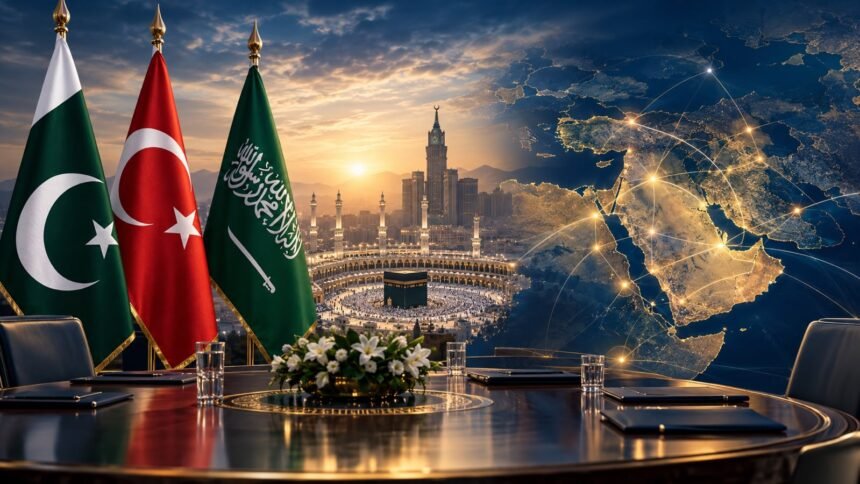
The geopolitical architecture of the Middle East is undergoing its most radical realignments since the collapse of the Ottoman state. Signed in Makkah in August 2026, the joint defense agreement between Saudi Arabia, Türkiye, and Pakistan frequently termed the Makkah Joint Defense Agreement marked a pivot in regional security dynamics. The formal announcement that the top-tier Strategic Political Defense Committee (SPDC) will convene in Riyadh next week signals that this accord is shifting rapidly from diplomatic posturing toward operational planning. Bringing together foreign ministers, defense ministers, and chiefs of general staff, the upcoming Riyadh talks arrive at a volatile juncture. Renewed Houthi missile and drone strikes targeting Saudi critical infrastructure have exposed persistent vulnerabilities, while parallel suggestions from Tehran calling for political engagement with the Houthis complicate the strategic equation.
As three of the Muslim world’s formidable powers formalize mutual defense commitments, a central question emerges:
Can this trilateral axis establish a durable Middle Eastern security framework, or will internal divergence and external pressures limit its transformative potential?
For decades, Gulf security rested on the assumption of an implicit or explicit American umbrella. Standardized after the 1990–1991 Gulf War, this framework relied on heavy U.S. troop presence, forward airbases, and sea-lane defense to deter external aggressors. However, shifting priorities in Washington driven by a strategic pivot toward the Indo-Pacific, domestic wariness of foreign entanglements, and conditional U.S. arms transfers have created pervasive uncertainty among Gulf monarchies. While Washington maintains military installations across the region, its reluctance to retaliate forcefully against asymmetric attacks on Gulf energy infrastructure over the past decade exposed the limits of Western security guarantees. Rather than replacing Washington entirely, regional actors are engaging in strategic hedging, creating overlapping security mechanisms to insulate themselves against American policy shifts.
For Riyadh, cultivating deeper defense ties with Ankara and Islamabad represents an intentional diversification of its strategic portfolio. Crown Prince Mohammed bin Salman’s Vision 2030 requires absolute stability to attract foreign capital and transform the Saudi economy a mandate continually threatened by cross-border strikes. By formalizing a collective security framework with Pakistan and Türkiye, Saudi Arabia gains access to Pakistan’s battle-tested military manpower and nuclear deterrence capability alongside Türkiye’s advanced defense-industrial complex and drone technology.
Türkiye’s participation highlights its ascension as an autonomous security provider across the Middle East, North Africa, and the South Caucasus. Ankara’s defense sector has matured from a regional supplier into a major exporter of unmanned aerial systems, naval platforms, and modern armored vehicles. By extending its security radius into the Arabian Peninsula, Türkiye secures lucrative arms export contracts while cementing its role as a power broker in Gulf dynamics. This trilateral alignment allows Ankara to institutionalize its footprint in the Gulf without relying on Western alliances, bridging its NATO commitments with an eastern strategic footprint.
Pakistan’s position within this alliance requires a delicate balancing act. Structurally dependent on Saudi financial support and oil credits, Islamabad has long maintained covert and overt military assistance to the Kingdom. However, Pakistani strategists remain wary of overextending their armed forces or being drawn into purely sectarian conflicts. Islamabad shares a long, volatile border with Iran and cannot afford a direct military confrontation with Tehran. Pakistani Foreign Minister Ishaq Dar underscored this balance by noting that Islamabad remains in direct communication with Iranian leadership, emphasizing that the Makkah pact is strictly defensive and not directed against any third state. Pakistan seeks to fulfill its defense commitments to Riyadh while maintaining diplomatic backchannels with Iran and preserving its defense partnerships with Türkiye and the United States.
The immediate trial for this trilateral framework is the escalating crisis in Yemen. Recent Houthi strikes targeting Saudi energy installations and civilian infrastructure have tested the pact’s mutual defense clause. Under the agreement, an attack on one signatory is treated as an attack on all three. Yet the precise threshold for triggering a joint response remains undefined. Iran’s diplomatic signaling suggesting political engagement with the Houthis rather than military escalation presents both an opportunity and a trap. Tehran aims to leverage its influence over the Houthis to deter direct Turkish or Pakistani military intervention in Yemen. The upcoming SPDC meeting in Riyadh must reconcile these conflicting pressures, deciding whether to deploy joint air defense assets, offer technical radar support, or initiate mediated talks with the Houthi leadership.
Whether the Makkah agreement evolves into a functional collective defense mechanism similar to a regional NATO or remains a framework for strategic deterrence depends on several operational variables. In its current state, the pact functions as a mechanism for deterrence and defense-industrial cooperation rather than a fully integrated command structure. It signals to regional actors that unprovoked attacks on Saudi Arabia carry diplomatic and military costs involving Ankara and Islamabad. Moreover, interest from neighboring states including reports of potential expansion to involve Egypt, Qatar, or Kuwait suggests that the arrangement could serve as the nucleus for a broader Middle Eastern security mechanism.
Significant constraints persist. Bridging the operational doctrines, command structures, and equipment standards of three distinct military forces presents formidable technical challenges. Geopolitical priorities also diverge Türkiye remains focused on its northern and Mediterranean frontiers, Pakistan’s strategic doctrine centers on South Asia, and Saudi Arabia concentrates primarily on the Gulf and Red Sea corridors. Furthermore, if the pact is perceived purely as an anti-Iran coalition, it risks worsening regional fault lines and triggering counter-alignments.
The forthcoming Riyadh meeting of the Strategic Political Defense Committee will clarify whether Pakistan, Türkiye, and Saudi Arabia can translate shared security concerns into institutionalized defense mechanisms. The Makkah agreement reflects a structural shift toward a multipolar Middle East, where regional powers assume primary responsibility for their security architecture. While this trilateral arrangement may not immediately replace legacy Western security umbrellas, it marks an important step toward regional self-reliance, reshaping deterrence dynamics across the Gulf and the wider Islamic world.
Author
I am an independent researcher with a passion for exploring global affairs through the lens of critical thinking and evidence-based analysis. My writing examines contemporary political, economic, and strategic issues, with the aim of presenting balanced perspectives that inform, engage, and encourage meaningful discourse.