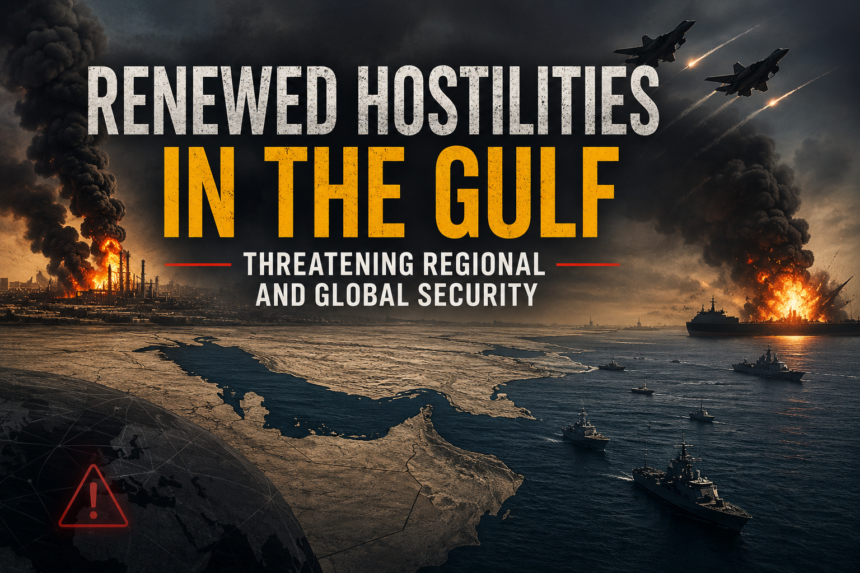

The renewed Gulf conflict has become a major geopolitical crisis with serious implications for regional and global security. Although the intensity of direct fighting has eased, the risk of escalation remains high through proxy warfare, cyber operations, and strategic competition. It emphasizes that military force alone cannot resolve the conflict and advocates for diplomacy, particularly the revival of the Pakistan-brokered Memorandum of Understanding (MoU), as the most viable path to lasting peace. The author concludes that regional cooperation, adherence to international law, and sustained dialogue are essential to prevent a wider war and ensure long-term stability.
Asif Haroon Raja
Part Four
A Dangerous Escalation
Military escalation has once again eclipsed diplomacy. Both sides continue climbing the escalatory ladder, with neither appearing willing to lower the temperature.
Every new strike invites retaliation, bringing the region closer to an all-out war whose consequences could extend far beyond the Middle East.
The longer the conflict continues, the greater the danger that miscalculation, rather than deliberate policy, could trigger a much wider confrontation involving additional regional and global powers.
If Iran sees the war as a fight for the survival of the Islamic Republic, US President Donald Trump sees it as the litmus test of his ‘peace through strength’ foreign policy.
Five months into the war, Iran has emerged as the first and only state to challenge Mr. Trump’s ‘might is right’ approach, albeit at significant cost to itself, its neighbours, and the global economy.
The challenge, rooted in Iranian perceptions of the Islamic Republic’s 47-year-long history, complicates Mr. Trump’s quest for a credible off-ramp threatens to trap him in an escalatory cycle.
Updated Assessment of the Gulf Situation
The military confrontation in the Gulf appears to be entering a new and more complex phase. While the tempo of direct US-Iran and Israel-Iran exchanges has declined, the conflict is expanding horizontally through proxy actions, indirect pressure and strategic signalling.
This suggests that none of the principal actors seeks an immediate full-scale regional war, yet none is prepared to concede its strategic objectives.
Recent mediation efforts have reportedly produced a temporary reduction in direct attacks, although the situation remains fragile and susceptible to rapid escalation.
The following developments deserve particular attention:
- Ukraine’s Attack on an Iranian Vessel in the Caspian Sea
Ukraine’s strike on an Iranian vessel in the Caspian Sea has added an entirely new dimension to the crisis.
Tehran has condemned the attack, summoned Ukraine’s diplomatic representative and warned of retaliation, arguing that Kyiv has opened another front against Iran.
If Tehran follows through on its threats, the Ukraine-Russia war and the Gulf conflict could become strategically intertwined, with Russia and Iran likely to deepen military coordination.
Such a development would complicate Western calculations and widen the geographical scope of the conflict.
- Iran’s Warning to the United Kingdom
Iran’s warning to Britain over the reported use of British military facilities by US strategic bombers underscores Tehran’s doctrine that any state facilitating attacks against Iran may itself become a legitimate military target.
Whether or not such threats are implemented, they serve as a powerful deterrent message aimed at discouraging regional and extra-regional partners from actively supporting further military operations against Iran.
- Iraqi Territory – A Potential Flashpoint
Iraq remains one of the most vulnerable theatres for unintended escalation.
The presence of multiple armed groups operating with varying degrees of independence creates the risk that attacks launched from Iraqi soil—whether by pro-Iran militias, anti-Iranian groups or other rogue elements—could trigger wider military responses.
Unless Baghdad succeeds in exercising effective control over its territory, Iraq is likely to remain a potential catalyst for renewed regional confrontation.
- The Absence of Direct Israel-Iran Exchanges
One of the most noteworthy developments has been the absence of sustained direct exchanges of fire between Israel and Iran following the signing and subsequent difficulties surrounding the memorandum of understanding.
Although hostile rhetoric continues, both sides appear to recognise the immense costs of another round of direct confrontation.
This relative restraint may indicate that diplomatic channels, whether direct or indirect, remain active despite public recriminations.
Is a ceasefire in the offing?
The available indicators suggest that the prospects for another ceasefire are better today than they were a week ago, but optimism should remain cautious.
The temporary pause in direct military exchanges, reported diplomatic contacts through regional mediators, mounting pressure on military resources, economic concerns and the growing risk of regional spillover all provide incentives for de-escalation.
Nevertheless, the ceasefire would almost certainly be tactical rather than strategic. None of the principal actors appears prepared to abandon its long-term objectives.
Iran is unlikely to compromise on its sovereignty or strategic deterrence, Israel continues to view Iran’s military capabilities as an existential challenge, and Washington remains determined to preserve its regional influence.
Accordingly, the most probable scenario is not the end of the conflict, but a period of managed confrontation characterised by intermittent proxy attacks, intelligence operations, cyber warfare, diplomatic bargaining and limited military incidents, while all parties avoid the political and military costs of another full-scale regional war.
Such a pause could eventually evolve into more durable negotiations, provided no major provocation derails the current momentum.
Strategic Inferences
One of the most consequential developments of the crisis was the reported assassination of Iran’s Supreme Leader, Ayatollah Ali Khamenei.
If viewed through the prism of international law, the targeted killing of the head of state of a country not formally at war with the United States would represent a highly controversial precedent with far-reaching legal and political implications.
Such actions raise serious questions about the future of international norms governing state sovereignty and political assassinations.
The conflict has also demonstrated Iran’s resilience and its capacity to impose significant military and economic costs on its adversaries.
Despite sustained American and Israeli military operations, Tehran has continued to employ the Strait of Hormuz as a strategic lever, using its geographic advantage to exert pressure on global energy markets and international diplomacy.
At the same time, the United States has reportedly committed enormous military resources to the conflict while several of its regional military installations have come under repeated Iranian missile and drone attacks.
Its stockpile of interceptors and Tomahawk missiles are depleting and their restocking would require time.
Even if Washington ultimately retains military superiority, the financial, logistical and strategic costs of a prolonged campaign will be substantial.
This naturally raises broader strategic questions. If the United States remains deeply engaged in a prolonged Gulf conflict while relations with several NATO allies continue to deteriorate, will it possess sufficient military and political capacity to respond simultaneously to future crises elsewhere, particularly in the Indo-Pacific?
Would it be able to effectively deter or respond to a major contingency involving Taiwan?
Iran, for its part, appears to have restored much of its underground military infrastructure, missile production capability and launch facilities. Its leadership appears convinced that it possesses both the endurance and strategic depth necessary to sustain a prolonged conflict.
The American strategy of compelling Iran into submission primarily through sustained aerial bombardment has thus far failed to produce the desired political outcome.
Yet, despite limited success, Washington appears to remain committed to increasing military pressure in the hope that continued escalation will eventually force Tehran to concede.
President Trump’s determination to project strength, Iran’s resilience, and Israel’s continued advocacy of a hard-line military approach have collectively prolonged the conflict.
Many hard-line elements within Iran remain convinced that previous ceasefires and negotiations were tactical pauses designed to allow Washington and its allies to regroup, reinforce their military posture and prepare for a broader confrontation.
These perceptions continue to complicate efforts to restore mutual trust.
The possible entry of additional actors, including the Houthis and other regional armed groups, would significantly widen the conflict, threaten critical maritime trade routes and produce devastating regional and global consequences.
Any attempt to launch a large-scale ground campaign against Iran, short of the nuclear option, would involve immense military, political and economic risks.
History suggests that occupying or subduing a large, resilient and heavily armed regional power would be extraordinarily costly and could ultimately prove counterproductive.
The Cost of Unconditional Alliances
Washington’s unwavering support for Israel throughout successive Middle Eastern conflicts has attracted increasing international criticism.
Critics argue that continued political, military and diplomatic backing for Israel, particularly during the Gaza conflict, has weakened America’s moral authority, damaged its international standing and reduced its credibility as an impartial global leader.
Many observers believe that America’s global influence is increasingly being tested, not because of a lack of military power, but because of growing questions regarding the consistency of its foreign policy and its commitment to the principles of international law.
Israel’s military leadership and political establishment continue to face allegations of violations of international humanitarian law before international judicial forums.
At the same time, the United States has strongly opposed several international legal initiatives directed against Israeli officials, a position that has further intensified debate regarding the selective application of international justice.
Conclusions
The Gulf crisis has entered a dangerous new phase in which diplomacy is steadily giving way to military confrontation. Every passing day increases the risk of regional spillover, economic disruption and the involvement of additional state and non-state actors.
No military victory can provide a durable solution to this conflict. The only realistic path to lasting peace lies in reviving meaningful negotiations based on mutual security guarantees and respect for international law.
The Pakistan-brokered Memorandum of Understanding, despite its collapse, remains the only credible diplomatic framework capable of preventing a wider regional war.
Its revival, supported by sustained international engagement and political will on all sides, offers the best hope for restoring stability to the Gulf and safeguarding global peace and economic security.
Policy Recommendations
Immediate Ceasefire:
All parties should agree to an immediate cessation of hostilities and refrain from further military escalation that could trigger a wider regional conflict.
Revival of the MoU:
The 17 June 2026 Memorandum of Understanding should be revived as the principal diplomatic framework for resolving outstanding disputes through negotiations rather than force.
Freedom of Navigation:
The Strait of Hormuz and the Bab al-Mandab should remain open to international shipping under mutually agreed security arrangements, as prolonged disruption threatens the global economy.
Regional Security Dialogue:
A comprehensive Gulf Security Dialogue involving Iran, the GCC States, Iraq, Türkiye, Pakistan, and other key regional stakeholders should be institutionalised to establish a durable collective security architecture.
Discouraging Spoilers:
External and regional actors that seek to sabotage diplomatic initiatives should be isolated politically and diplomatically, while confidence-building measures should be encouraged.
Respect for International Law:
All parties must avoid targeting civilian infrastructure, political leaders, and non-combatants, and should adhere to international humanitarian law.
Pakistan’s Continued Mediation:
Pakistan, with the support of friendly countries such as Qatar, Saudi Arabia and Oman, should continue facilitating dialogue and confidence-building measures to prevent the conflict from spiralling into a wider regional war.
Concluding Assessment
The Gulf region stands at a strategic crossroads. Although the immediate danger of a full-scale regional war appears to have receded, the fundamental drivers of conflict remain unresolved.
The relative calm following the Memorandum of Understanding should therefore be viewed not as a durable peace, but as a fragile operational pause.
Military deterrence has, for the time being, overtaken battlefield escalation, while diplomacy is striving to keep pace with rapidly evolving strategic realities.
The conflict has already reshaped the regional balance of power. It has underscored the growing significance of indigenous missile and drone capabilities, exposed the vulnerabilities of even the most sophisticated military infrastructure, and demonstrated the limitations of coercive military power in achieving enduring political objectives.
Equally important, it has reaffirmed the indispensable role of regional diplomacy, credible mediation and strategic restraint in preventing crises from spiralling into catastrophic wars.
The coming weeks and months will determine whether the principal actors can transform this fragile pause into a sustainable political process or whether a single miscalculation, proxy attack or strategic provocation will once again plunge the Gulf into open conflict.
The stakes extend far beyond the Middle East, encompassing global energy security, maritime trade, great-power competition and the future architecture of regional security.
History repeatedly demonstrates that wars may determine military outcomes, but lasting peace is secured only through statesmanship, dialogue and mutual accommodation.
In that context, the present lull should be regarded not as the end of the crisis but as a rare diplomatic opportunity.
If wisely utilised, it could lay the foundation for a more stable and inclusive regional security framework.
If squandered, the region may witness another cycle of violence with consequences far more severe than those already endured.
The strategic contest in the Gulf is therefore entering a new phase—one in which diplomacy, deterrence and geopolitical realignment will matter as much as military power.
The choices made today will shape not only the future of the Middle East but also the stability of the wider international order for years to come. Mmm
Concluding Note
“Peace is not achieved by military superiority alone; it is sustained through justice, dialogue, and mutual respect.“
The Gulf has once again become the epicentre of global geopolitics. Whether it becomes the cradle of a new security architecture or the spark for a wider international conflict will depend upon the wisdom of today’s leaders.
The renewed Gulf conflict is no longer merely a confrontation between the United States and Iran. It has become a defining geopolitical contest with far-reaching implications for regional stability, global energy security, international trade, and the future balance of power.
History demonstrates that wars may settle military scores, but they seldom resolve political disputes. Every missile fired widens mistrust, hardens positions, and postpones peace.
The real victors will not be those who inflict the greatest destruction, but those who possess the wisdom to replace confrontation with dialogue and coercion with diplomacy.
The Pakistan-brokered Memorandum of Understanding, despite its collapse, remains the most practical foundation for renewed negotiations. If revived with sincerity and political will, it can still prevent a catastrophic regional war whose consequences would extend far beyond the Gulf.
As the saying goes, “Jaw-jaw is always better than war-war.” In an era of nuclear weapons, hypersonic missiles, and economic interdependence, there can be no winners in a prolonged regional war. Statesmanship—not brinkmanship—must guide the path forward.
“The supreme art of statesmanship is not to win wars, but to prevent them.”
Concluded
About the Author
Brigadier (Retd) Asif Haroon Raja, SI (M) is a war veteran. He is Command and Staff Course and War Course qualified, holds an MSc in War Studies, and served as Defence Attaché in Egypt and Sudan, as well as Dean of the Corps of Military Attachés in Cairo.
He is a defence, security, and geopolitical analyst, columnist, featured columnist of IntelDrop magazine Washington, author of five books, former Chairman of Thinkers Forum Pakistan, Patron-in-Chief of Centre for Development Studies Think Tank, Director of Meesakh Research Centre; he regularly appears on media platforms.