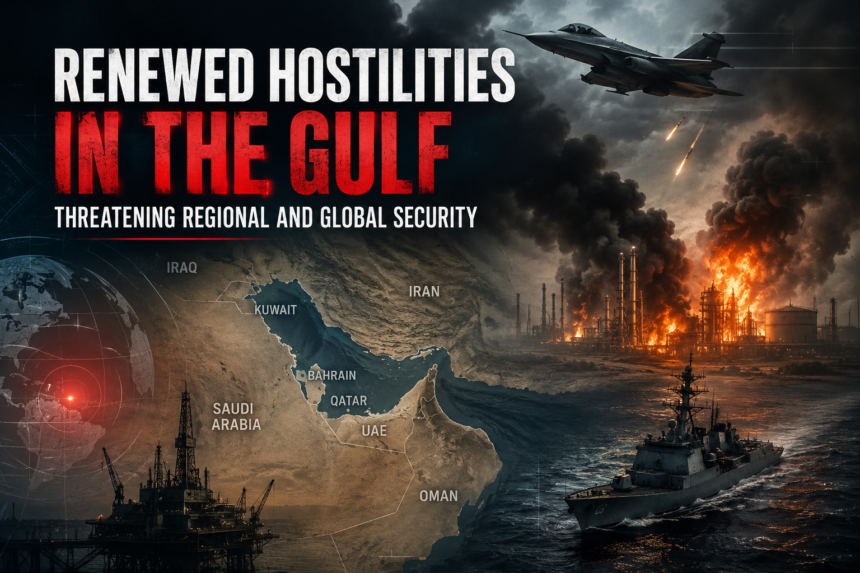

The renewed Gulf conflict has eroded trust in existing regional security arrangements, particularly confidence in the United States as a security guarantor. It contends that escalating military confrontation, shifting regional alliances, and the failure of diplomacy have increased instability, while presenting Pakistan as an important mediator seeking to balance relations with Saudi Arabia and Iran. The article concludes that only renewed political dialoguebuilding on the earlier Pakistan-brokered Memorandum of Understanding (MoU)can prevent further regional escalation and restore stability.
Part Three
Asif Haroon Raja
Loss of Trust
The renewed war has profoundly shaken the confidence of the Gulf Cooperation Council (GCC) States in the security umbrella that the United States has provided since the early 1980s.
Despite hosting nearly two dozen American military bases financed largely by the oil-rich Gulf monarchies, these installations proved unable to shield themselves fully from Iran’s missile and drone attacks, let alone guarantee the security of their host nations.
The redeployment of critical American air defence assets from the Gulf to Israel during the first phase of the conflict further unsettled the Arab States, reinforcing perceptions that their own security concerns had become secondary.
Another disappointment has been Iran. Before the outbreak of renewed hostilities, the GCC States had been cautiously pursuing rapprochement with Tehran, particularly after the Pakistan-Saudi Arabia Mutual Strategic Defence Partnership signed in September 2025.
There were also discussions about expanding the arrangement to include Kuwait, Egypt, Türkiye and Qatar as the foundation of a broader regional security framework.
Renewed Military Escalation
Following Iran’s reported attacks on Saudi and Qatari oil tankers, the United States resumed military operations and gradually intensified its campaign.
Over the past two weeks, American forces have targeted Iranian military installations, strategic islands, ports and key infrastructure, including power plants, water facilities, bridges, railway lines and hospitals. Reports also suggest that the Bushehr nuclear facility has not escaped attack.
Iran has retaliated by striking American military bases across the GCC and targeting airports, petrochemical facilities, desalination plants, electricity grids and other strategic infrastructure. Kuwait, Bahrain and Jordan are reported to have suffered the heaviest damage.
According to reports, Iranian missile and drone attacks have struck numerous American military facilities in the region, causing extensive damage to infrastructure and military equipment and resulting in casualties among US personnel.
Satellite imagery from multiple commercial and independent sources has reportedly confirmed damage to jets, aircraft shelters, fuel depots, radar installations and other military facilities.
Shifting Strategic Equations
The conflict is reshaping strategic thinking across the Gulf.
Increasingly, policymakers in the affected Arab States are reassessing their long-term security options. Some advocate deeper engagement with Iran once hostilities cease, while others see greater merit in strengthening regional security arrangements led by trusted Muslim partners, with Pakistan emerging as a potential pillar of such a framework.
Is the IRGC a Barrier to Peace?
One of the most debated questions concerns the role of Iran’s Islamic Revolutionary Guard Corps (IRGC).
Reports suggest that differences have emerged between elements of Iran’s civilian leadership and the IRGC, particularly after the reported assassination of Supreme Leader Ayatollah Ali Khamenei and the subsequent decentralisation of portions of the Guard’s command structure.
At the same time, various allegations have circulated claiming that certain elements within the IRGC have been compromised or infiltrated by foreign intelligence agencies, including Mossad.
Others allege that some IRGC factions have encouraged the Houthis to widen the conflict by threatening shipping in the Red Sea.
These claims remain unverified and controversial. Nevertheless, they have gained attention because of the sequence of events following the signing of the 17 June Memorandum of Understanding (MoU).
From a strategic perspective, many analysts argue that it would have been against Iran’s economic interests to resume hostilities before the expiration of the sixty-day implementation period provided under the MoU.
During that period, Tehran stood to gain significant economic and diplomatic benefits.
Israel’s opposition to any lasting US-Iran rapprochement is widely condemned. Many observers assess that such an agreement would reduce regional tensions and diminish Israel’s strategic leverage.
Critics contend that continued conflict serves the interests of those seeking to keep the region permanently unstable.
The key question, therefore, is what Iran stands to gain by prolonging a costly conflict while simultaneously straining relations with Arab States that had recently begun improving ties with Tehran.
Equally important is the question of how long Iran can sustain the conflict while relying on the Strait of Hormuz as its principal strategic lever.
Whatever the answers may be, only a credible political settlement can prevent further regional destabilisation.
The Pakistan-brokered MoU remains the most viable framework for restoring dialogue and ending the conflict.
Pakistan’s Strategic Dilemma
Pakistan now finds itself navigating an increasingly delicate strategic balance.
On one hand, it is committed to its strategic defence partnership with Saudi Arabia. On the other hand, it seeks to preserve cordial relations with neighbouring Iran, while preventing the conflict from spilling into the wider region.
Initially, Houthi threats to commercial shipping through the Bab al-Mandab Strait were viewed as limited, particularly since the movement had avoided becoming directly involved in the Iran-US conflict despite expressing political support for Tehran.
The situation changed dramatically when Houthi forces reportedly attacked Saudi oil tankers transiting the Bab al-Mandab, forcing them to reverse course.
The incident raised fresh concerns regarding the security of one of the world’s most vital maritime trade routes.
Pakistan’s Enhanced International Standing
Pakistan has earned considerable diplomatic recognition for its efforts to mediate between Washington and Tehran.
Its successful facilitation of two rounds of negotiations demonstrated an ability to engage constructively with both adversaries.
Earlier, Pakistan had also enhanced its regional standing following its military performance during the four-day conflict with India, strengthening perceptions of Pakistan as an emerging regional security provider.
These achievements came despite Pakistan simultaneously confronting terrorism, economic challenges and internal security threats. Under the leadership of Field Marshal Syed Asim Munir, the armed forces continued counterterrorism operations while supporting national economic stabilisation efforts.
Pakistan’s diplomatic breakthrough in bringing the United States and Iran together for negotiations represented a significant foreign policy achievement.
Although the Islamabad summit ended without agreement, it laid the foundation for the subsequent Swiss negotiations that produced the 17 June MoU.
The collapse of that agreement has complicated Pakistan’s diplomatic position.
Islamabad has consistently reaffirmed its commitment to Saudi Arabia’s security while urging Iran to exercise restraint and prevent further escalation, including restraining Houthi attacks on Red Sea shipping.
Pakistan has also warned that any threat to its maritime interests would invite an appropriate response while continuing diplomatic engagement with all parties in pursuit of a negotiated settlement.
Diplomacy Overshadowed by Hardliners
The renewed conflict demonstrates how hard-line elements on all sides can undermine painstaking diplomatic efforts.
Political moderation and strategic restraint have once again given way to military escalation.
Reports that Iran declined a renewed American proposal for dialogue, conveyed through Iraqi mediation, further illustrate how rapidly diplomatic openings can disappear.
Unless pragmatism prevails over confrontation, the Gulf risks entering another prolonged cycle of conflict whose consequences will extend far beyond the Middle East.
The Pakistan-brokered MoU, despite its collapse, remains the most practical foundation upon which future negotiations can be rebuilt.
To be concluded
About the Author
Brigadier (Retd) Asif Haroon Raja, SI (M) is a war veteran. He is Command and Staff Course and War Course qualified, holds an MSc in War Studies, and served as Defence Attaché in Egypt and Sudan, as well as Dean of the Corps of Military Attachés in Cairo.
He is a defence, security, and geopolitical analyst, columnist, featured columnist of IntelDrop magazine Washington, author of five books, former Chairman of Thinkers Forum Pakistan, Patron-in-Chief of Centre for Development Studies Think Tank, Director of Meesakh Research Centre; he regularly appears on media platforms.