
Student protests in India, triggered by examination paper leaks and unemployment, grew into a nationwide movement demanding education reforms and accountability. It examines the resignation of the Education Minister, the political impact on the BJP, and how the protests highlighted the growing influence of India’s youth in shaping public policy.
Part One
Asif Haroon Raja
The Immediate Trigger – Examination Paper Leaks and Student Grievances
India witnessed one of the largest youth-led protest movements in recent years.
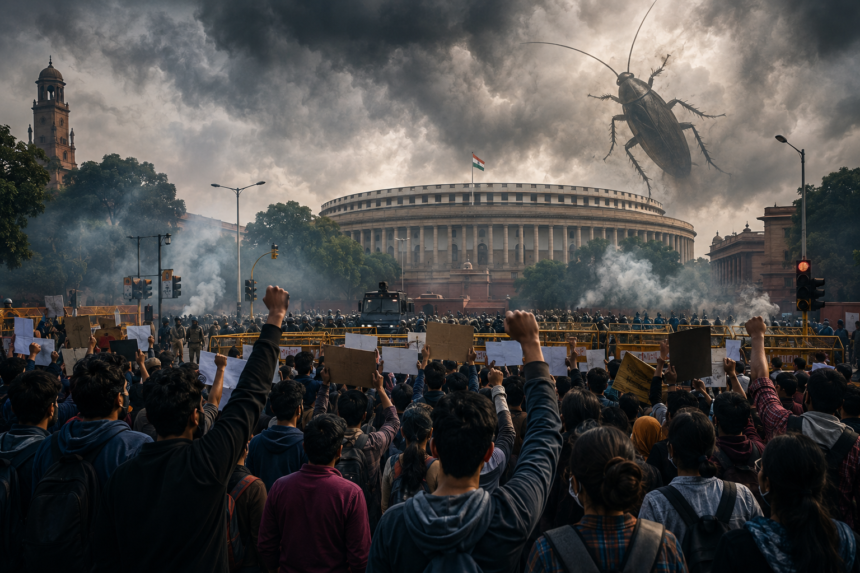
Triggered by repeated examination paper leaks, allegations of irregularities in competitive examinations, and growing frustration over unemployment, the protests rapidly evolved into a broader movement demanding accountability, transparency, and reforms in the education sector.
The movement was spearheaded by the Cockroach Janta Party (CJP), a youth-driven organisation that transformed from an online campaign into a nationwide protest movement.
Students, young professionals, parents, and civil society activists participated in demonstrations in New Delhi and several major Indian cities.
Despite police action, including tear gas and baton charges in some locations, the protests remained largely peaceful and continued to gather momentum.
Immediate Outcome
The principal demand of the protesters was the resignation of India’s Education Minister, Dharmendra Pradhan, who was held politically responsible for repeated examination scandals.
After weeks of sustained demonstrations, Pradhan resigned, marking a rare political concession by Prime Minister Narendra Modi’s government.
The government also agreed to a series of measures, including education reforms, legal action against examination fraud, withdrawal of many cases against protesters, and compensation for families affected by the crisis.
Political Repercussions for the BJP
The protests have several important political implications for the ruling Bharatiya Janata Party (BJP):
- The resignation represents one of the few occasions during Narendra Modi’s tenure that sustained public protests have resulted in the resignation of a cabinet minister.
- The movement exposed widespread dissatisfaction among Generation Z regarding education, employment opportunities, and governance.
- The BJP’s image of strong and decisive governance has been challenged by its delayed response to the crisis.
- Opposition parties may attempt to capitalise on growing youth discontent ahead of future elections.
- The protests demonstrated the increasing influence of digitally organised grassroots movements capable of mobilising nationwide support outside traditional political structures.
Strategic Assessment
The protests suggested that India’s politically aware Generation Z is becoming a significant force capable of influencing public policy through sustained, largely peaceful mobilisation.
Whether the Cockroach Janta Party evolves into a lasting political force or remains a pressure group will depend on its organisational cohesion and its ability to broaden its agenda beyond education reforms.
The student protests represent more than a reaction to examination irregularities; they reflect broader concerns about governance, accountability, and economic opportunity.
The student and youth movement, referred to as the “Cockroach Janta Party,” had been protesting for months against examination paper leaks and shortcomings in the education system.
Education Minister’s Resignation
Although the immediate crisis has eased, the underlying issues remain unresolved. His resignation has provided the Modi government with an opportunity to reset its relationship with India’s youth.
Failure to implement meaningful reforms could deepen public dissatisfaction and erode the BJP’s political standing among younger voters.
Unless the government successfully reforms the examination system, curbs corruption, and expands employment opportunities, student unrest could re-emerge.
At the same time, it remains too early to conclude that these protests alone will significantly weaken the BJP’s overall electoral position, as that will depend on how the government responds and whether public discontent spreads to other policy areas.
To be Concluded
About the Author
Brigadier (Retd) Asif Haroon Raja, SI (M) is a war veteran. He is Command and Staff Course and War Course qualified, holds an MSc in War Studies, and served as Defence Attaché in Egypt and Sudan, as well as Dean of the Corps of Military Attachés in Cairo.
He is a defence, security, and geopolitical analyst, columnist, featured columnist of IntelDrop magazine Washington, author of five books, former Chairman of Thinkers Forum Pakistan, Patron-in-Chief of Centre for Development Studies Think Tank, Director of Meesakh Research Centre; he regularly appears on media platforms.