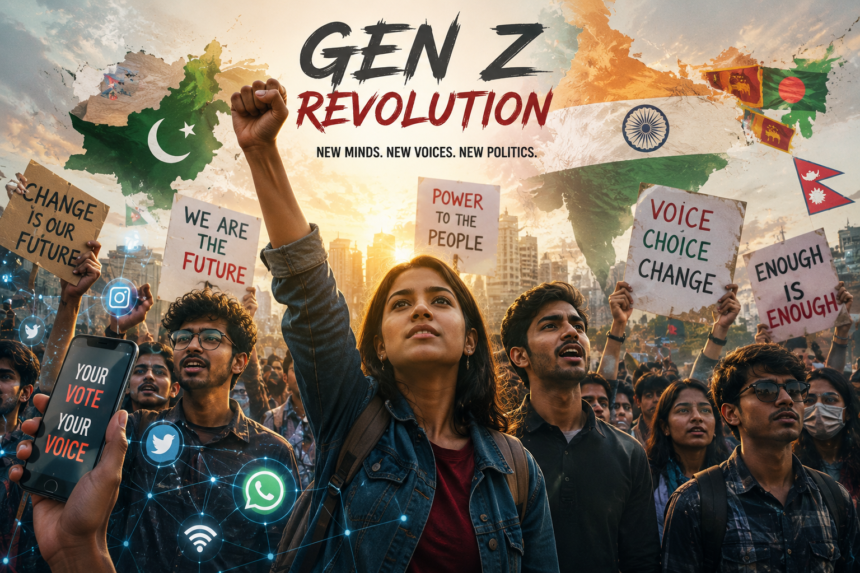

How Generation Z is transforming politics in South Asia through digital platforms, social media, and issue-based activism. It argues that young people are increasingly challenging governments over concerns such as education, employment, transparency, and accountability, making them a powerful force in shaping the region’s political future.
Nuzhat Nazar
For decades, South Asian politics followed a familiar script.
Political parties mobilised around ideology, religion, ethnicity, nationalism or charismatic personalities. Elections determined governments. Television shaped public opinion. Political leaders spoke, and citizens listened.
That political order is now facing its biggest disruption in decades.
The disruption is called Generation Z.
Born into the internet age, Gen Z is becoming the first generation in South Asia to experience politics almost entirely through smartphones rather than television, through creators rather than commentators, and through memes as much as manifestos. It is changing not only how politics is consumed but also how governments are challenged.
The transformation has become visible across the region.
In Bangladesh, what began as protests over government job quotas evolved into a nationwide movement that ultimately led to the fall of Sheikh Hasina’s government. In Sri Lanka, the Aragalaya movement started as a response to economic hardship before forcing President Gotabaya Rajapaksa from office. In Nepal, student-led frustration over governance, unemployment and corruption helped intensify political pressure that culminated in the resignation of the prime minister.
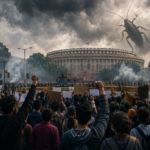
India may not be following the same political trajectory, but the early signs of a similar generational shift are becoming increasingly visible. The NEET examination controversy and the emergence of the Cockroach Janta Party illustrate how quickly student grievances can expand into broader debates about governance, accountability and institutional trust.
What connects these movements is not ideology.
It is psychology.
Unlike Millennials, who largely adapted to existing political systems, Gen Z has grown up questioning institutions. They have witnessed economic uncertainty, the COVID-19 pandemic, rising living costs, intense academic competition and a digital ecosystem where information is immediate and authority is constantly scrutinised. Their instinct is not to defer to institutions but to interrogate them.
This generation is also psychologically different in another important way.
Previous generations often accepted delayed rewards. They believed education would eventually guarantee employment and social mobility.
Gen Z is far less convinced.
When years of preparation are followed by paper leaks, cancelled examinations or shrinking employment opportunities, frustration quickly becomes political. Merit is no longer viewed as an abstract principle; it is seen as the foundation of economic survival.
Technology has accelerated this transformation.
Earlier political movements required organisations, funding and traditional leadership. Today’s movements can begin with a hashtag, a meme or a thirty-second video. Information spreads horizontally rather than vertically. There is no single leader to negotiate with, no headquarters to shut down and no television narrative that governments can fully control.
Humour has become one of Gen Z’s most effective political weapons.
Across South Asia, satire increasingly performs a role once reserved for political speeches. Memes simplify complex political arguments into content that can reach millions within hours. Irony has become a form of resistance, making authority easier to question and harder to protect.
Perhaps the defining characteristic of Gen Z is its scepticism.
This generation is less willing to trust governments simply because they hold power, less persuaded by appeals to history or ideology, and more interested in tangible outcomes. Employment, affordability, educational fairness, transparency and accountability often matter more than the political narratives that dominated previous decades.
This shift poses a new challenge for governments across South Asia.
Many political systems were built to manage organised opposition parties. They are less prepared for decentralised digital movements that have no clear leadership, no permanent structure and no predictable timeline. Suppressing one protest no longer guarantees the end of the conversation because the conversation continues online.
That does not mean every student protest will become a revolution. Bangladesh, Sri Lanka, Nepal and India each have distinct political systems, institutions and social dynamics. Direct comparisons oversimplify complex realities.
However, they do point to a broader regional trend.
South Asia is witnessing the political coming of age of its largest and most digitally connected generation. For the first time, a generation that grew up online is beginning to shape national politics in meaningful ways.
Governments that interpret these movements merely as law-and-order problems may overlook the deeper transformation underway.
The real story is not a leaked examination paper, a university protest or a viral hashtag.
It is that the balance of political power is slowly changing.
In the twentieth century, governments largely controlled information.
In the twenty-first century, Gen Z increasingly controls attention.
And in modern politics, attention is often the most valuable form of power.
Nuzhat Nazar is a journalist and strategic affairs analyst with more than ten years of experience reporting on foreign policy, defence, and economic developments. Based in Islamabad, she focuses on geopolitics, regional security dynamics, and Pakistan’s positioning in a shifting global order.