
Rimsha Saleem
China’s nuclear SLBM test in the South Pacific signals a mature sea-based deterrent, escalating Indo-Pacific security competition.
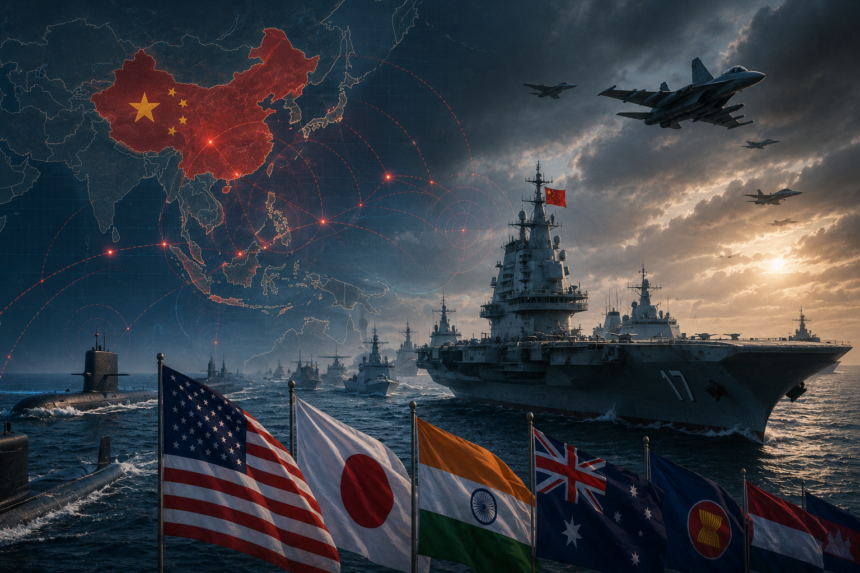
The geopolitical equilibrium of the Indo-Pacific experienced a profound shift this week following China’s successful test-firing of a long-range, nuclear-capable submarine-launched ballistic missile (SLBM) into the open waters of the South Pacific. This rare deployment marking only the third time in nearly half a century that Beijing has launched an intercontinental-range asset directly into the Pacific Ocean signals a departure from its historically cautious, highly lofted internal testing trajectories. While official statements from the People’s Liberation Army Navy framed the exercise as routine annual training, the operational timing and geographic scope reveal a deliberate piece of strategic signaling aimed at validating a mature, sea-based nuclear deterrent and reshaping the parameters of regional deterrence.
From a technical and doctrine-driven perspective, the July 6 test underscores China’s rapid transition toward a fully mature, highly survivable nuclear triad. Historically, the sea-based leg of Beijing’s deterrent dependent on older ballistic missile submarine classes operating in constrained regional waters was viewed by defense analysts as the weakest link in its strategic architecture, highly vulnerable to advanced Western anti-submarine warfare capabilities. By demonstrating a successful 7,300-kilometer strike from the South China Sea to the South Pacific, China has signaled its operational transition toward a credible Continuous At-Sea Deterrence posture. This capability ensures a highly resilient second-strike capability, signaling to Washington and its allies that any attempt to execute a disarming first strike against land-based targets would be met with devastating, highly survivable sea-based retaliation.
This expanding military posture is deeply intertwined with the intensifying security dilemma defining the Taiwan Strait and East Asian maritime corridors. From Beijing’s perspective, its accelerating strategic modernization is an inherently defensive reaction to what it perceives as a coordinated, US-led campaign of military encirclement, characterized by the expansion of monoliteral alliances like AUKUS, enhanced intelligence integration with Japan and Australia, and a perceived erosion of the One-China principle. Conversely, Washington and its regional partners view China’s rapid naval expansion, militarization of artificial features, and assertive strategic testing as an aggressive attempt to rewrite the regional security architecture, justifying their own defensive deployments and turning the Indo-Pacific into a highly volatile arena of competitive deterrence.
The political fallout from the South Pacific test illustrates the growing fragmentation of regional stability and the erosion of traditional diplomatic mechanisms. The launch drew sharp, immediate condemnation from Tokyo, Canberra, and Wellington, alongside deep anxieties from Pacific Island nations who view the utilization of their maritime backyard for strategic missile testing as a direct challenge to regional non-proliferation norms. The fact that Beijing utilized an ad hoc, selective notification process rather than an institutionalized, transparent mechanism underscores a dangerous deficit in institutional confidence-building measures. Without robust, bilateral frameworks for missile launch notifications and crisis communication, the risk of technical misinterpretation or political overreaction among competing powers rises exponentially.
Within this shifting strategic landscape, the long-standing Pakistan-China strategic partnership acquires added complexity. As Beijing’s primary security partner in South Asia, Islamabad benefits from continued access to advanced conventional military hardware, joint doctrinal development, and deeper maritime cooperation in the Indian Ocean. However, as the broader Indo-Pacific splits into highly polarized, armed camps, Pakistan must carefully manage its strategic alignment. Islamabad’s long-term national security interests are best served by preventing the Indian Ocean from becoming a secondary theater of great power naval confrontation, requiring a sophisticated diplomatic balancing act that preserves its vital strategic ties with China without triggering a complete rupture with Western capital markets and security partners.
Restoring long-term stability to the Indo-Pacific requires an urgent pivot away from unmitigated military competition toward structured strategic stability talks. The current approach where both blocs operate on the assumption that unilateral deterrence actions are defensive while interpreting the adversary’s actions as inherently hostile is an unsustainable path toward unintended conflict. Washington and Beijing must prioritize formalizing institutionalized, mandatory notification protocols for all strategic missile tests and space launches, moving beyond ad hoc diplomacy. Regional stability cannot be maintained by weapons’ capabilities alone; it requires a baseline level of transparency and mutual reassurance that limits the risk of miscalculation while establishing clear boundaries for great power competition.
About the Author: I am an independent researcher with a passion for exploring global affairs through the lens of critical thinking and evidence-based analysis. My writing examines contemporary political, economic, and strategic issues, with the aim of presenting balanced perspectives that inform, engage, and encourage meaningful discourse.