
Asif Haroon Raja
Just one day before the Israeli elections, a masterstroke by Field Marshal Asim Munir reportedly foiled the bloody political drama planned by Israeli Prime Minister Benjamin Netanyahu.
To rescue his sinking political fortunes and win votes, Netanyahu was allegedly planning a major and brutal attack on Iran on the night of 26/27 October. In his view, a decisive attack on Iran would either swing the military balance in favour of the US and Israel, or would delay the elections.
But little did he realise that he was up against one of the world’s finest military minds and a far-sighted leader, Field Marshal Syed Hafiz Asim Munir!
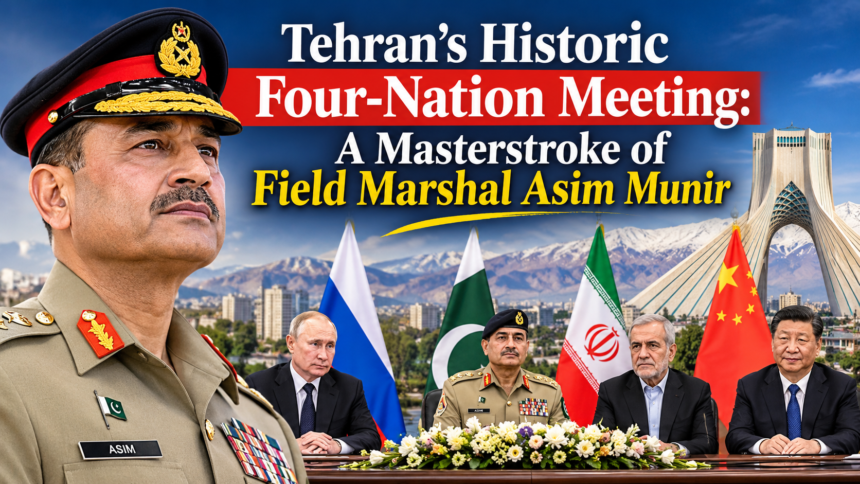
Demonstrating exceptional strategic acumen, the Field Marshal not only travelled to Tehran himself but also arranged for the senior Saudi and Turkish leadership to come to the Iranian capital.
This masterstroke effectively tied Israel’s hands, as it knew full well that launching an attack while the highest leadership of Pakistan, Saudi Arabia and Türkiye was present in Tehran would amount to inviting its own complete destruction.
The inside reports emerging from Tehran’s historic four-nation meeting, along with sensational revelations attributed to Iranian research institutions, reportedly sent shockwaves through international diplomacy!
Through the mediation of Pakistan’s military chief, Field Marshal Syed Hafiz Asim Munir, behind-the-scenes negotiations were reportedly conducted among Saudi Arabia, Türkiye, Pakistan and Iran.
Under the proposed understanding, Iran has allegedly agreed to make a historic departure from its decades-old policy by restraining its regional proxy groups and scaling back its network of support.
According to Iranian research sources, the five sensational details of this historic agreement are as follows:
- A Major Decision on Yemen, the Houthis and Bab al-Mandab
Iran will completely restrain Yemen’s Houthi rebels from attacking Saudi Arabia’s oil installations and conducting operations against commercial shipping routes in the Red Sea and the Bab al-Mandab Strait.
In return, economic continuity and stability will be restored across the region.
- Reduction of Proxy Activities in Syria, Iraq and Lebanon
Iran will formally guarantee that it will limit the activities of its foreign military personnel and allied militias, while respecting the sovereignty and territorial integrity of regional states.
- Security Guarantees Under the Mecca Pact
The Mecca Pact, comprising Saudi Arabia, Pakistan and Türkiye, will guarantee that any external attack on Iran by the United States or Israel will be prevented and that Iran will not be left isolated.
- Protection of Commercial Routes and the Strait of Hormuz
The Strait of Hormuz, the Persian Gulf and the Bab al-Mandab Strait will be declared a fully secure zone for the shared commercial movement of all Islamic countries, effectively establishing a free-trade zone.
- Ending Sectarian Exploitation and the Politics of War
This alleged shift in Iranian policy would remove the principal pretext used by the Zionist state and the United States to foment war by exploiting the Shia–Sunni divide among Muslims.
“All the credit for Iran’s historic agreement with Saudi Arabia, including its final consent to scale back its proxy networks, goes exclusively to the extraordinary and bold diplomacy of Field Marshal Asim Munir!”
This diplomacy has liberated the region from the perpetual blackmail of Netanyahu and Western powers.
The biggest and most historic diplomatic development of the day has supposedly demonstrated who is currently the greatest architect and guardian of Muslim unity and global peace.
Iranian Foreign Ministry spokesperson Esmaeil Baghaei, during a press conference in Tehran and in remarks before the international media, reportedly revealed that the proposal for this historic and urgent meeting among Saudi Arabia, Pakistan, Türkiye and Iran had originated with Field Marshal Syed Hafiz Asim Munir himself.
This alleged acknowledgement is a slap in the face of all those internal troublemakers and external Zionist agents who have continually spread false narratives about Pakistan’s diplomatic isolation.
From Tehran to Ankara and Riyadh, the world is now said to be acknowledging that, under the Field Marshal’s leadership, Pakistan has emerged as a strong bridge of Muslim unity, bringing all the major regional powers to one table and helping avert the horrors of war.
Pakistan’s diplomatic efforts, particularly those of Field Marshal Syed Asim Munir, amid the ongoing regional conflict will be written in golden letters in history.
It is reportedly due to his diplomatic initiatives that Iran and Saudi Arabia are now sitting together to discuss solutions to their differences, while efforts are underway to find a viable way to avert the global war looming at the door.
Israel Election: Netanyahu’s Coalition Falls Short of a Majority
General elections were held in Israel on October 27, 2026. Despite allegations of electoral irregularities and interference raised during the campaign, which the Central Elections Committee subsequently dismissed as unfounded, Prime Minister Benjamin Netanyahu’s Likud-led coalition, comprising right-wing and ultra-Orthodox parties, secured only 53 seats in the 120-member Knesset.
The opposition bloc, led by Gadi Eisenkot, won 48 seats, while the two Arab-led parties secured a record 19 seats.
The final count therefore leaves all three political groupings short of an outright majority. The magic figure required to form a government is 61 seats.
The results represent a significant setback for Netanyahu’s ruling coalition, which previously commanded 68 seats. The Arab parties, with their unprecedented representation, have emerged as potentially decisive players in the formation of the next government.
However, political differences and the reluctance of several opposition leaders to cooperate with Arab parties have complicated the prospects of forming an alternative government.
Future Prospects
Israel faces a period of political uncertainty and difficult coalition negotiations.
Netanyahu may attempt to retain power through political realignments or a broader coalition arrangement, while the opposition will explore possibilities for forming an alternative government.
If neither side succeeds in assembling a viable majority, Israel could face another round of elections.
The outcome has weakened Netanyahu’s parliamentary position but has not yet ended his political tenure. He remains Prime Minister until a new government is formed.
God willing, truth and righteousness will ultimately prevail.
About the Author
Brigadier (Retd) Asif Haroon Raja, SI (M) is a war veteran. He is Command and Staff Course and War Course qualified, holds an MSc in War Studies, and served as Defence Attaché in Egypt and Sudan, as well as Dean of the Corps of Military Attachés in Cairo. He commanded the largest brigade in Kashmir.
He is a defence, security, and geopolitical analyst, columnist, featured columnist of IntelDrop magazine Washington, author of five books, former Chairman of Thinkers Forum Pakistan, Patron-in-Chief of Centre for Development Studies Think Tank, Director of Meesakh Research Centre; he regularly appears on media platforms.