
Part Three
Asif Haroon Raja
Narendra Modi, a long-time protégé of the Rashtriya Swayamsevak Sangh (RSS), served as the Chief Minister of Gujarat from 2001 to 2014 before becoming Prime Minister following the Bharatiya Janata Party’s (BJP) victory in the 2014 general elections.
He subsequently secured re-election in 2019 and 2024 and, barring unforeseen political developments, is expected to remain in office until 2029.
Under his leadership, the BJP has consolidated its dominance across India and currently governs the majority of the country’s states.
During his tenure, Modi has emerged as the central figure in Indian politics. His supporters credit him with accelerating economic growth, modernising the armed forces, expanding India’s diplomatic outreach, and enhancing the country’s global profile.
At the same time, his critics contend that democratic institutions—including the judiciary, the Election Commission, and other constitutional bodies—have become increasingly susceptible to executive influence, raising concerns about the erosion of institutional independence and democratic checks and balances.
India’s mainstream corporate media has also undergone a marked transformation. A significant section, often described by critics as the “Godi media,” is perceived as largely supportive of the government, while influential business conglomerates have generally maintained close relations with the ruling establishment.
Despite the narrative of a rising and prosperous India, significant structural challenges persist beneath the surface.
Millions continue to live below the poverty line, educational disparities remain pronounced, and youth unemployment continues to pose a serious socio-economic challenge despite sustained economic growth.
These underlying pressures have generated growing frustration among India’s younger generation.
Throughout his years in power, Modi has consistently promoted the ideology of Hindutva as the cornerstone of his political agenda.
Critics argue that this has contributed to increased religious polarisation, with Muslims and other minority communities expressing growing concerns over discrimination, while Kashmir has remained a particularly contentious issue marked by prolonged political and security tensions.
The BJP’s emphasis on projecting India primarily through a Hindu nationalist narrative has further deepened communal divisions.
Public confidence in India’s examination system suffered a severe setback after the leak of the National Eligibility-cum-Entrance Test (NEET) examination paper.
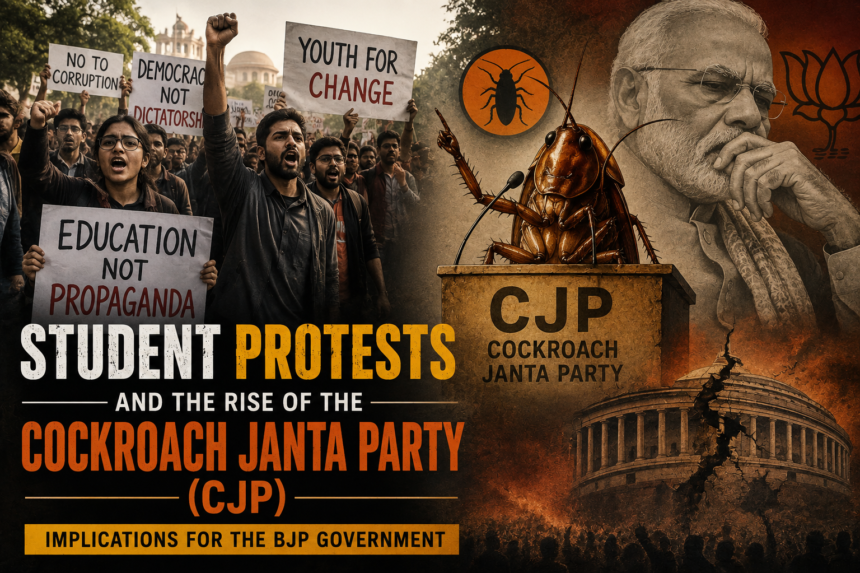
Although examination irregularities have surfaced periodically over the years, the latest scandal became a catalyst for an unprecedented nationwide student movement, transforming long-standing grievances over corruption, unemployment, and governance into a broader demand for accountability.
India has witnessed a similar turning point before. In 1974, the mass movement led by Jayaprakash Narayan against corruption and unemployment evolved into a nationwide campaign that challenged Prime Minister Indira Gandhi’s authority, ultimately culminating in the Emergency of 1975 and her electoral defeat in 1977.
While historical circumstances differ, the comparison illustrates how student-led movements can reshape India’s political landscape.
Although the Cockroach Janta Party (CJP) suspended its protests following the resignation of the Education Minister, its most significant achievement lay in bringing together young Indians from diverse religious, ethnic, and social backgrounds.
Their demonstrations at Jantar Mantar symbolised a rare display of unity that transcended communal identities and challenged the politics of division.
Whether this emerging spirit of solidarity proves to be a temporary phenomenon or evolves into a sustained political force remains an open question.
Much will depend on whether opposition parties, led by figures such as Rahul Gandhi, can harness this momentum into a coherent national movement.
Gandhi has already intensified pressure on the government by demanding the resignation of Home Minister Amit Shah over the handling of the protests.
If this youth-driven movement continues to expand and opposition parties successfully capitalise on its message of unity and accountability, the BJP could face its most formidable political challenge in more than a decade.
Furthermore, if economic pressures, governance concerns, and regional security challenges converge simultaneously, they could significantly increase domestic political pressure on the government and compel it to devote greater attention to internal stability alongside its external strategic priorities.
Broader Strategic Implications
The emergence of the student movement and the Cockroach Janta Party marks more than an isolated episode of public unrest. It may represent the first significant challenge to the BJP’s political dominance originating from India’s younger generation.
Whether this movement develops into a transformative national force or fades into another chapter of protest politics will depend on its leadership, organisational resilience, and the response of the Modi government. These dynamics and their strategic implications are examined below.
They have unfolded against a backdrop of multiple internal and external challenges confronting the Indian state. Although the protests were primarily driven by educational grievances, they also reflect wider public concerns over governance, unemployment, and accountability.
India has long faced numerous separatist and insurgent movements of varying intensity. These include insurgencies in Jammu and Kashmir, several armed movements in the northeastern states, and left-wing extremist groups, among others.
While the intensity and capabilities of these movements differ considerably, together they continue to pose security and governance challenges that require significant political, economic, and military resources.
The northeastern region remains particularly sensitive because of its ethnic diversity, geographical isolation, and proximity to international borders with China, Bangladesh and Myanmar.
Periodic unrest, demands for greater autonomy, and insurgent activities have persisted despite peace agreements with some groups.
Any prolonged political instability or erosion of public confidence in governance could complicate efforts to consolidate peace in the region.
Externally, India continues to manage a complex strategic environment. Relations with China remain strained following the military standoff along the Line of Actual Control.
China also continues to assert its claims over Arunachal Pradesh, while India’s narrow Siliguri Corridor—often referred to as the “Chicken’s Neck”—is widely regarded by defence analysts as a strategic vulnerability because it connects the northeastern states with the rest of the country.
Although there is no evidence of an imminent Chinese military move against the corridor, its security remains an important element of Indian strategic planning.
Relations with Bangladesh, which have generally been cooperative over recent years, have nevertheless experienced periods of tension over issues such as border management, migration, water sharing, and domestic political developments.
Any sustained deterioration in bilateral relations could complicate India’s security calculus in the northeast, given the region’s dependence on stable cross-border connectivity.
The possibility of a triangular strategic partnership between China, Pakistan and Bangladesh in the near future cannot be ruled out.
Taken together, these internal and external pressures present a demanding strategic environment for New Delhi.
The youth protests are unlikely, by themselves, to constitute an existential threat to the BJP government or to the Indian state.
However, if economic challenges, governance concerns, and regional security issues persist simultaneously, they could collectively increase political pressure on the government and require greater attention to domestic stability alongside external security priorities.
Strategic Assessment
History demonstrates that governments are often most vulnerable not because of a single crisis but because multiple crises emerge simultaneously and reinforce one another.
If youth dissatisfaction, economic pressures, regional unrest, insurgent violence, and external strategic tensions were to intensify at the same time, New Delhi could face a more complex national security environment than at any point in recent years.
Whether these pressures evolve into a broader political challenge will depend on the government’s ability to restore public confidence through effective governance, sustain economic growth, address legitimate public grievances, and manage its relationships with neighbouring countries while maintaining internal cohesion.
Prospects of Prime Minister Modi Completing His Tenure
It is possible that Prime Minister Narendra Modi will complete his current term, but the political environment appears more challenging than during his previous tenures.
The BJP continues to possess considerable institutional strength, a disciplined party organisation, and a substantial electoral base.
However, it is also facing mounting pressures arising from slowing economic growth, youth unemployment, inflation, social polarisation, recurring ethnic unrest in parts of the northeast, continued security challenges in Jammu and Kashmir, and an increasingly assertive political opposition.
The recent student protests indicate that dissatisfaction is no longer confined to opposition parties but has spread to sections of India’s younger generation.
Whether this develops into a broader political movement will depend largely on the government’s response to governance issues and economic concerns.
At present, the BJP government doesn’t face an imminent threat of collapse, but its political dominance appears to be under greater pressure than in previous years. Modi can no longer dictate terms and have his way.
Concluded
About the Author
Brigadier (Retd) Asif Haroon Raja, SI (M) is a war veteran. He is Command and Staff Course and War Course qualified, holds an MSc in War Studies, and served as Defence Attaché in Egypt and Sudan, as well as Dean of the Corps of Military Attachés in Cairo.
He is a defence, security, and geopolitical analyst, columnist, featured columnist of IntelDrop magazine Washington, author of five books, former Chairman of Thinkers Forum Pakistan, Patron-in-Chief of Centre for Development Studies Think Tank, Director of Meesakh Research Centre; he regularly appears on media platforms.