
Part One
Asif Haroon Raja
Balochistan: The Other Side of the Picture
To understand the present-day challenges of Balochistan, it is essential to appreciate its historical evolution.
The British Origins of the Sardari System
The roots of the present-day Sardari system can largely be traced to British colonial rule. Before the British annexed parts of Balochistan in the late nineteenth century, tribal chiefs exercised authority within their respective tribes, but their powers varied considerably and were often balanced by tribal customs and collective decision-making.
After establishing control over the region, the British found it more practical and economical to govern Balochistan indirectly rather than through a large civil administration.
They therefore strengthened the authority of selected tribal chiefs by recognising them as Sardars and Nawabs, granting them official status, financial allowances, land grants, and administrative powers in return for their loyalty to the colonial government and their responsibility for maintaining law and order.
Under this arrangement, the Sardars became intermediaries between the colonial administration and the tribal population. Their influence expanded well beyond traditional tribal leadership.
They exercised considerable authority over land, taxation, dispute resolution, and local administration, while enjoying extensive political and economic privileges.
This policy served British strategic interests. It enabled them to secure the sensitive frontier adjoining Afghanistan with minimal military and administrative expenditure, while ensuring that tribal resistance remained fragmented and manageable.
Although Pakistan inherited this colonial administrative structure after independence, successive governments found it difficult to dismantle because the Sardars had already become deeply entrenched in the province’s political and social fabric.
Over time, many tribal chiefs transformed their traditional authority into political influence, enabling them to dominate provincial politics for decades.
Thus, while the Sardari system originated as an instrument of British frontier policy, its continuation after independence became one of the principal factors shaping Balochistan’s political landscape.
Whether this system ultimately protected tribal traditions or impeded the province’s socio-economic development remains a subject of continuing debate.
What is beyond dispute, however, is that the colonial legacy continues to influence Balochistan’s politics even today.
Origins of Baluchistan
The province, as we know it today, did not exist at the time of Pakistan’s independence in 1947. Instead, there were two distinct political entities: British Balochistan and Kalat State (commonly referred to as Kalati Balochistan).
British Balochistan became part of Pakistan in 1947 and was reorganised as the Quetta Division in 1956. The State of Kalat acceded to Pakistan on 27 March 1948.
Quaid-e-Azam Muhammad Ali Jinnah permitted the Khan of Kalat to continue as the head of the newly created Balochistan States Union, which was later reorganised as the Kalat Division in 1956.
The present-day province of Balochistan came into existence only in 1970, following the dissolution of the One Unit scheme.
The educational conditions at the time of independence reflected decades of neglect.
Before 1947, the entire region had only 114 educational institutions, comprising one high school, sixteen secondary schools, and ninety-seven primary schools. The literacy rate stood at a mere 5.5 percent.
Educational facilities were particularly limited. British Balochistan had only a handful of schools, while the Kalat State largely relied on traditional Madrassas for education.
Progress made by Baluchistan
Following the creation of the province in 1970, educational development gradually accelerated. The University of Balochistan was established in 1970, followed by the Balochistan University of Engineering and Technology, Khuzdar, in 1987.
Since then, educational infrastructure has expanded considerably.
Today, Balochistan has more than 15,000 schools, 145 colleges, 5 medical colleges, 12 universities, 13 cadet colleges, including two for women, and two girls’ cadet colleges. The literacy rate has risen to approximately 54.5 percent.
Students from Balochistan also benefit from substantial educational opportunities.
The province receives a significant share of national scholarships, while over 45,000 students are pursuing education in institutions run by the Pakistan Army.
Every year, the Army provides scholarships to 7,728 students, amounting to approximately Rs. 155 million.
Army Public Schools educate a large number of local students and provide employment to more than 1,050 local teachers.
Similarly, the Frontier Corps has established 94 schools in remote areas, extending educational facilities to thousands of students while creating employment opportunities for over 1,100 local teachers.
Technical education has also expanded through institutions established across the province, producing thousands of skilled graduates.
In terms of educational infrastructure, Balochistan today compares favourably with many other provinces. The ratio of educational institutions and teachers to the student population is, in several respects, better than that of Punjab.
Likewise, the availability of cadet colleges relative to the population is significantly higher in Balochistan.
Impact of the Legacy of Colonialism on the Sardari System
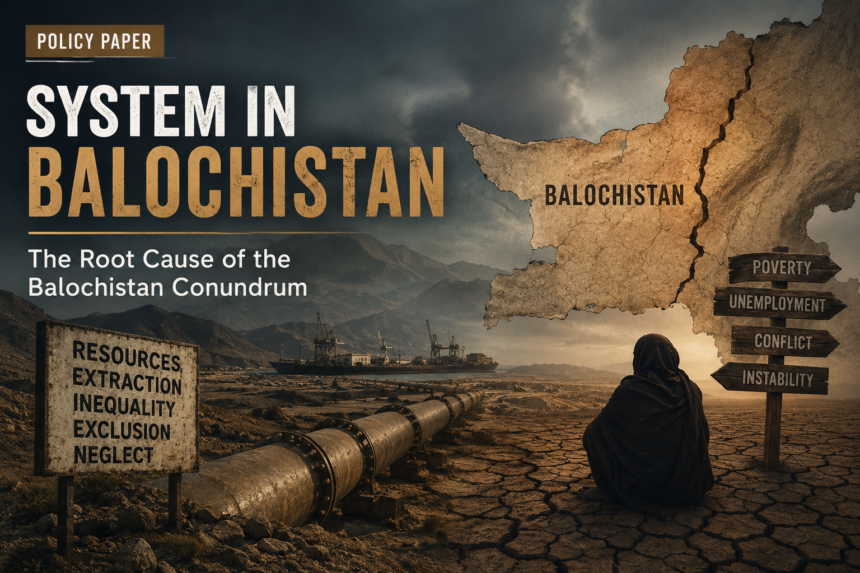
Despite these developments, Balochistan continues to face deep-rooted socio-economic challenges. One of the principal reasons lies in the persistence of the Sardari system created by the British.
Unfortunately, after independence, much of this colonial-era structure remained intact. Political influence, land ownership, and control over local resources continued to be concentrated in the hands of a few tribal elites.
Consequently, large sections of the population remained deprived of quality education, healthcare, employment opportunities, and meaningful political participation. It left the ordinary people politically and economically marginalised.
The enduring concentration of power has had profound consequences for the province’s social and economic development.
While successive governments have invested heavily in infrastructure, education, health, and connectivity, the benefits have not always reached the ordinary people to the extent intended.
Understanding the historical role of the Sardari system is therefore essential to understanding the Balochistan conundrum.
To be continued in Part Two…
About the Author
Brigadier (Retd) Asif Haroon Raja, SI (M) is a war veteran. He is Command and Staff Course and War Course qualified, holds an MSc in War Studies, and served as Defence Attaché in Egypt and Sudan, as well as Dean of the Corps of Military Attachés in Cairo.
He is a defence, security, and geopolitical analyst, columnist, featured columnist of IntelDrop magazine Washington, author of five books, former Chairman of Thinkers Forum Pakistan, Patron-in-Chief of Centre for Development Studies Think Tank, Director of Meesakh Research Centre; he regularly appears on media platforms.