
Asif Haroon Raja
Circulating Rumours and Suspense
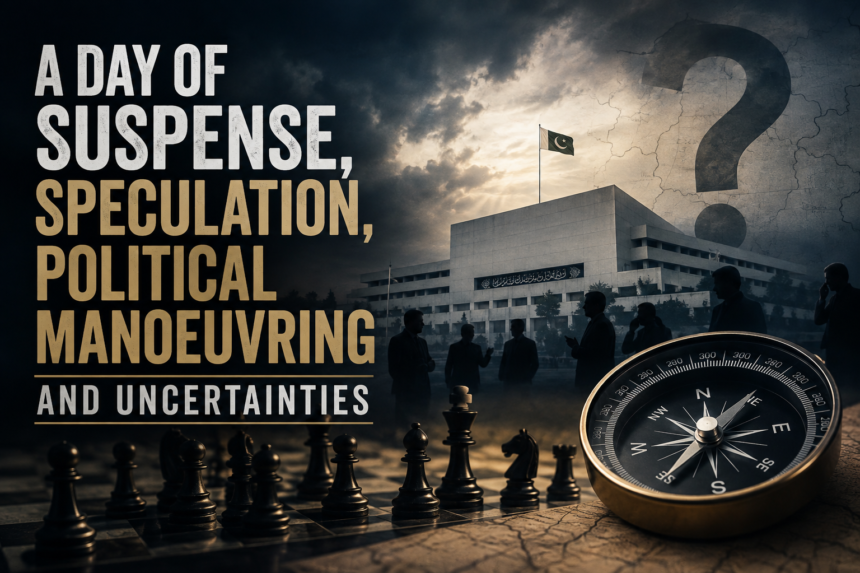
Yesterday was a day full of suspense, speculation and political intrigue. All kinds of stories and conjectures were in circulation, creating an atmosphere of uncertainty and anticipation.
The most prominent report was that Imran Khan (IK) had tendered an apology over the 9 May episode, paving the way for a possible understanding between the government/establishment and the PTI leadership.
Gathering Political Storm
Another narrative was that the government, already caught in a swirl of complex challenges and facing a growing rift with its coalition partner, the PPP, over the AJK crisis, had found itself in an increasingly vulnerable position.
A call by the PTI government in KP for a decisive long march towards Islamabad on 27 September, coupled with Jamaat-e-Islami’s threat to launch countrywide protests if fuel prices were not reduced, added to the government’s anxieties.
Government’s Challenges
At this critical juncture, the government can ill afford political instability and deteriorating law and order.
It is already struggling to steer the dwindling economy out of troubled waters through promised foreign investment and the revival of CPEC under its second phase.
Speculations and Conjectures
The critics viewed the reported developing understanding between the PPP and PTI, along with the possible emergence of a broader opposition alliance including JUI-F, as one of the biggest threats to the government.
Without PPP support, they argued, the PML-N government could find it difficult to sustain its political position.
In this calculation, the days of the ruling arrangement were supposedly numbered, making it imperative either to extend a hand of friendship towards PTI or to restore the PPP’s confidence in terms acceptable to the coalition partner.
Reported Undertaking by IK
Another report making the rounds was that, owing to his failing health and his party’s inability to generate meaningful pressure on the government, IK had given an undertaking to the establishment that he would refrain from active politics and media warfare during his stay at Al-Shifa and thereafter at Bani Gala, which was reportedly to be given the status of a sub-jail.
PTI’s Flights of Imagination
The PTI and its supporters interpreted the Supreme Court’s decision as a favourable development for IK, reportedly believing that the three-member bench had opened the way for his medical treatment outside Adiala Jail.
It was further reported that Bushra Bibi could be released from Adiala Jail within a week.
PTI’s Euphoria
The PTI and IK’s followers consequently went into a state of euphoria. They celebrated the Supreme Court’s decision regarding the medical examination and possible admission of the jailed PTI leader to Al-Shifa Hospital.
For many of his supporters, the development was seen as a possible route towards securing relief from the various cases against him on medical grounds, potentially paving the way for early elections.
Some were already imagining IK returning to the political throne.
Government’s Discomfort
The Government, however, appeared uncomfortable with the Supreme Court’s decision.
It reportedly took the position that the order had bypassed the jurisdiction and authority of the Islamabad High Court and the superintendent of Adiala Jail and that the court was not legally empowered to issue such directions in the manner adopted.
The Government further argued that the existing rules and jail manual did not permit prisoners suffering from illnesses to receive treatment at civilian hospitals. It consequently filed a review petition seeking reconsideration of the decision.
Drama at its Peak
Then came the most dramatic episode.
At around midnight, television channels showed what appeared to be a huge convoy, with sirens blazing, speeding from Adiala Jail towards the Islamabad Expressway.
Excited crowds waved at the passing convoy and chanted slogans, while some enthusiasts reportedly pitched tents outside Shifa International Hospital to welcome their political hero.
Deception
According to reports, however, a decoy convoy was sent towards Al-Shifa International Hospital, while the media narrative suggested that Khan had been shifted there.
Reports attributed to multiple independent journalists subsequently claimed that Imran Khan had instead been taken to PIMS, administered an injection and then returned to Adiala Jail.
If these reports are accurate, millions of Pakistanis were kept engaged for more than six hours in a carefully orchestrated spectacle surrounding a hospital transfer that ultimately did not take place.
Imran Khan’s Medical Check-up
The team of specialist doctors comprised experts in ophthalmology, cardiology, and internal medicine. After conducting a detailed medical examination, they declared him medically fit and in good health.
His sister, Uzma Khan, remained present throughout the examination and treatment.
After the medical examination was completed, IK was shifted back to Adiala Jail in the early hours of 21 August, at approximately 5:00 a.m.
My Comments
The details that have emerged regarding the Supreme Court’s decision to shift Imran Khan to Al-Shifa Hospital on health grounds are concerning. It is troubling to see how senior judges of such a high court could arrive at what appears to be such a flawed decision.
In my personal view, if this decision were challenged in any reputable court in the world, it would not withstand judicial scrutiny.
First, during the day before yesterday’s hearing, no such relief was even sought by Imran Khan’s lawyers.
Second, whenever a prisoner’s health requires examination or treatment, a medical board is constituted.
The board makes recommendations regarding the patient’s treatment, and the court then passes an order in accordance with those recommendations.
Here, however, the order has been passed first, while the medical board is to be constituted afterwards.
The Jail Manual contains a comprehensive protocol for decisions concerning the treatment of prisoners, but it has apparently been disregarded.
It is the doctors who have to determine the nature of the patient’s illness and the duration of treatment required. Depending upon the illness and treatment, this period may be short or long; nevertheless, the decision rests with the doctors.
Here, the court itself determined a fixed period for which the patient was to remain in hospital.
What guarantee did the court have that the patient will recover within that period?
Conversely, what happens if he recovered much earlier? Would he still have to remain in hospital for the entire period prescribed by the court?
The court has also barred Imran Khan, his family and his party from engaging in politics or issuing statements concerning his health.
Such an order should not have been directed specifically at one political party; rather, it should have been general in nature and applicable to everyone.
Because of this apparent deficiency, other political parties—and even a section of the government—have, since yesterday, been engaging extensively in politics over Imran Khan’s health and the court order.
Apparently, it seems that the court itself is also politicising Imran Khan’s health. Otherwise, there appears to be no justification for not deciding the government’s objections and, on its own, ordering that Imran Khan remain in hospital for an extended period.
Open Violation of the Supreme Court Undertaking
PTI’s politics, particularly the actions of Imran Khan’s sisters, have made it clear that their priority is not obtaining legal or medical relief for the so-called “Niazi fitna,” but rather creating political agitation.
Uzma Khan is openly violating the undertaking she submitted before the Supreme Court. All three sisters had undertaken that Imran’s health would not be used for political purposes.
Despite this, disclosing details of her meeting with Imran to YouTubers, promoting fabricated trends on social media, and gathering crowds outside Shifa Hospital, thereby creating a security issue, are being portrayed as political tactics by Imran Khan’s three sisters.
It was reportedly because of such actions that the government took Imran Khan to PIMS Hospital for a medical examination.
However, even at PIMS Hospital, despite the presence of his personal physicians, coming outside and making inflammatory statements allegedly demonstrates that their sole objective is to conduct propaganda against state institutions.
All these facts, it is argued, demonstrate that PTI and Imran Khan’s sisters are unwilling to honour their undertakings when it conflicts with their political interests.
The Supreme Court should also take serious notice of such alleged unconstitutional relief and the violation of the undertaking.
After all, if a facility is not available to ordinary prisoners, how can it be extended to one individual—particularly when that facility is subsequently being used for political advantage?
The Challenges Before the PML-N Government
In my assessment, the most important challenges confronting the PML-N government are:
Preventing the ruling coalition from collapsing by addressing the PPP’s grievances and restoring mutual confidence.
Providing immediate relief to the masses. This could become more feasible if hostilities in the Middle East end and normal traffic through the Strait of Hormuz is restored, easing pressure on energy and commodity prices.
Establishing a stable PML-N government in AJK, preferably with a two-thirds majority, while dealing firmly and lawfully with the JAAC agitation and investigating any credible allegations of external involvement.
Pursuing constitutional reforms, including the proposed 28th Amendment, while carefully assessing their implications for the NFC Award and the 18th Amendment.
Considering smaller administrative units within the existing provinces as an alternative to creating additional provinces, where this can improve governance, administration and service delivery.
Keeping the option of political engagement with PTI open. In a volatile political environment, no channel of communication should be permanently closed.
Preparing for a post-Imran PTI. Whether through internal evolution or a change in leadership, a PTI without IK could potentially present a different political equation.
Expediting local-government elections and accelerating reforms aimed at strengthening state institutions, governance and administrative efficiency.
Pakistan’s present political environment remains fluid.
Deception
The latest news is that the route of the convoy was changed midway in the wake of security concerns because of the heavy traffic jams and noise and din made by the PTI followers. The law enforcement agencies advised the change of route to avoid untoward incidents.
Conclusions
Yesterday’s rumours may prove exaggerated, some may turn out to be politically motivated, while others may contain elements of truth.
What is certain, however, is that the country cannot afford prolonged political confrontation at a time when economic recovery, internal stability, regional security and external investment require political calm and institutional focus.
The coming weeks should therefore be judged less by political rumours and more by concrete decisions, verifiable developments and the ability of the major political stakeholders to place national stability above partisan interests.
The courts must remain above politics. In this regard, the Constitutional Court and the Supreme Court have a greater responsibility to ensure that the judiciary remains strictly apolitical, impartial and independent, and that justice is dispensed solely on merit, in accordance with the Constitution and the law.
About the Author
Brigadier (Retd) Asif Haroon Raja, SI (M) is a war veteran. He is Command and Staff Course and War Course qualified, holds an MSc in War Studies, and served as Defence Attaché in Egypt and Sudan, as well as Dean of the Corps of Military Attachés in Cairo.
He is a defence, security, and geopolitical analyst, columnist, featured columnist of IntelDrop magazine Washington, author of five books, former Chairman of Thinkers Forum Pakistan, Patron-in-Chief of Centre for Development Studies Think Tank, Director of Meesakh Research Centre; he regularly appears on media platforms.