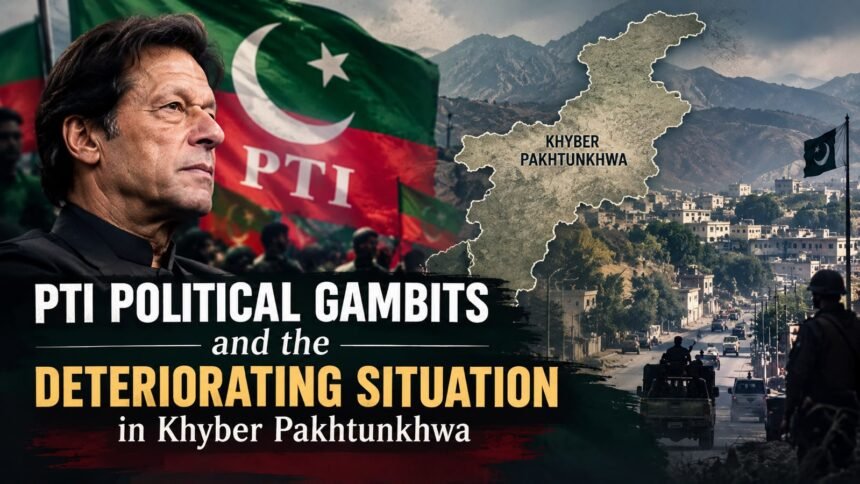

PTI’s Political Gambits and the Deteriorating Situation in Khyber Pakhtunkhwa
Asif Haroon Raja
The security situation in Khyber Pakhtunkhwa (KP) has become increasingly intertwined with Pakistan’s wider political confrontation. The province is already the principal theatre of terrorism, while political polarisation and the repeated mobilisation of street power have further complicated the security environment.
Following 9/11, Pakistan faced a sustained wave of terrorism and militancy, particularly in the former FATA and parts of Balochistan.
Pakistani security analysts have long argued that hostile external forces sought to exploit terrorism to destabilise Pakistan and undermine its strategic and nuclear capabilities.
According to this assessment, terrorism continues to be employed as an instrument of pressure against Pakistan, while the presence of the Tehreek-e-Taliban Pakistan (TTP) in Afghanistan and its relationship with elements of the Afghan Taliban regime remain major security concerns.
From Political Opposition to Street Confrontation
After the ouster of the PTI Government through a vote of no confidence in April 2022, Imran Khan increasingly adopted a confrontational political strategy.
Instead of relying primarily on parliamentary politics, constitutional processes and institutional mechanisms, the PTI increasingly turned towards mass mobilisation, street pressure and prolonged confrontation with the government and state institutions.
Confident of his personal popularity and political charisma, Imran Khan sought to use his considerable street power to regain political authority.
Over the subsequent period, the PTI organised a large number of public gatherings, rallies and mobilisation campaigns, frequently presenting the political struggle in existential terms and calling upon its supporters to fight for what it described as “genuine freedom.”
The confrontation subsequently culminated in a series of long marches towards Islamabad. Major attempts included the march of 25 May 2022 from Peshawar, the mobilisation of October-November 2022 from Lahore, and the 24 November 2024 march from Peshawar.
On several occasions, clashes occurred between protesters and law-enforcement personnel. The PTI and the government presented sharply different accounts of casualties, responsibility and the use of force.
The November 2024 confrontation, for example, involved tear gas, road blockades, arrests and clashes as PTI supporters attempted to approach the federal capital.
The repeated attempts did not achieve the PTI’s stated political objective of forcing a change of government or securing the immediate release of Imran Khan.
Nevertheless, the party has continued to rely heavily on street mobilisation.
Another March Towards Islamabad
The PTI had announced 27 September 2026 as the date for another major march on Islamabad, with KP Chief Minister Sohail Afridi playing a prominent role in the mobilisation.
The political committee subsequently decided to postpone the march. On 25 September, Afridi announced that the march would now depart from Peshawar on 4 October.
The postponement followed internal consultations within the party. Media reports have cited differences among PTI leaders, questions concerning preparations and logistical constraints, while PTI leaders have publicly maintained that the movement remains committed to its political objectives.
The latest development therefore represents another test of PTI’s ability to convert political mobilisation in KP into a sustained nationwide movement without allowing the confrontation to descend into violence.
The Question of State Resources
The use of provincial government machinery in partisan political mobilisation has been a recurring source of controversy.
Ahead of the November 2024 protest, the federal Interior Ministry specifically instructed the KP chief secretary to ensure that provincial state machinery, equipment, officials and finances were not utilised for the PTI demonstration.
Islamabad police also alleged that official KP resources, including weapons and tear-gas shells, had been used during earlier protests. Another allegation was the involvement of TTP and the Afghan militants. Several Afghans were arrested, who were jailed after confessing their crimes.
The underlying constitutional issue, however, remains important: provincial institutions, police personnel, public funds and government equipment are state resources and should not become instruments of partisan political confrontation.
Any attempt by a provincial government to use these resources for an expedition against the federal government risks turning a political dispute into an institutional confrontation between different tiers of the state.
The Escalating War of Rhetoric
The confrontation has also intensified through inflammatory political rhetoric. PTI leaders have repeatedly demanded the release of Imran Khan, who has remained incarcerated since August 2023, while government figures have accused the party of attempting to create disorder and undermine state authority.
Statements attributed to PTI leaders about physically reaching or breaking into Adiala Jail, or about dealing with Islamabad in destructive terms, have further raised tensions.
Such rhetoric is particularly dangerous because political mobilisation in a highly polarised environment can quickly translate into confrontation between protesters and law-enforcement personnel.
The appropriate response from all political actors should therefore be restraint, constitutionalism and political dialogue rather than threats, intimidation or physical confrontation.
Internal Security Dimension
The most worrying aspect of the present situation is the interaction between political instability and the deteriorating security environment in KP.
KP has suffered disproportionately from terrorism, including suicide attacks, attacks on police and security forces, and assaults on public institutions.
The TTP continues to pose a serious threat from sanctuaries across the Afghan border, while the province also faces challenges from other militant organisations.
Against this background, allegations that weapons or other material are being moved into KP for use during political mobilisation deserve careful investigation by the relevant security and law-enforcement agencies.
Similarly, allegations of coordination between PTI elements, the TTP and the Afghan Taliban regime are extremely serious. They should be substantiated through credible intelligence and investigative findings.
What is beyond dispute is that any political movement that creates space for militant organisations to exploit instability would have serious consequences for Pakistan’s internal security.
External Security Dimensions
The timing of the proposed long march raises serious security questions and inevitably invites speculation about whether there is any tacit convergence of interests among the PTI, the TTP, the BLA and their respective external supporters.
While such coordination would require credible evidence to establish, the coincidence of political mobilisation with an intensifying militant campaign in KP and Balochistan cannot simply be ignored.
During August and September, KP witnessed a particularly high number of terrorist and suicide attacks, followed by Balochistan.
The situation became even more serious from 18 September onwards, when tensions along Pakistan’s western border escalated sharply and Afghanistan and Pakistan became engaged in direct hostilities.
In addition to deadly attacks in Kohat and Hangu, a series of drone incidents were reported in the Kohat and Torkham areas.
According to Pakistani authorities, eight drones were intercepted and destroyed before they could reach their intended targets.
The situation subsequently escalated further following the reported mobilisation of substantial Afghan military forces along Pakistan’s western frontier, including specialised formations.
Afghan forces reportedly launched ground attacks in the Kurram, Waziristan, Spin Boldak and Chitral sectors, prompting Pakistan’s armed forces to respond.
Pakistan is now confronting a complex security challenge involving the Afghan Taliban regime, elements of the Afghan security establishment, and militant organisations operating from Afghan territory, particularly the TTP and BLA.
Islamabad’s position is that Afghan soil must not be allowed to serve as a sanctuary or launch pad for terrorism against Pakistan.
Pakistan’s response has consequently extended beyond conventional border defence. In reported precision strikes, Pakistani forces have targeted militant hideouts, safe havens, launch pads, arms and ammunition depots and other facilities allegedly being used to support terrorist operations against Pakistan.
Reports have also referred to strikes against drone-production facilities and other military-linked installations in areas including Herat and Kandahar. Such operations are intended, according to Pakistani accounts, to degrade the militants’ operational capability while minimising civilian casualties and collateral damage.
There have also been reports concerning PAF strikes on facilities in Kandahar. Reportedly, the compound of Ameerul Momineen Haibatullah Akhundzada was used for training of TTP and Afghan militants and suicide bombers under his direction supervision.
The emerging security environment demonstrates that Pakistan’s western frontier can no longer be viewed merely through the prism of conventional border management.
Terrorism, cross-border militancy, drone warfare, political instability and the activities of hostile external actors are increasingly interconnected.
This makes the situation in KP particularly sensitive. Any attempt to launch a major political mobilisation towards Islamabad while the province is simultaneously facing an intensified terrorist threat could place an additional burden on the security forces and create opportunities for militant elements to exploit political disorder.
The priority must therefore be to prevent the political confrontation from becoming a security crisis. Political parties should pursue their objectives through constitutional and peaceful means, while the state must remain focused on protecting its citizens, safeguarding critical installations and decisively countering terrorism.
The May 9 Legacy
The events of 9 May 2023 remain a major source of confrontation between the PTI and the state. Attacks on military and other public installations resulted in extensive damage and criminal proceedings against numerous PTI workers and leaders.
The legal process should now be allowed to run its course. Those against whom credible evidence exists should face due process and judicial determination, while those against whom evidence is insufficient should not be punished merely on the basis of political association.
The case involving Sohail Afridi illustrates the importance of this principle. Police had sought to nominate him in the Radio Pakistan Peshawar on the basis of release of a video clearly showing Afridi resorting to violent acts at the place of occurrence. Afridi’s lawyers however, contend that the available video material and forensic did not conclusively establish his involvement.
The Information War
The political confrontation has also developed into an intense information war.
PTI has made extensive use of social media to criticise the government and military leadership and to mobilise supporters inside Pakistan and abroad.
Government institutions, in turn, have strengthened their traditional and social-media communication capabilities to challenge what they regard as misinformation and fabricated narratives.
The battle for public opinion is unlikely to disappear. However, the state would be better served by relying on timely facts, documentary evidence, transparent communication and credible spokespeople rather than merely responding to every allegation with another allegation.
The same principle applies to reports concerning Imran Khan’s health. Genuine medical concerns should be addressed through transparent medical assessments rather than either exaggerated political claims or blanket dismissal by opponents. Health must not be politicised.
KP’s Governance Crisis
While the political confrontation continues, the people of KP are facing problems that should be receiving far greater attention from their elected representatives.
PTI has governed KP since 2013, and the province continues to face serious deficiencies in governance, public security, infrastructure, healthcare, education and economic development. The persistence of terrorism has compounded these difficulties.
The people of KP have every right to demand better policing, a stronger Counter-Terrorism Department, improved education and healthcare, employment opportunities, infrastructure development and effective local government.
Unfortunately, political confrontation has increasingly overshadowed these priorities.
A provincial government has a constitutional responsibility to govern the province, protect its citizens and deliver public services. It cannot allow the pursuit of partisan political objectives to consume the bulk of its political energy. Its priorities should be set right.
The Way Forward
The present confrontation is therefore much larger than another PTI-government dispute. It represents a dangerous intersection of political polarisation, institutional confrontation, terrorism and weak governance in one of Pakistan’s most strategically sensitive provinces.
The federal government must maintain law and order without excessive or indiscriminate force.
The KP government must ensure that provincial institutions and resources remain dedicated to constitutional governance rather than partisan confrontation.
The PTI, for its part, should pursue its political objectives through peaceful and constitutional means.
At the same time, the security establishment must remain focused on the genuine militant threat and distinguish clearly between political dissent and terrorism.
Pakistan cannot afford to allow political differences to create a vacuum that militant organisations or hostile external actors can exploit.
The ultimate sufferers of prolonged confrontation will not be political leaders sitting in Islamabad, Peshawar or elsewhere; they will be the ordinary people of KP and Pakistan, who are already paying the price of terrorism, insecurity, poor governance and economic hardship.
The urgent requirement, therefore, is not another battle for the streets of Islamabad but a return to constitutional politics, institutional restraint, political dialogue, effective governance and an uncompromising campaign against terrorism.
About the Author
Brigadier (Retd) Asif Haroon Raja, SI (M) is a war veteran. He is Command and Staff Course and War Course qualified, holds an MSc in War Studies, and served as Defence Attaché in Egypt and Sudan, as well as Dean of the Corps of Military Attachés in Cairo. He commanded the largest brigade in Kashmir.
He is a defence, security, and geopolitical analyst, columnist, featured columnist of IntelDrop magazine Washington, author of five books, former Chairman of Thinkers Forum Pakistan, Patron-in-Chief of Centre for Development Studies Think Tank, Director of Meesakh Research Centre; he regularly appears on media platforms.