

Asif Haroon Raja
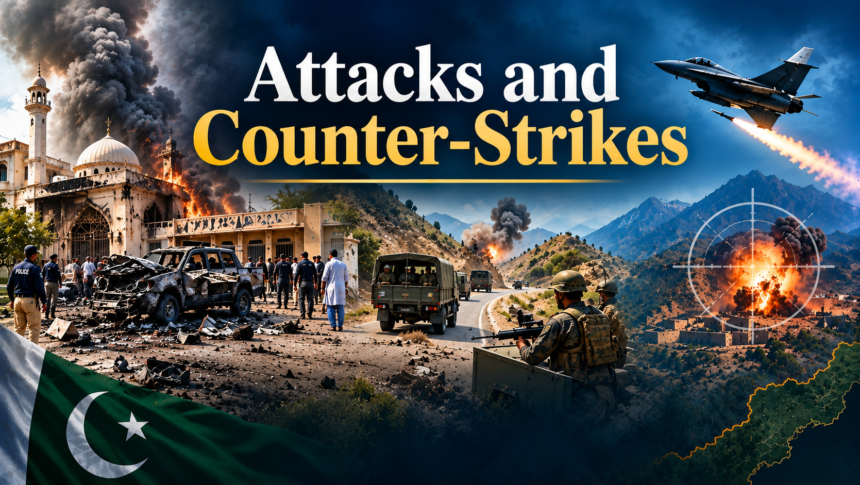
Following the deadly vehicle-borne suicide attack on a mosque in the Old Police Lines area of Kohat during Friday prayers, which reportedly martyred a number of police personnel and civilians, and the subsequent ambush of a military convoy on the Hangu–Kohat Road, in which two officers and several soldiers were martyred, Pakistan has responded with counter-strikes against terrorist targets across the border.
Pakistan’s Response
Pakistan Air Force carried out intelligence-based precision air strikes last night at hideouts and terrorist camps of Hafiz Gul Bahadur Group and Fitna Al Khawarij in Kunar and Nangarhar provinces. These camps were completely devastated. According to initial information, 28 terrorists were sent to hell, while several others were reportedly injured.
In the latest reported operation early this morning, Pakistani airstrikes targeted a large gathering of the Hafiz Gul Bahadur terrorist group in Paktika, reportedly killing several senior leaders and other key members of the organisation.
If independently verified, the operation would represent a significant blow to a group that Pakistan has repeatedly accused of conducting or facilitating attacks against its security forces and civilians.
Every act of Afghan-abetted Indian terrorism by these Fitna Al Khawarijs will be met with the full force and resolve of the State of Pakistan.
Pakistan will continue taking necessary action until Afghanistan takes concrete steps to prevent and eliminate cross-border terrorism.
Speculations
There has also been speculation that elements within the Afghan Taliban may have provided information regarding the gathering at Paktika, possibly because of growing international pressure on Kabul to demonstrate that Afghan territory is not being used by terrorist organisations.
Growing Discontent in Afghanistan
There are growing indications of discontent within the ruling TTA establishment, with some elements reportedly dissatisfied with the policies and decisions of the higher leadership. Public frustration within Afghanistan also appears to be increasing amid the country’s continuing political, economic and security difficulties.
In my assessment, the precision and effectiveness of the reported strike raises questions about the quality and source of the intelligence that enabled it.
While it would be premature to conclusively attribute the information to insiders without independent verification, the possibility of actionable intelligence from within the group or its associated networks cannot be ruled out.
Widening Trust Deficit
The broader issue is nevertheless clear. Pakistan’s experience with the de facto Afghan Taliban authorities since 2022 has produced a persistent trust deficit.
Despite repeated assurances from Kabul that Afghan territory would not be permitted to serve as a launching pad for attacks against Pakistan, cross-border terrorism attributed to the TTP and other militant groups has continued.
Pakistan therefore has legitimate grounds to demand verifiable action rather than rely solely on verbal assurances.
On numerous occasions, Kabul has assured Islamabad that it would act responsibly, prevent the use of Afghan soil against Pakistan and develop relations befitting two neighbouring Muslim countries.
There have also been reported understandings concerning the relocation of TTP elements away from Pakistan’s border and, at various stages, discussions regarding action against senior militant leaders.
Yet the persistence of cross-border attacks indicates that these assurances have not produced the results expected by Islamabad.
Pakistan has consequently borne a heavy human and material cost from terrorism emanating from or facilitated through Afghan territory, particularly since 2022.
Diplomatic engagement, repeated warnings and other measures have so far failed to produce a sufficiently durable improvement in the security environment.
This has understandably strengthened the argument within Pakistan for a more robust policy based on deterrence and verifiable compliance.
The credibility gap was further highlighted by recent public statements from Afghan officials. Just a day before the Kohat Police Lines attack, Afghan Taliban spokesperson Zabihullah Mujahid reportedly told a Western correspondent that the Kabul authorities neither supported nor harboured terrorist groups and desired brotherly relations with Pakistan.
Such declarations will ultimately have to be judged against developments on the ground rather than by words alone.
Another source of concern for Islamabad is Kabul’s growing relationship with New Delhi. Statements from Afghan officials portraying India and Afghanistan as sharing common interests, combined with India’s expanding engagement with Afghanistan, have added another strategic dimension to Pakistan’s security concerns.
The history of tensions along the western border, including armed clashes between Afghan and Pakistani forces, has further complicated bilateral relations.
Pakistan should therefore approach Kabul with cautious engagement rather than unquestioning reliance. Dialogue should continue because geography makes sustained interaction unavoidable, but it must be backed by clear benchmarks, verification mechanisms and reciprocal obligations.
Afghan assurances should be assessed against measurable actions, particularly regarding the TTP and other groups operating from Afghan territory.
The policy should neither be driven by emotion nor based on misplaced trust. Pakistan’s response should rest on three principles:
Credible Deterrence, Verifiable Compliance and Proportionate Reciprocity.
Any demonstrable violation of bilateral understandings or continued support for cross-border terrorism should invite appropriate, lawful and proportionate measures.
At the same time, Pakistan should keep the diplomatic channel open and make clear that a stable, peaceful and genuinely cooperative Afghanistan remains in Pakistan’s interest.
The responsibility now lies with Kabul to translate its repeated assurances into concrete action. Only sustained and verifiable action against terrorist groups operating from Afghan soil can begin to rebuild the trust that has been steadily eroded.
About the Author
Brigadier (Retd) Asif Haroon Raja, SI (M) is a war veteran. He is Command and Staff Course and War Course qualified, holds an MSc in War Studies, and served as Defence Attaché in Egypt and Sudan, as well as Dean of the Corps of Military Attachés in Cairo. He commanded the largest brigade in Kashmir.
He is a defence, security, and geopolitical analyst, columnist, featured columnist of IntelDrop magazine Washington, author of five books, former Chairman of Thinkers Forum Pakistan, Patron-in-Chief of Centre for Development Studies Think Tank, Director of Meesakh Research Centre; he regularly appears on media platforms.