
Nuzhat Nazar
In a world of shifting alliances and competing interests, Pakistan’s diplomatic challenge is no longer simply about building relationships, but turning them into influence, investment and strategic advantage.
In 1971, Pakistan helped bridge one of the world’s deepest geopolitical divides, facilitating the historic opening between the United States and China. Washington and Beijing were ideological rivals, yet Islamabad maintained the diplomatic access needed to bring them closer. It was a reminder that international influence is not always determined by economic size or military strength. Sometimes, it comes from knowing how to keep doors open when others have closed them.
More than half a century later, the world is witnessing another geopolitical transformation. Traditional alliances are being tested, economic partnerships are increasingly shaped by strategic competition, and diplomacy is no longer limited to negotiations behind closed doors.
For Pakistan, this changing landscape presents an opportunity to redefine how it engages with the world.
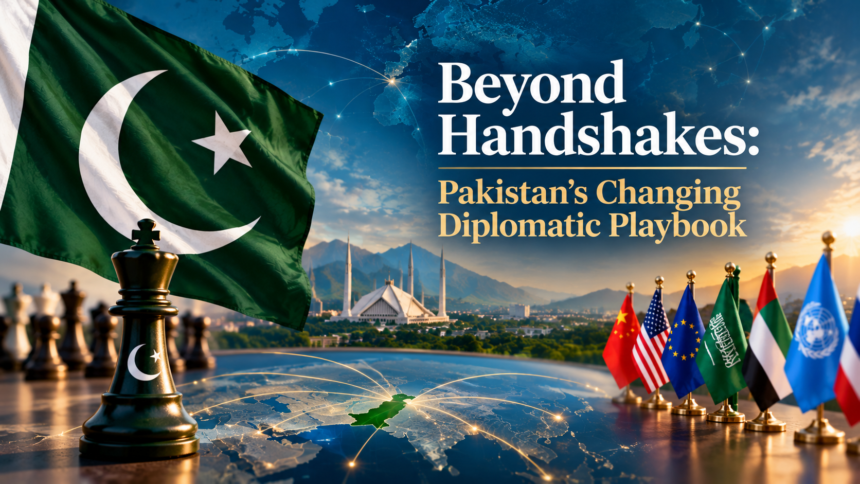
From Washington to Beijing, Riyadh to Tehran, Brussels to Moscow, Pakistan’s diplomatic engagements now span security cooperation, economic partnerships, regional connectivity, multilateral negotiations and conflict mediation. The challenge is not merely to maintain these relationships, but to make them work together in pursuit of national interests.
And that requires more than conventional diplomacy.
Pakistan’s relationship with China remains one of the clearest examples of how bilateral diplomacy can evolve into a multidimensional partnership. What began as a strategic relationship has expanded through the China-Pakistan Economic Corridor into infrastructure, energy, industrial cooperation and regional connectivity.
The next phase of CPEC, however, cannot rely on infrastructure alone. Industrial productivity, technology transfer, agricultural modernisation and export competitiveness must become central to the relationship. Pakistan’s economic future depends not simply on attracting foreign capital, but on creating the domestic capacity to benefit from it.
Meanwhile, engagement with the United States illustrates a different diplomatic reality. Pakistan’s longstanding relationship with Washington has experienced periods of cooperation and disagreement, often influenced by regional security developments. Yet both countries continue to have overlapping interests in counterterrorism, trade, investment and regional stability.
Maintaining productive relations with Washington while preserving a close strategic partnership with Beijing reflects the importance of diplomatic flexibility. In an era of US-China competition, Pakistan’s interests are not necessarily served by reducing every international relationship to a choice between rival powers.
This is where strategic autonomy becomes essential: not distancing Pakistan from its partners, but ensuring that cooperation with one does not automatically foreclose opportunities with another.
Perhaps the most interesting illustration of this diplomatic approach is Pakistan’s involvement in efforts to facilitate dialogue between Iran and the United States.
Unlike traditional bilateral diplomacy, shuttle diplomacy depends on the ability to communicate across political divides. Pakistan’s involvement in the Islamabad Talks and subsequent efforts to encourage restraint demonstrates the potential value of maintaining working relationships with countries whose interests sharply diverge.
The process has also exposed the limitations of mediation. Diplomatic channels can facilitate communication, but they cannot independently resolve disagreements over security guarantees, sanctions or regional influence. A mediator’s effectiveness ultimately depends on the willingness of the parties to negotiate.
Nevertheless, Pakistan’s participation reflects a broader diplomatic possibility: the ability to contribute to regional stability without necessarily becoming a party to every confrontation.
The same principle applies to Pakistan’s expanding relationships with Gulf countries and Türkiye. Saudi Arabia and the United Arab Emirates remain important economic and strategic partners, while cooperation with Türkiye extends into defence technology, trade and political coordination.
The Makkah Joint Defence Agreement between Pakistan, Saudi Arabia and Türkiye adds a trilateral dimension to these relationships. Its longer-term significance will depend on implementation, institutional coordination and its contribution to regional stability. But it represents only one component of a much wider diplomatic network.
Economic diplomacy, arguably, is where this network faces its most consequential test.
Pakistan’s access to European markets under the GSP+ arrangement demonstrates how diplomacy can generate measurable economic benefits. In 2024 alone, Pakistan received an estimated €732 million in tariff exemptions under the scheme. These are tangible advantages that directly affect exporters, industrial employment and foreign exchange earnings.
Yet preferential market access also comes with responsibilities. Maintaining trade benefits requires compliance with international commitments, improvements in governance and sustained engagement with European institutions.
The broader lesson is clear: foreign policy cannot remain disconnected from domestic economic performance.
Diplomatic missions must increasingly function as commercial facilitators, identifying export opportunities, building investor confidence and supporting Pakistani businesses entering international markets. Agreements signed abroad must be matched by predictable policies, competitive industries and effective institutions at home.
Multilateral diplomacy offers another avenue for expanding Pakistan’s international role.
Pakistan’s participation in the United Nations Security Council during 2025–26 and its chairmanship of the Shanghai Cooperation Organisation’s Council of Heads of State for 2026–27 provide platforms to advance national priorities through collective engagement.
The SCO, in particular, offers opportunities to connect regional security discussions with trade, transit, technology and economic connectivity. Its value should be measured not only through diplomatic declarations, but through practical cooperation among member states.
Similarly, Pakistan’s engagement with the United Nations provides opportunities to raise issues including Jammu and Kashmir, regional security, peacekeeping and climate vulnerability.
Climate diplomacy deserves particular attention. Pakistan’s exposure to devastating floods and extreme weather makes access to adaptation finance and climate-resilient development a matter of economic security, not simply environmental advocacy.
For a country facing substantial development challenges, securing climate financing and international technical cooperation could prove as important as many conventional diplomatic agreements.
But diplomacy is not conducted exclusively by governments.
In an age where narratives travel across borders in seconds, public diplomacy has become an essential instrument of national influence. Universities, journalists, entrepreneurs, artists, athletes and diaspora communities all shape how a country is perceived internationally.
The history of ping-pong diplomacy offers an important lesson. Sporting exchanges between American and Chinese players in 1971 helped soften public perceptions at a moment when political relations were deeply strained. Pakistan’s role in facilitating the broader US-China opening demonstrated how informal engagement and formal diplomacy could reinforce one another.
Today, Pakistan has opportunities to expand this approach through academic exchanges, cultural partnerships, sports, tourism and digital communication.
Its international image cannot depend solely on official statements or crisis-driven news coverage. A sustained public-diplomacy strategy would allow Pakistan to communicate its cultural diversity, economic potential, technological talent and policy perspectives to audiences beyond diplomatic circles.
However, credibility remains fundamental. Public diplomacy works when international messaging is supported by visible progress at home.
This brings Pakistan’s diplomatic evolution to its most important question: what happens after the meetings, agreements and international engagements?
The effectiveness of foreign policy cannot be measured simply by the number of visiting delegations, joint statements or photographs of leaders shaking hands.
It must also be measured by investment that materialises, exports that increase, partnerships that endure, diplomatic disputes that move towards resolution and institutions that become more capable of sustaining international cooperation.
Pakistan has historical experience in facilitating dialogue, established strategic partnerships, access to major international markets and participation in important regional and global institutions.
The opportunity now lies in connecting these advantages through a coherent diplomatic strategy.
Bilateral relationships can open doors. Multilateral engagement can build coalitions. Economic diplomacy can generate prosperity. Shuttle diplomacy can reduce tensions. Public diplomacy can build understanding and trust.
But none of these instruments can substitute for domestic economic strength, policy consistency or effective implementation.
Pakistan’s diplomatic future will therefore be shaped not simply by how many countries it engages, but by how effectively those relationships serve its long-term interests.
The real achievement in diplomacy is not being present in every conversation. It is ensuring that those conversations produce something that lasts.