
Nuzhat Nazar
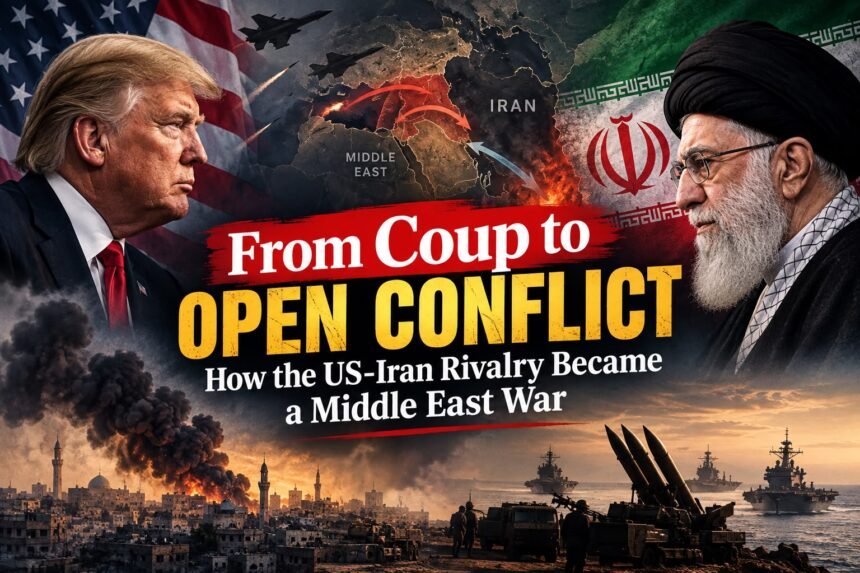
The conflict between the United States and Iran did not begin with nuclear centrifuges, ballistic missiles or Israeli air strikes. Its roots run much deeper — through oil, regime change, revolution, sanctions and four decades of competing attempts to shape the Middle East.
Understanding the confrontation today therefore requires going back more than 70 years.
One of the defining moments came in 1953.
Iranian Prime Minister Mohammad Mossadegh had moved to nationalise the country’s oil industry, challenging the dominance of the British-controlled Anglo-Iranian Oil Company. Britain fiercely opposed the move, while Washington increasingly viewed political instability in Iran through the prism of the Cold War.
The result was Operation TPAJAX, the covert US-backed operation that contributed to Mossadegh’s overthrow in August 1953. The coup did not install Shah Mohammad Reza Pahlavi — he was already Iran’s monarch — but it dramatically strengthened his authority and helped consolidate a government closely aligned with the West. US State Department historical records explicitly document the planning and implementation of the covert operation.
The consequences lasted far longer than anyone involved may have anticipated.
For Washington, the Shah became an important strategic partner against Soviet influence. For many Iranians, however, 1953 became evidence that Western powers were prepared to intervene in Iranian politics when their strategic or economic interests were threatened.
There is another historical irony here: Washington was not always trying to stop Iran from developing nuclear technology.
In 1957, the United States and Iran signed an agreement for cooperation on the peaceful uses of atomic energy as part of the broader American “Atoms for Peace” approach. The agreement was explicitly designed to assist Iran with civilian nuclear research and development.
At the time, Iran was an American ally.
Then came 1979.
The Iranian Revolution overthrew the Shah and transformed the country into an Islamic Republic led by Ayatollah Ruhollah Khomeini. The revolution was not simply a change of government. It fundamentally reversed Iran’s geopolitical orientation.
A country that had served as one of Washington’s closest regional partners became one of its most determined opponents.
Later that year, Iranian students seized the US Embassy in Tehran. Fifty-two Americans were held hostage for 444 days. The episode became a defining political trauma for the United States and helped cement mutual hostility between Washington and Tehran.
Then, in September 1980, Saddam Hussein’s Iraq invaded Iran.
The Iran-Iraq War lasted eight years and devastated both countries. Washington increasingly tilted towards Baghdad, supplying various forms of support even as Iraq used chemical weapons, although US policy was complicated by the secret Iran-Contra arms dealings with Tehran.
For Iran, the lesson was profound: the country needed ways to deter adversaries considerably more powerful than itself.
That experience helped shape what later became one of the central pillars of Iranian security strategy — building relationships with armed non-state actors across the region.
The timeline matters here. Hezbollah emerged in Lebanon during the 1980s with substantial Iranian backing. The Houthis in Yemen became closely associated with Iran much later. Over time, Tehran developed links with groups in Lebanon, Iraq, Yemen, the Palestinian territories and elsewhere, creating what became known as the “Axis of Resistance.”
From Tehran’s perspective, these relationships created strategic depth and allowed Iran to deter or pressure its adversaries far beyond its own borders. From the American, Israeli and Gulf perspective, the same network represented Iran’s ability to destabilise the region without necessarily engaging in conventional interstate war.
The next major confrontation centred on Iran’s nuclear programme.
After years of sanctions and negotiations, Iran and the P5+1 powers — the United States, Britain, France, Russia, China and Germany — reached the Joint Comprehensive Plan of Action in 2015.
Under the JCPOA, Iran accepted restrictions on uranium enrichment, centrifuge numbers and its enriched uranium stockpile, along with enhanced international monitoring. In return, nuclear-related sanctions were eased. The International Atomic Energy Agency subsequently verified that Iran had taken the nuclear steps required for implementation.
But the agreement did not survive US politics.
In May 2018, President Donald Trump withdrew the United States from the JCPOA and restored sanctions as part of his “maximum pressure” strategy. Iran initially remained within major limits before progressively breaching JCPOA restrictions from 2019 onward.
The confrontation increasingly moved from sanctions towards military action.
In January 2020, a US drone strike in Baghdad killed Major General Qasem Soleimani, commander of the Islamic Revolutionary Guard Corps’ Quds Force and perhaps the most influential architect of Iran’s regional strategy.
Iran retaliated with ballistic missile strikes on bases hosting American troops in Iraq, but both governments stopped short of allowing the exchange to become a full-scale war.
For several years, that pattern defined the relationship: escalation followed by restraint.
But the regional landscape changed dramatically after the Gaza war began in October 2023.
Attacks involving Iran-aligned groups increased, while the previously indirect Israel-Iran confrontation became increasingly direct. In April 2024, Iran launched hundreds of missiles and drones towards Israel after an Israeli strike on an Iranian diplomatic compound in Damascus killed senior Iranian commanders.
By 2025, the shadow war had become open military confrontation.
During the 12-day Israel-Iran war in June 2025, the United States directly struck Iran’s nuclear infrastructure. Under Operation Midnight Hammer, US forces attacked Fordow, Natanz and Isfahan. Seven B-2 bombers participated in the operation, while Tomahawk cruise missiles were also used against targets at Isfahan.
Yet even that did not end the confrontation.
In February 2026, the United States and Israel launched a much wider military campaign against Iran, known on the American side as Operation Epic Fury. Iran responded with missiles, drones and attacks across the regional theatre, transforming what had for decades been a largely indirect rivalry into a much broader Middle Eastern conflict.
And this is where the Strait of Hormuz becomes critical.
Hormuz is not merely a narrow stretch of water beside Iran. It is one of the most strategically important energy corridors in the world. Before the latest disruptions, roughly one-fifth of global oil and LNG flows were linked to the strait. The war has therefore turned a US-Iran security confrontation into an issue affecting energy markets, shipping costs and economies thousands of kilometres away.
As of early October 2026, diplomacy has returned — but the conflict is far from resolved.
Qatar, Pakistan and other regional actors are involved in mediation. Iran has received American responses to proposals aimed at reducing tensions, while negotiations have focused heavily on the conditions and sequencing required to restore normal maritime movement through Hormuz. Tehran says reopening the strait depends on conditions contained in an earlier interim understanding being fulfilled.
That brings the story almost full circle.
For decades, Washington tried sanctions, containment, negotiations, covert action and military force. Iran responded with asymmetric warfare, regional partnerships, missile development and nuclear leverage.
Neither side has been able to eliminate the other’s strategic options.
And that may be the most important lesson of the entire US-Iran confrontation.
This is no longer simply a dispute over Iran’s nuclear programme. It is a struggle over regional power, deterrence, American military presence, Israel’s security, Iran’s political survival and control of some of the world’s most important energy routes.
The question now is not whether Washington and Tehran distrust each other — seven decades of history have answered that.
The real question is whether, after moving from covert confrontation to direct war, both sides can construct a diplomatic arrangement strong enough to prevent the next escalation from becoming even more difficult to contain.