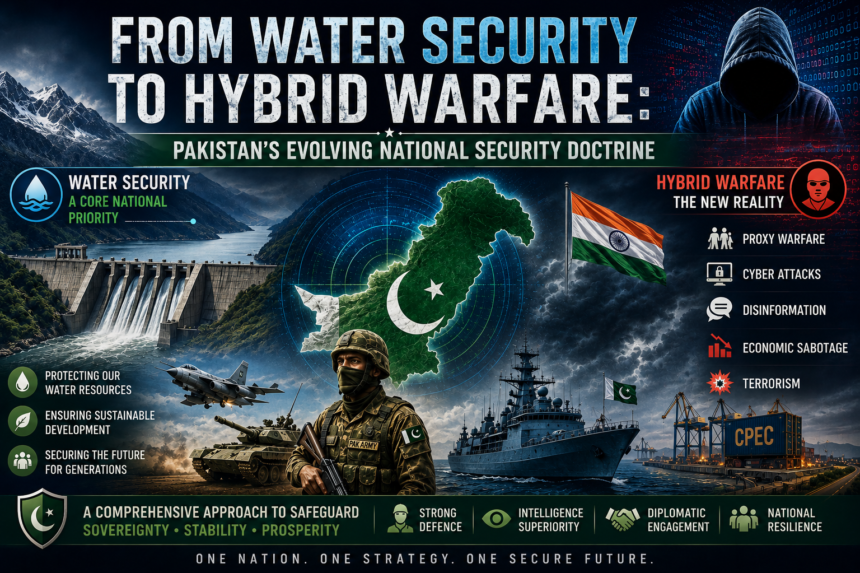

Pakistan’s national security doctrine is evolving beyond traditional military defence to a broader, integrated approach that treats water security, terrorism, hybrid warfare, governance, institutional resilience and technological modernisation as interconnected pillars of national security. The latest Corps Commanders’ Conference signals that lasting peace depends not only on military strength but also on capable institutions, effective governance and strategic adaptation to emerging threats.
The latest Corps Commanders’ Conference (CCC) was more than a routine review of Pakistan’s security environment. It offered an important insight into how Pakistan’s military leadership increasingly views national security—not as a series of isolated challenges, but as an interconnected strategic landscape where terrorism, water security, governance, hybrid warfare and technological transformation reinforce one another.
Perhaps the most significant takeaway was the elevation of the Indus Waters Treaty (IWT) to the country’s highest military forum. Since its signing in 1960, with the World Bank as a broker, the treaty has survived the wars of 1965 and 1971, the Kargil conflict and decades of strained Pakistan-India relations. It has long been regarded as one of the world’s most durable transboundary water agreements. Traditionally, debates surrounding the treaty have remained within the domains of diplomacy, international law and water management.
That context makes the latest message particularly significant.
By reaffirming that Pakistan would take “all necessary measures” to ensure its rightful share of water under the treaty, the military signalled that water security is no longer viewed solely as an environmental or developmental issue. It is increasingly being treated as a strategic national asset. In a region facing climate stress, population growth and rising competition over shared water resources, the protection of Pakistan’s water interests is now being framed as an essential component of national security.
The conference also reiterated Pakistan’s longstanding concerns over cross-border terrorism. The forum expressed concern over the continued use of territory under the control of the Afghan Taliban by groups that Pakistan alleges are responsible for attacks inside its territory, while reaffirming the continuation of intelligence-based operations under Operation Ghazab-lil-Haq. Whether or not international actors share every aspect of Pakistan’s assessment, the message reflects the country’s continued perception that terrorism emanating from across its western border remains among its foremost security challenges.
Equally important was the emphasis on hybrid warfare. According to the military’s assessment, hostile actors are increasingly relying on disinformation campaigns, proxy networks and other non-conventional methods to create instability. This reflects a broader evolution in global conflict, where military competition increasingly extends beyond the battlefield into cyberspace, information operations, economic coercion and the digital domain. The conference suggests that Pakistan is adapting its strategic thinking to this changing character of warfare.
Yet perhaps the most consequential—and least discussed—aspect of the conference was its emphasis on governance.
The forum stressed that military operations alone cannot produce lasting peace and called for stronger governance structures, improved public service delivery and welfare-oriented administration in conflict-affected regions, alongside efforts to dismantle the nexus between terrorism, organised crime and political patronage.
This reflects a lesson repeatedly demonstrated in Pakistan’s own counterterrorism experience. Military operations can dismantle terrorist infrastructure and restore immediate security, but durable stability depends on effective civilian administration, policing, justice, economic opportunity and public confidence in state institutions. Without these foundations, security gains are difficult to sustain.
The governance agenda articulated by the military differs from the governance reforms advocated by institutions such as the International Monetary Fund, which primarily focus on fiscal management, transparency and regulatory effectiveness. Yet both point towards a common principle: resilient states require capable institutions. Whether the challenge is terrorism, economic reform, or climate resilience, institutional capacity increasingly defines national strength.
Another notable feature of the conference was the directive to accelerate the Armed Forces’ multi-domain transformation plan. Although the official statement provided limited detail, the terminology itself is revealing. Modern conflict increasingly spans land, air, sea, cyber, space and the information domain simultaneously. Success therefore depends not only on advanced military hardware but also on integrated command structures, cyber capabilities, artificial intelligence, intelligence fusion and rapid decision-making. The emphasis on multi-domain transformation suggests that Pakistan is seeking to modernise not only its military capabilities but also its strategic doctrine.
At the same time, the conference reaffirmed Pakistan’s commitment to dialogue, regional stability and peaceful conflict resolution in accordance with international law. This dual message—combining military preparedness with diplomatic engagement—suggests that deterrence and dialogue continue to be viewed as complementary pillars of Pakistan’s regional strategy.
Taken together, these themes point to an important evolution in Pakistan’s understanding of national security. Traditional defence remains central, but it is increasingly being viewed alongside water security, institutional resilience, governance, hybrid threats and technological adaptation. Security is no longer defined solely by defending territorial borders; it increasingly encompasses the state’s ability to safeguard strategic resources, counter disinformation, strengthen institutions, maintain public trust and adapt to emerging forms of conflict.
Whether one agrees with every element of Pakistan’s threat assessment is ultimately secondary. The more significant takeaway is that Pakistan’s security establishment is broadening its conception of national security to reflect an increasingly complex strategic environment.
The success of this evolving doctrine, however, will depend not on official statements alone but on implementation. Strategic thinking must be matched by stronger civilian institutions, effective governance, economic resilience and sustained civil-military coordination. Only then can a broader conception of national security translate into lasting peace, stability and national resilience.
The author Nuzhat Nazar is a journalist and strategic affairs analyst with more than ten years of experience reporting on foreign policy, defence, and economic developments. Based in Islamabad, she focuses on geopolitics, regional security dynamics, and Pakistan’s positioning in a shifting global order.