
Part Four
Pakistan effectively combined military action with diplomacy to counter cross-border terrorism, compel Afghanistan to engage on the TTP issue, and reinforce its position as a resilient regional power capable of protecting its security interests while pursuing diplomatic solutions.
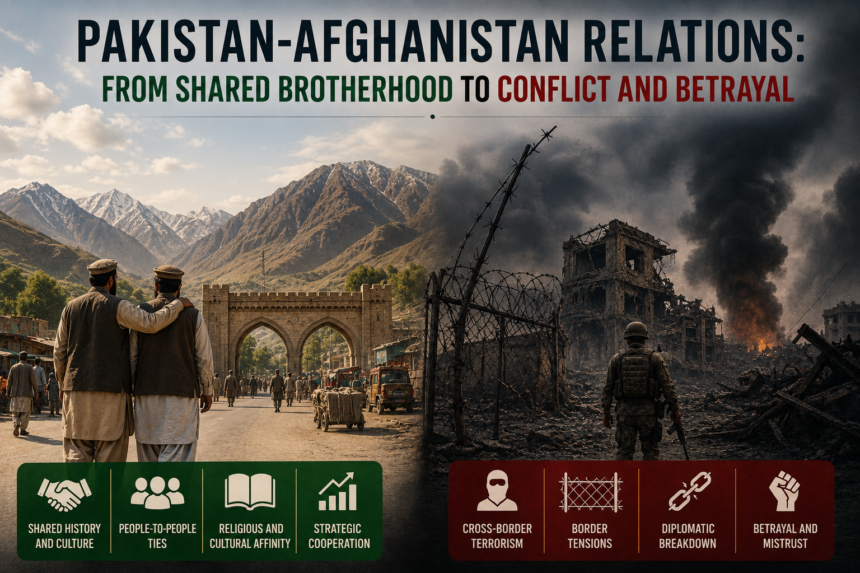
The October 2025 Border Confrontation
Against the backdrop of heightened regional tensions following the India-Pakistan conflict, relations between Islamabad and Kabul deteriorated to their lowest point since the Taliban’s return to power in 2021.
Pakistan maintained that repeated diplomatic engagement, military-to-military contacts and border coordination mechanisms had failed to persuade the Afghan authorities to dismantle the infrastructure of the Tehreek-e-Taliban Pakistan (TTP) and other anti-Pakistan militant groups operating from Afghan territory.
As cross-border terrorism continued unabated, Pakistan concluded that a more robust response had become unavoidable. The crisis reached its peak on 11 October 2025 when coordinated attacks were launched across multiple sectors of the Pakistan-Afghanistan border in Khyber Pakhtunkhwa and Balochistan.
Pakistan attributed these attacks to militants operating with support from Afghan territory and responded with a large-scale military operation aimed at neutralising the immediate threat. Pakistan armed forces not only repulsed the attacks but also inflicted heavy losses on the attackers, destroying numerous border posts, militant launch pads and logistical facilities.
Precision strikes were carried out against militant infrastructure at selected locations inside Afghanistan, including areas around Spin Boldak and Kandahar that Pakistan identified as staging grounds for cross-border attacks. The scale of the confrontation highlighted the growing risk that continued instability along the western frontier could develop into a wider interstate conflict.
It also underscored the urgent need for effective border management, verifiable counterterrorism cooperation and sustained diplomatic engagement between the two neighbouring states.
Diplomatic Efforts
Recognising the potentially catastrophic consequences of prolonged hostilities, regional partners, including Qatar, Saudi Arabia, the United Arab Emirates and Türkiye, intensified diplomatic efforts to defuse the crisis. In response to these initiatives, Pakistan agreed to participate in talks aimed at restoring stability and establishing a framework to address its long-standing security concerns.
The willingness of both sides to return to the negotiating table demonstrated that, despite deep mistrust and recurring confrontation, diplomacy remained the only viable path to preventing a prolonged conflict between two countries whose geography, history, faith and economic future remain inextricably linked.
The Doha Peace Talks
The military confrontation was followed by intensive diplomatic efforts led by Qatar and supported by other friendly regional states to prevent further escalation of hostilities. After a prolonged deadlock, direct negotiations between the Pakistani and Afghan delegations finally commenced in Doha. The lengthy impasse itself reflected the depth of mistrust that had accumulated between the two neighbours.
The principal difference centred on the Tehreek-e-Taliban Pakistan (TTP). While the Afghan delegation reportedly sought an immediate ceasefire and the restoration of normal trade and transit arrangements, Pakistan maintained that no durable settlement was possible unless Kabul took credible action to prevent Afghan territory from being used for cross-border terrorism.
Islamabad argued that the TTP issue lay at the heart of the crisis and therefore had to be addressed before any lasting confidence-building measures could succeed. By the conclusion of the talks, the Afghan side reportedly reaffirmed that its territory would not be used against Pakistan and expressed its willingness to continue discussions on border security and related issues.
Although the agreement represented only an initial understanding rather than a comprehensive settlement, it created a diplomatic opening for further negotiations scheduled to continue in Türkiye. From Pakistan’s perspective, the Doha dialogue achieved an important diplomatic objective by bringing its security concerns regarding cross-border terrorism to the forefront of regional and international attention.
The ultimate success of the process, however, depended not on declarations but on the implementation of concrete and verifiable measures against militant groups operating from Afghan soil. Former Afghan Vice President Amrullah Saleh also argued that the negotiations placed the Taliban in a difficult diplomatic position by compelling them either to acknowledge responsibility for the TTP or to demonstrate their willingness and ability to act against it.
Pakistan’s Strategic Accomplishments
The Pakistan Armed Forces remain one of the most professional military institutions in the region, possessing the capability to confront and defeat adversaries across the full spectrum of conflict. History bears witness to their performance in multiple wars against India, culminating in what the world regards as a comprehensive military success during the four-day conflict of May 2025.
On the western front, Pakistan twice repulsed incursions by the Afghan Taliban forces, inflicting substantial casualties on both hostile troops and Khawarij militants. Security forces also captured several border posts and established defensive buffer zones in vulnerable sectors to enhance border security and deny militants freedom of movement.
Despite facing an Indian military that is nearly five times larger and enjoys significantly greater material resources, Pakistan continues to stand as a formidable defensive wall along its eastern borders. Through superior professionalism, operational readiness, and strategic resolve, it has maintained a credible deterrent against external aggression.
Pakistan’s achievements, however, have not been confined to the military domain alone. Within a remarkably challenging regional environment, Islamabad simultaneously managed multiple diplomatic, security, and strategic objectives. It supported Iran during a period of heightened regional tension, engaged the United States through diplomacy, responded firmly to security challenges emanating from Afghanistan, and successfully countered Indian military adventurism.
At the same time, Pakistan maintained close strategic consultations with China, strengthened its defence cooperation with Saudi Arabia, deepened its engagement with Russia, and demonstrated financial credibility by honouring its international commitments. The country’s growing diplomatic relevance was further reflected in the numerous expressions of support, appreciation, and outreach it received from capitals across the world.
Taken together, these developments underscore Pakistan’s emergence as a resilient regional actor capable of balancing military preparedness, diplomatic engagement, and strategic foresight in an increasingly turbulent geopolitical environment.
To be concluded
The author, Brigadier (Retd) Asif Haroon Raja, SI (M), is a war veteran. He is Command and Staff Course and War Course qualified, holds an MSc in War Studies, and served as Defence Attaché in Egypt and Sudan, as well as Dean of the Corps of Military Attachés in Cairo. He is a defence, security, and geopolitical analyst, columnist, featured columnist of IntelDrop magazine, Washington, author of five books, former Chairman of Thinkers Forum Pakistan, Patron-in-Chief of Centre for Development Studies Think Tank, Director of Meesakh Research Centre; he regularly appears on media platforms.