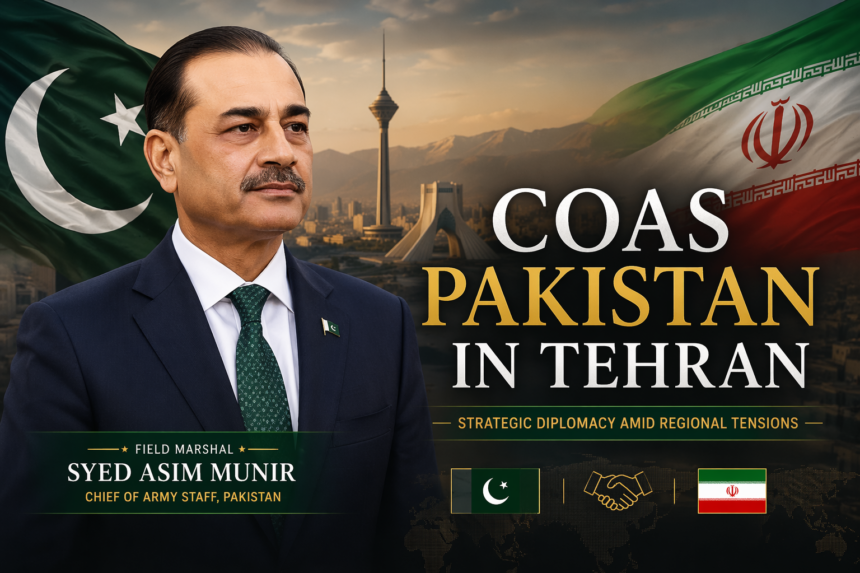

The current mission of Pakistan’s Chief of Army Staff (COAS), General Asim Munir, to Tehran is a move born out of a stark, inescapable reality: a single miscalculation in the Gulf could now spark a global energy collapse. He has not arrived for the sake of optics or routine military cooperation. He is there for damage control. This is not the traditional diplomacy of influence typically wielded by a superpower; it is a diplomacy of necessity. As the two week ceasefire deadline of April 22 approaches, Islamabad has transitioned from a passive host of talks to an active, high-stakes courier between Washington and Tehran.
While geopolitical analysts often describe these shifts in the sterile vocabulary of “strategic pivots,” the human cost of a failure in mediation is far more visceral. For the average Pakistani, already struggling under the weight of record-breaking inflation and a crumbling power grid, a total blockade of the Strait of Hormuz is not a theoretical security concern. It is an existential threat. If these mediation efforts collapse, the resulting surge in fuel prices will be felt at every kitchen table from Karachi to Gilgit. This moral dimension, the duty to protect a vulnerable population from the fallout of a confrontation they did not start is what lends the COAS’s mission its true urgency. Regional stability, in the end, is about the survival of people, not just the flow of oil.
Pakistan’s role is defined by a unique, and often uncomfortable, dual-access. Islamabad remains one of the few capitals capable of translating the rigid security requirements of the United States into a framework that respects the strategic sensitivities of the Iranian leadership. This is where the “Munir Doctrine” appears to be taking shape: a preference for quiet, results-oriented realism over the performative nature of traditional diplomacy. In a region where trust has long since evaporated, the directness of a military to military backchannel is perhaps the only currency that still carries value.
There is, however, a sharper reality beneath the diplomatic surface. Many observers describe Pakistan as a “neutral bridge,” but that is a convenient fiction. In truth, Pakistan’s mediation is less about neutrality and more about controlled relevance. By placing itself at the center of the world’s most dangerous flashpoint, Islamabad is reclaiming a strategic seat at the table. It is a calculated move to ensure that Pakistan remains “too pivotal to ignore” in the eyes of the West, particularly as it navigates a delicate relationship with international lenders. This is a high-wire act of sovereignty under immense external pressure.
The previous round of talks in Islamabad was characterized by a grueling 21 hour deadlock, largely centered on the sequencing of sanctions relief and enrichment pauses. The shift to Tehran suggests that the focus has moved toward a “phased de-escalation.” Instead of chasing a grand, all-encompassing peace treaty, the objective now is likely more humble: a series of small, reciprocal “de-tensions” to prevent a full-scale conflagration. It is an attempt to manage the possible rather than achieve the ideal. And that is where the risk lies.
The dangers of this mission are as significant as the potential rewards. Should the ceasefire expire without a concrete extension, Pakistan faces the prospect of being blamed for the impasse by both sides. There is also the internal risk of managing a domestic audience deeply sensitive to the perception of external dictation. Balancing the demands of a Washington that holds the keys to financial survival against a neighbor that can influence internal security is a brutal task. One wrong move, and the bridge collapses.
Yet, the opportunity is undeniable. If Pakistan can facilitate even a temporary reprieve, it will have demonstrated that mid-tier powers can still shape global outcomes through persistent, nuanced engagement. This isn’t about idealistic regional leadership; it is about cold, hard survival and the pursuit of a predictable neighborhood.
Ultimately, the COAS’s presence in Tehran is a gamble on the power of pragmatism. Pakistan has provided the table and the atmosphere, but the final decision to step back from the brink belongs to the principals in Tehran and Washington. Islamabad is doing the heavy lifting of a middleman in a room full of pyromaniacs, hoping that common sense prevails before the next spark. Whether this diplomacy of necessity will be enough to shield the region’s people from the flames remains the defining question of the hour. That, however, is the gamble.