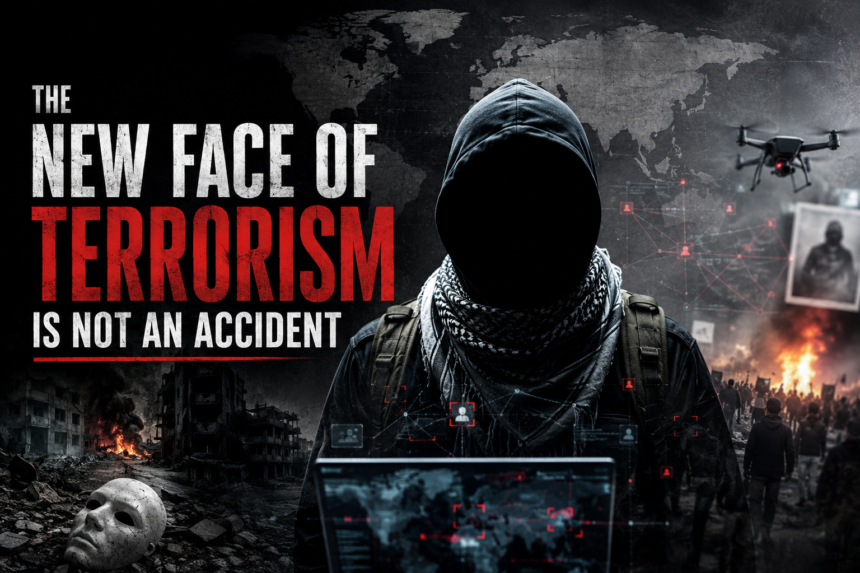

The growing visibility of women in terrorist organisations is not evidence of empowerment or social change, but a deliberate strategic adaptation. Modern terrorist groups have evolved beyond traditional insurgency and now wage war in both the physical and information domains, using women as powerful symbols to strengthen propaganda, attract recruits, exploit security assumptions and reshape international perceptions. While military operations can eliminate terrorists on the battlefield, defeating terrorism today also requires exposing and dismantling the narratives, recruitment networks and media machinery that create the next generation of operatives.
Nuzhat Nazar
When Italian journalist Francesca Marino interviewed Shaynaz Baloch, presented by the banned Baloch Liberation Army (BLA) as one of its commanders, the conversation was framed around women, resistance and the future of Balochistan. To many viewers, it may have appeared to be another interview from a conflict zone. But the interview itself was not the real story.
The real story was the image.
An armed woman. Calm, confident and introduced not as a fugitive, but as a commander. The production was polished. The messaging was deliberate. It reflected something modern terrorist organisations have come to understand remarkably well. In today’s conflicts, perception can be just as valuable as firepower.
This is where contemporary terrorism differs from the insurgencies of previous generations.
The battlefield has expanded beyond mountains, deserts and urban streets. It now stretches across social media platforms, online videos, podcasts and international interviews. Terrorist organisations no longer seek only to inflict casualties. They seek legitimacy. They seek visibility. Above all, they seek relevance.
That is why the growing prominence of women within terrorist propaganda deserves far greater attention than it has received.
It is tempting to see this as a recent phenomenon. It is not.
History suggests that whenever states strengthen security around one operational profile, terrorist organisations respond by constructing another. During Algeria’s war of independence in the 1950s, women crossed French checkpoints carrying explosives because soldiers were less likely to suspect them. In nineteenth century Russia, female revolutionaries played central roles in assassination campaigns against the Tsarist regime. Women also served as couriers and intelligence operatives in Zionist underground organisations during the British Mandate in Palestine. Decades later, the LTTE institutionalised female suicide bombers in Sri Lanka, while Boko Haram forced hundreds of women and girls into carrying out attacks across parts of Africa.
The organisations differed. Their ideologies often had little in common. Yet their strategic thinking followed a familiar pattern. Surprise has always been one of terrorism’s greatest advantages, and gender has repeatedly been used to create that surprise.
Pakistan is witnessing its own version of this evolution.
The suicide bombing outside Karachi University’s Confucius Institute in April 2022 was more than a tragic attack. It represented a strategic shift in how the banned BLA wanted to present itself. Shari Baloch was not portrayed simply as a suicide bomber. She was transformed into a symbol. An educated schoolteacher, a mother and a professional became the face of an organisation determined to demonstrate that its appeal supposedly extended beyond armed men in remote hideouts.
The messaging did not end there.
Subsequent cases involving female operatives, together with increasingly sophisticated propaganda videos featuring armed women, suggest an organisation investing heavily in image making. The videos are professionally edited. The language is carefully chosen. The visuals are designed for social media consumption. This is not spontaneous communication. It is strategic branding.
Modern terrorist organisations increasingly resemble media organisations with armed wings.
Their objective is not merely to recruit fighters. It is to shape how they are perceived internationally. Every interview, every photograph and every video attempts to blur the distinction between violent extremism and political legitimacy.
That makes the battle over narrative almost as important as the battle on the ground.
The testimony of Adeela Khudabaksh, a qualified nurse from Turbat who escaped recruitment, provides a rare glimpse behind this carefully constructed image. She described how radicalisation did not begin with violence. It began with conversation, persuasion and a gradual reshaping of identity. Only after trust had been established was violence presented as duty and suicide reframed as sacrifice.
That account reminds us that terrorist recruitment is rarely sudden. It is a slow psychological process built on grievance, isolation and manipulation.
This has profound implications for counterterrorism.
Military operations remain indispensable. Pakistan’s security forces continue to dismantle terrorist infrastructure through operations such as Shaban, denying violent groups physical space and operational freedom. Yet the long term challenge extends beyond armed encounters. It lies in disrupting the networks that recruit, indoctrinate, finance and publicise terrorism long before an attack takes place.
Too often, public attention focuses on the individual carrying the weapon. The real architecture of terrorism remains largely invisible. Behind every operative stand recruiters who identify vulnerable individuals, propagandists who manufacture narratives, financiers who sustain operations and media handlers who ensure every attack achieves maximum psychological impact.
The interview with Shaynaz Baloch should therefore be understood in a broader context. Whether intentionally or otherwise, it illustrates how contemporary terrorist organisations seek to position themselves before international audiences. The goal is not simply to communicate. It is to influence perception.
Pakistan’s challenge today is not only to defeat terrorists in the field, but also to understand how those terrorists are reinventing themselves in the information age.
Terrorism has always evolved. It changes its tactics, its technology and even the faces it places before the world. Effective counterterrorism must evolve with equal speed. Success will not be measured only by the number of attacks prevented or terrorists eliminated, but by whether societies can recognise and dismantle the narratives that produce the next generation of recruits before they ever reach the battlefield.
Nuzhat Nazar is a journalist and strategic affairs analyst with more than ten years of experience reporting on foreign policy, defence, and economic developments. Based in Islamabad, she focuses on geopolitics, regional security dynamics, and Pakistan’s positioning in a shifting global order.