
Asif Haroon Raja
Pakistan Subjected to False Allegations
Once again, an unsuccessful attempt has been made from the corridors of Washington to challenge Pakistan’s sovereignty and self-respect.
Under the growing pressure of President Donald Trump, anti-Pakistan lobbyists have intensified their rhetoric, with American Senator Lindsey Graham crossing diplomatic boundaries and openly targeting Pakistan.
In a threatening tone, he declared that if Pakistan refuses to join the Abraham Accords and recognize Israel, it will have to pay a heavy price.
This arrogant statement, rooted in a colonial mindset, has deeply hurt patriotic Pakistanis around the world and sparked a fresh wave of anger across social media.
The False Noor Khan Airbase Narrative
In this apparent campaign to pressure Pakistan, Senator Graham did not stop at threats alone. He also advanced what many described as one of the most sensational and fabricated allegations in recent diplomatic history.
The American senator alleged that during the Iran–US tensions, Pakistan allowed Iranian military aircraft — including RC-130 planes — to use Rawalpindi’s Noor Khan Airbase as shelter from possible American strikes.
Concern in Washington:
Using this narrative, Lindsey Graham reportedly demanded explanations from US Defense Secretary Pete Hegseth and American military leadership.
Pakistan’s Firm Response:
Pakistan categorically rejected the allegation, describing it as “baseless, misleading, and far removed from reality.” Clear messages were conveyed to those questioning Pakistan’s integrity: Pakistan’s soil is not used at anyone else’s command.
Khawaja Asif’s Courageous Position: A Voice for the Oppressed
The real source of frustration behind the senator’s outburst appears to be the bold statement made by Pakistan’s Defense Minister Khawaja Asif — which unsettled Israel and its supporters. Referring to Israel as a “festering wound,” Khawaja Asif stated in unequivocal terms:
“From Gaza to Lebanon and Iran, the blood of innocent children and civilians is being spilled. Joining hands with those responsible for such suffering goes against Pakistan’s ideology and national honor. We cannot bargain over the blood of the oppressed.”
Such remarks were bound to provoke anger in Tel Aviv, but Pakistan, many argue, has never been prepared to compromise on the issue of Palestinian suffering — neither yesterday nor today.
Kashmir and Palestine: A Matter of Principle
Pakistanis responding online reminded the American senator that Pakistan is not a colonial dependency, but an independent and sovereign nuclear power.
A Principled Position:
Pakistan’s refusal to recognize Israel is not viewed domestically as a temporary political tactic, but as a principled stance rooted in the vision of Quaid-e-Azam Muhammad Ali Jinnah — one tied to the establishment of an independent Palestinian state based on the 1967 borders.The other is to grant right of self-determination to the Kashmiris in accordance with the UN resolutions.
Many citizens argued that if American senators could look beyond superpower politics and hear the cries of Gaza’s mothers and children, they might speak more about humanity than about defending a state accused of oppression.
Trump’s Statement Shakes the Islamic World
Trump’s remarks reportedly sent shockwaves through parts of the Muslim world:
“Whoever Refuses to Recognize Israel Should Prepare for Destruction.”
Critics pointed out that before the bodies of tens of thousands of Muslims had even been buried, Washington was already demanding that Muslim nations embrace Israel or face consequences.
Emerging Alternative Alliances
In January 2026 Saudi Arabia, Pakistan, and Türkiye discussed a draft trilateral defense framework that deliberately excluded Israel from the regional security structure. This suggested that Muslim countries were not merely refusing verbally, but were also exploring alternative strategic alignments.
Trump later wrote on Truth Social that, considering America’s efforts regarding Iran, these countries should now sign the Abraham Accords and recognize Israel.
Meanwhile, Senator Lindsey Graham openly warned that if Saudi Arabia, Qatar, and Pakistan refused to follow this path, there would be “serious consequences,” and the peace proposal would become unacceptable.
The threat became more visible through the words of Trump’s allies than through Trump himself.
Ripple Effects of Abraham Accords
On May 24, 2026, Trump held phone calls with the leaders of Saudi Arabia, the UAE, Qatar, Pakistan, Türkiye, Egypt, Jordan, Bahrain, and other Muslim countries urging recognition of Israel after the Iran war.
The central theme of the discussion was once again the “Abraham Accords.” Washington wanted the Islamic world to move forward with formally recognizing Israel, but this time the situation was not the same as before.
According to sources, most countries maintained cautious silence — and that silence itself proved to be the strongest response and a political resistance.
Pakistan responded firmly that it was under no obligation to comply with such demands.
Saudi Arabia told American media that Riyadh would recognize Israel only if an “irreversible path” toward the creation of a Palestinian State was guaranteed — a condition Israel has so far refused to accept.
Later, Trump himself mentioned the discussion on social media, making it clear that he had failed to secure the diplomatic backing he had expected.
American Strategy or Shielding Israel?
Some analysts are of the view that Trump may be using the Abraham Accords as “lubrication” to keep Israel satisfied during negotiations with Iran. In other words, Israel would not accept any Iran deal unless the Arab world formally recognized it.
Trump’s tone shifted from “join whenever you are ready” in May 2025 to “this is mandatory” in May 2026 — transforming an invitation into a condition.
For Saudi Arabia, this is not merely a diplomatic matter, but an extremely sensitive national and religious issue. As the guardian of Makkah and Madinah, Riyadh risks severe damage to its standing in the Muslim world if it openly recognizes Israel without a Palestinian settlement.
Trump understands this reality, yet continues to apply pressure — seeing it not as moral leadership, but political coercion.
Iranian Foreign Minister Abbas Araghchi declared: “Iran will never recognize an occupying regime responsible for genocide and the killing of children.”
The Palestinian question remains the core issue, yet many believe it is increasingly being sidelined.
Qatar’s situation is also described as highly complicated. In September 2025, Israel allegedly targeted a Hamas negotiating delegation in Doha, yet Qatar continues to play the role of mediator.
Pakistan, meanwhile, has also been involved in mediation efforts between Iran and the United States. Observers note that if Islamabad recognizes Israel, it risks losing credibility in Tehran’s eyes; but if it refuses, it may face exclusion from broader regional arrangements.
According to critics, this is not diplomacy — it is power politics and coercive pressure — while the suffering of the Palestinian people, which has shaken global conscience for 77 years, remains largely ignored.
The Lesson of History and the Storm Ahead
History of American politics bears witness to the fact that whenever Washington tried to treat the Middle East as a “deal-making project,” the region descended further into instability.
The Abraham Accords began in 2020 with Bahrain and the UAE, while Morocco and Sudan later joined — yet the Palestinian issue remained unresolved exactly as before.
Public sentiment against Israel runs extremely deep in Pakistan, Saudi Arabia, and Qatar. No government in these countries can simply ignore these emotions and move toward recognizing Israel without facing immense domestic backlash.
Trump’s ultimatum exposes a larger reality: the world’s most powerful state appears willing to rise above the UN Charter, international law, and even human conscience in order to write “peace agreements” over the bodies of oppressed people.
History does not describe such agreements as peace, but as cowardice — and nations have always learned more from people of conscience than from the timid.
Major Iranian Attack on a US Military Base in Kuwait
One of the biggest and most alarming developments in the Gulf region has now unfolded, as Iran officially acknowledged targeting a US airbase in Kuwait with ballistic missiles and drones.
The Iranian military issued an extremely stern warning to Washington, declaring that if the United States carries out any retaliatory action, it will face a devastating response beyond anything it could have imagined.
Meanwhile, Kuwait’s military issued a nationwide emergency alert after warning sirens sounded across the country. Kuwaiti authorities confirmed that their air defense systems successfully intercepted multiple missiles and drones before they could reach their targets. Preventive measures have been taken.
Key Reasons Behind the Escalation
The attack was carried out in response to American airstrikes near the southern Iranian city of Bandar Abbas, where US forces targeted an Iranian drone-control facility.
Ceasefire Under Severe Threat
This latest attack has placed the already fragile ceasefire in extreme jeopardy, raising fears that the entire Middle East could slide toward a full-scale regional war.
Atmosphere of Fear Across the Gulf
The sound of sirens and explosions across Kuwait and neighboring states has triggered panic online and within the international community. It is feared that this may mark the beginning of a new regional conflict.
The situation around the Strait of Hormuz and the Gulf region is rapidly moving out of control, and the coming days could prove extremely critical for global peace and stability.
Role of Spoilers
India’s Research and Analysis Wing (RAW) has finalized its next information warfare campaign targeting Pakistan, built around three core themes focused on Israel, regional alliances, and civil‑military relations.
The campaign will be deployed via coordinated social media networks including PTI‑linked, PTM‑aligned, Afghan GDI‑controlled accounts, and established Indian propaganda assets such as “Baba Banaras”.
Main goals:
Create internal chaos, fuel extremism against the State, and destroy Pakistan’s strategic ties with Iran.
- Key Hostile Narratives
📌 Narrative 1: Israel Recognition + Militancy Link
Claim:
*Pakistan plans to recognise Israel, but is only holding back due to internal pressure; *Al‑Qaeda (AQ) and ISKP are funded to attack Pakistan in response to this policy shift.
Objective:
Trigger religious outrage, frame state institutions as “betraying Islam”, and justify terrorist attacks.
📌 Narrative 2: Sabotage Pakistan–Iran Relations
Claim: Israel and the USA have secured deals to set up military/intelligence bases in Balochistan, to be used for operations against Iranian interests.
Objective: Create deep mistrust between Pakistan and Iran, break security/economic cooperation, and stir unrest in Balochistan.
📌 Narrative 3: Divide Civil & Military Leadership.
Two contradictory parallel narratives run at the same time:
- Version A: COAS FM Asim Munir wants to recognise Israel; PM Shehbaz Sharif is blocking it.
- Version B: PM Shehbaz Sharif wants to recognise Israel; FM Asim Munir is refusing.
Objective:
Foment institutional conflict, erode public trust, and weaponise religious sentiment against whichever side is labelled “pro‑Israel”.
- Deployment Details:
- Platforms: X (Twitter), Facebook, YouTube, TikTok, local forums
- Controlled Assets: *PTI‑affiliated accounts, *PTM‑aligned pages, *Afghan GDI handles, *Propaganda network “Baba Banaras”, bot farms & paid influencers to fake mass support.
- Strategic Goals:-
A. Trigger political instability & public agitation
B. Turn jihadi/extremist elements against the state
C. Sever Pakistan’s alliance with Iran
D. Provide cover for attacks by TTP, ISKP, BLA
E. Damage Pakistan’s ideological & regional standing
Assessment & Conclusion
This campaign targets Pakistan’s most sensitive fault lines — religion, civil‑military relations, and regional security.
Contradictory claims are designed to create confusion and division regardless of facts.
Immediate counter‑narrative planning, public awareness, and monitoring are critical to neutralise disinformation and protect national stability.
Change of War Tunes to Reconciliation
The latest US-Iran peace framework includes a $300 billion reconstruction package for Iran, according to the New York Times. The programme is being structured as an international investment fund that Washington would help facilitate as part of a final settlement.
The rebranding is deliberate. Washington is calling it an “investment fund” to avoid the words “reparations” or “compensation,” which would face fierce congressional opposition at home.
Iran calls it what it is: a reconstruction programme for damage Washington inflicted. Iranian officials have privately estimated total war damage at between $300 billion and $1 trillion.
The deal goes further still. Major American oil and energy companies would invest in Iran’s energy sector and enter into joint ventures as part of the agreement. The country Trump tried to bomb into the Stone Age may soon host American corporate investment.
The investment fund concept was reportedly conceived by Steve Witkoff and Jared Kushner, both real estate investors, who floated promoting development projects in Tehran. Even in ending a war, the instinct is to find a property angle.
Trump, who spent years lambasting Obama for sending $1.7 billion to Iran, is now weighing a settlement that dwarfs that figure by a factor of nearly 180. He has told confidants he will not sign anything that looks like America paying cash directly to Iran, with Qatar emerging as a possible conduit to release funds.
Iran entered this war under bombardment. It is exiting it with a reconstruction fund, energy partnerships, frozen assets released, and its nuclear programme deferred rather than dismantled. Iran did not win a battle. It won the war.
USA-Iran Conflict – My Opinion
President Trump appears trapped. He seems unable to end the war without a green signal from his close ally in Israel, Prime Minister Netanyahu.
He and the Israeli lobbies in Washington are continually pressuring Trump not to sign the deal, to attack Iran’s energy sector, and to assassinate the left over top Iranian leaders specifically Baqar Qalibakh. Shifting of uranium to Russia or China is not acceptable to Tel Aviv.
Iran has made it clear it is ready to respond firmly if Trump attempts any move near the Strait of Hormuz. His recent announcement about “unblocking Hormuz” carries no weight for Iran. In my view, it was made with the intent of luring Iran into a trap.
Unfortunately, this confrontation will not end unless Netanyahu gives Trump the approval to proceed.
But Netanyahu’s hold on power is getting weaker with every passing day due to increased opposition within Israel, in the USA and in Europe. Never before Israel was so vulnerable to external attacks as it is now.
The Lesson of History and the Coming Storm
The history of American politics bears witness to the fact that whenever Washington approached the Middle East as a “deal-making project,” the region descended further into instability.
The Abraham Accords began in 2020 with Bahrain and the UAE, while Kazakhstan, Morocco, and Sudan later joined — yet the Palestinian issue remained exactly where it was.
Public sentiment against Israel runs extremely deep in Pakistan, Saudi Arabia, and Qatar. No government can simply ignore these emotions and recognize Israel without facing serious consequences at home.
Trump’s ultimatum exposes a larger reality: the world’s most powerful nation appears willing to rise above the UN Charter, international law, and human conscience itself in order to write “peace agreements” over the bodies of oppressed people.
History does not call such agreements peace — it calls them cowardice. And nations have always learned more from people of conscience than from the timid.
The World Will No Longer Be Run by Trump Alone
What suddenly happened was that the atmosphere of the ceasefire once again turned into explosions, drone strikes, and threats?
This question is now echoing across the entire Middle East. Apparently, the issue is not merely a violation of a ceasefire, but part of a much larger diplomatic tug-of-war, behind which new regional political alignments appear to be taking shape.
For the first time, Washington realized that Gulf and Muslim countries are no longer prepared to follow the American line on every issue. The moment an “absolutely not” was sensed, regional politics began to take a new turn.
Against this backdrop, sudden ceasefire violations started surfacing. Iran reportedly increased drone activity near areas of American naval presence, while the United States carried out limited retaliatory actions around Bandar Abbas, sending a stern message that the balance of power in the region still remains in its hands.
The key question being raised is whether this was merely a military response — or a calculated pressure tactic designed to drag Arab States back into an atmosphere of fear and compel them toward new agreements.
Iran, too, appears to be playing differently this time. Tehran understands that if it adopts complete silence, political and economic pressure against it will only intensify.
Therefore, through limited resistance, it seeks to convey that no formula for regional security can succeed while ignoring Iran’s role and interests.
On the other hand, Saudi Arabia has also adopted an unusually independent posture this time. Riyadh made it clear that regional decisions will no longer be shaped solely under external pressure.
Pakistan and Türkiye also conveyed, in soft yet unmistakable terms, that they would not become part of any agreement that further divides the region.
This diplomatic “silent refusal” may have been the most unexpected response for Washington.
Perhaps the most surprising development involved the Sultanate of Oman. For decades it has quietly played the role of a bridge between the United States and Iran.
Despite Muscat’s traditionally balanced policy, the fact that it too received stern messages from Washington on account of its alignment with Iran to jointly manage Hormuz toll fee, is evidence that America now seeks complete political alignment — not merely friendship.
A New Awakening in Middle East
A new mindset now seems to be emerging across the region. Gulf States have realized that endless wars, instability, and proxy conflicts ultimately damage them the most.
That is why Saudi Arabia, Qatar, Oman, and other regional states are increasingly moving toward a security framework based on dialogue, economic partnership, and mutual understanding.
The Middle East may be entering, for the first time, an era in which the countries of the region are attempting to define their own diplomatic direction.
Global powers will still exert influence, but it has become clear that every decision will no longer be dictated solely from Washington or any single capital.
A powerful message has been sent: the world order can no longer be driven by one leader alone. Capitalist imperialism has its limits.
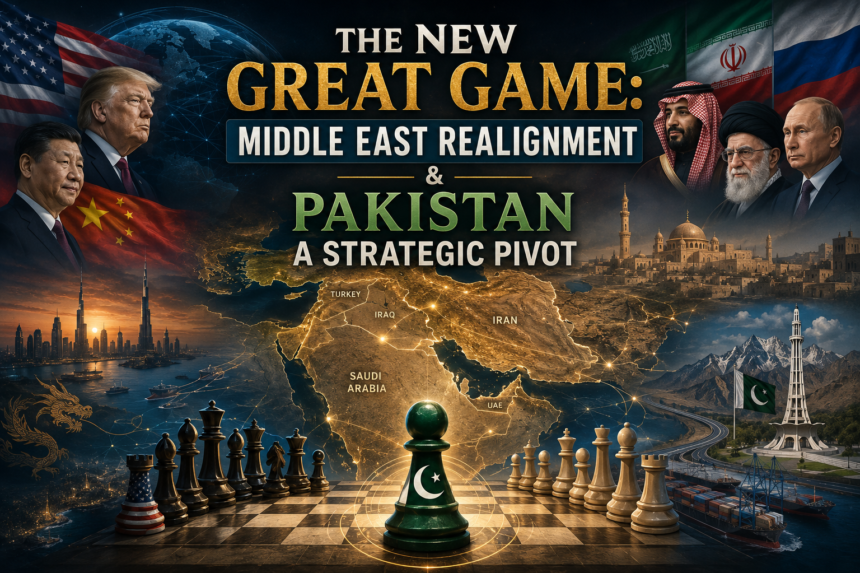
Pakistan – A Geostrategic Pivot and a Bridge
The politics of the Middle East are changing rapidly in the aftermath of the war, sending a clear message to the world that a new diplomatic and strategic axis is emerging within the Islamic world.
There was a time when all major decisions concerning the region were shaped in Washington, London, or the Gulf capitals.
Now the situation appears to be evolving in a way that could make Pakistan the central hub for major security, economic, and geopolitical decisions in the Muslim world in the years ahead.
The formal alignment of Qatar, Türkiye, Kuwait, and Azerbaijan with the Saudi Arabia–Pakistan security framework is not an ordinary development.
In reality, it represents the foundation of a new bloc being built not merely as a defense alliance, but upon a shared vision of energy cooperation, trade, intelligence coordination, and regional stability.
Pakistan is no longer seen merely as a nuclear power; it is increasingly emerging as a symbol of connectivity, mediation, and balance of power within the Islamic world.
The growing understanding between the United States and Pakistan regarding concessions linked to Iran, along with China signaling its intention to advance Middle Eastern engagement through Pakistan, indicates that Islamabad is gradually becoming a true “Bridge State” between global powers.
This is precisely why projects such as CPEC 2.0, Gwadar, the Central Asian trade corridors, and Gulf energy connectivity are no longer viewed simply as economic ventures, but as components of an emerging global realignment.
The port of Gwadar is no longer just a coastal city in Baluchistan. It is increasingly being viewed as a future energy gateway.
Gulf oil reserves, China’s industrial relocation, and new railway and trade corridors are positioning Pakistan at a strategic crossroads from where it could influence the trade and security policies of the entire region.
Pakistan’s role in Afghanistan is also becoming stronger. With the inclusion of new regional partners, connectivity and corridor projects are gaining fresh momentum, while the world is increasingly recognizing that no lasting solution for peace, trade, or security in Afghanistan is possible without Pakistan’s involvement.
The New Great Game
The fundamental reality is that a “New Great Game” of imperialist powers has already begun — but this time, the rules of the game have changed.
Pakistan is no longer merely a matter of geography; it has become geopolitics itself. The world may choose to overlook Pakistan temporarily, but it can no longer exclude it from the major decisions shaping the region.
About the Author
Brigadier (Retd) Asif Haroon Raja, SI (M) is a war veteran. He is Command and Staff Course and War Course qualified, holds an MSc in War Studies, and served as Defence Attaché in Egypt and Sudan, as well as Dean of the Corps of Military Attachés in Cairo.
He is a defence, security, and geopolitical analyst, international columnist, author of five books, former Chairman of Thinkers Forum Pakistan, Patron-in-Chief of Centre for Development Studies Think Tank, Director of Meesakh Research Centre; he regularly appears on media platforms.