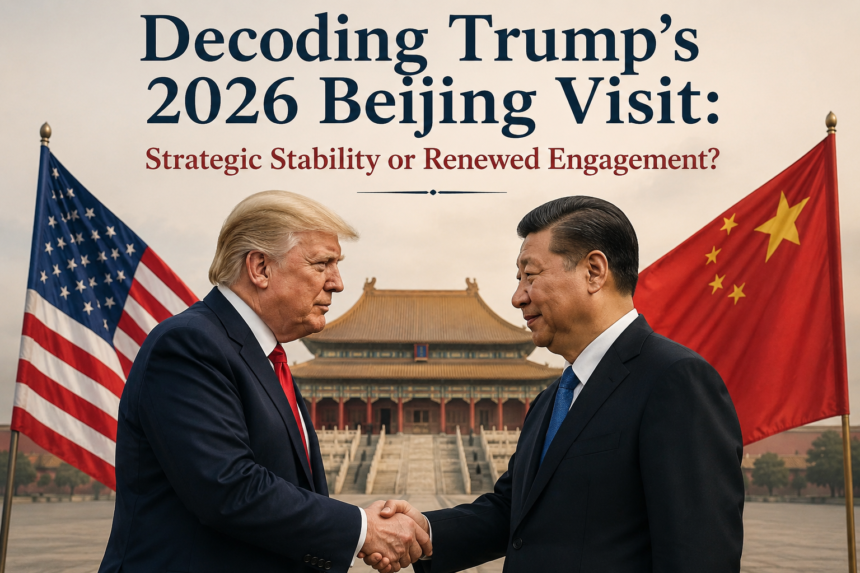

United States President Donald Trump’s state visit and meeting with his Chinese counterpart, President Xi Jinping, from 13–15 May 2026, seems more than a diplomatic engagement between two global powers. This visit, which took place amid the ongoing Iran-US conflict, increasing technological competition, and rising geopolitical fragmentation, represented a calculated attempt by both the U.S. and China to modify rivalry without leaving competition.
The summit produced no transformative breakthrough. It elucidated an important reality of global politics that the U.S. and China are moving toward a model of managed strategic competition, where diplomacy functions less as conflict resolution and more as crisis management. Both world powers are well aware that they need each other’s cooperation. Though President Trump called the Beijing summit a success and hinted at promising trade agreements.
This was the second state visit of President Trump to China, and the first visit during his second presidency came nearly nine years after his 2017 visit. However, the geopolitical environment surrounding the 2026 summit was fundamentally different. In 2017, economic engagement was desired, but this meeting was conducted during a period of heightened uncertainty shaped by war in the Middle East, intensified U.S.–China technological rivalry, and competing visions of global order.
Why the Visit Mattered
Apparently, the visit appeared symbolic. Trump was received with exceptional diplomatic ceremony at the Great Hall of the People, accompanied by military honors, cultural visits, and even a rare invitation to Zhongnanhai. Zhongnanhai is the leadership compound and political heart of Chinese leadership, where foreign dignitaries are seldom hosted. Yet symbolism alone cannot explain the summit’s significance.
The timing of the meeting reflects its deeper strategic importance. This visit was scheduled for April, but the summit was postponed due to the 2026 Iran-U.S. war. This was a development that unexpectedly strengthened China’s strategic position. With the U.S. preoccupied in the Middle East, China gained influence in Indo-Pacific diplomacy. Analysts argued that the diversion of U.S. military resources toward the Gulf potentially reduced its strategic flexibility in East Asia, particularly concerning Taiwan.
In this respect, China entered the summit from a position of relative confidence. On the other hand, following talks between both presidents, the White House said that both sides agreed on the importance of keeping the Strait of Hormuz open. President Xi reportedly emphasized that no conflict can justify the weaponization or militarization of the waterway. China also expressed interest in purchasing American oil as part of efforts to reduce its reliance on the strait.
President Trump further stated that China promised not to supply military equipment to Iran. While speaking on Fox News’ Hannity program, President Trump said, “He is not going to give military equipment—that’s a big statement.”
Strategic Stability or Renewed Engagement?
One of the most important outcomes of this meeting was President Xi Jinping’s announcement that both countries had agreed to establish a constructive China–U.S. relationship of strategic stability. President Xi described this framework as one involving competition kept within bounds, manageable differences, and enduring stability in which peace can be expected.
This language is significant because it reflects China’s effort to redefine bilateral competition through rules and limits rather than confrontation. President Xi explicitly warned against falling into the Thucydides Trap, the historical tendency for rising and established powers to drift toward war. Besides, during opening remarks, President Xi underlined that China and the U.S. “should be partners, not rivals,” while stressing that “the whole world is watching our meeting.”
However, beneath the rhetoric of stability lies continued structural rivalry. Trump’s language remained notably transactional and personal. President Trump praised President Xi as a great leader, described the summit as the biggest summit ever, and emphasized his desire for a relationship better than ever before. However, U.S. objectives were driven less by partnership and more by strategic bargaining. Rather than resolving tensions, the Beijing summit formalised competition under controlled conditions.
Economic Bargaining Under Strategic Pressure
Economics remained central to the summit. As President Trump remarked, “This visit has been amazing. We’ve achieved a fantastic trade agreement, which is excellent for both countries.” Moreover, the White House stated that both sides discussed ways to enhance economic cooperation, including expanded U.S. business access to Chinese markets and Chinese investment in American industries.
The announcement that China would order 200 Boeing aircraft became one of the visit’s most concrete deliverables. The agreement indicates China’s willingness to maintain economic interdependence despite geopolitical rivalry.
Similarly, the U.S. allowed ten major Chinese firms, including Alibaba, Tencent, ByteDance, and JD.com, to purchase NVIDIA’s H200 chips. This move appears contradictory at first glance, particularly given America’s broader technological restrictions against China. But it reflects a more nuanced U.S. strategy to contain critical technological dominance without fully severing economic ties.
President Trump’s Beijing diplomacy proposes U.S. is not pursuing complete economic decoupling. Instead, the U.S. seeks selective interdependence, maintaining trade while protecting strategic sectors such as semiconductors, artificial intelligence, and advanced computing.
China, meanwhile, used the visit to reassure American business elites. During meetings with U.S. Chief Executive Officers (CEOs), including Elon Musk and Tim Cook, President Xi told, “China’s door will only open wider,” and that “China-US economic and trade ties are mutually beneficial and win-win in nature,” showing China’s desire to prevent economic fragmentation despite political tensions.
Taiwan—The Unresolved Fault Line
No issue has highlighted the underlying fragility of U.S.–China relations more clearly than Taiwan. Before the meeting, President Trump publicly announced plans to discuss American arms sales to Taiwan with President Xi. This move is interpreted by analysts as a departure from traditional U.S. ambiguity on Taiwan-related security issues.
However, China responded forcefully. The Chinese Embassy in Washington issued a warning that four red lines in bilateral relations must not be crossed, placing the Taiwan issue at the top of the list.
During talks, President Xi reiterated that Taiwan remained the most important issue in China-U.S. relations, and warned that mishandling it could lead to clashes and even conflicts. He argued that Taiwan independence and cross-Strait peace are as irreconcilable as fire and water.
Yet despite firm rhetoric, neither side escalated the dispute. This restraint itself is revealing. The visit demonstrated mutual recognition that Taiwan remains a dangerous flashpoint requiring careful management, especially at a moment when U.S. strategic attention is divided by Middle Eastern instability.
The Iran War and China’s Mounting Leverage
Perhaps the most underappreciated dimension of the war was the role of the Iran War. The conflict significantly altered negotiating dynamics. The U.S. required China’s diplomatic cooperation to limit Iranian military escalation and maintain stability in the Strait of Hormuz, a critical global energy corridor.
Following talks, the White House stated that both countries agreed Iran can never have a nuclear weapon and underscored the importance of keeping Hormuz open for global energy flows. For China, this created strategic leverage. China positioned itself not merely as an economic competitor but as an indispensable diplomatic actor in crisis management. President Xi’s opposition to the militarisation of Hormuz further reflected China’s growing willingness to shape global security discussions traditionally dominated by the U.S.
What Did the Summit Really Achieve?
Despite ceremonial warmth and optimistic rhetoric, the summit did not fundamentally reset U.S.–China relations. It neither resolved trade disputes nor reduced technological competition. Taiwan remained contentious, and strategic distrust persisted. However, judging the summit solely by formal agreements would miss its broader significance.
Therefore, the real achievement was stabilisation without reconciliation. Both powers acknowledged that rivalry is now permanent but must remain bound. The summit effectively formalised a new geopolitical logic that competes intensely, cooperates selectively, and avoids escalation.
The Rise of Managed Rivalry
President Trump’s departure from China shows not the end of tensions but the beginning of a more structured phase of U.S.–China competition. This state visit revealed that economic interdependence continues to coexist with strategic distrust, technological rivalry, and geopolitical bargaining.
President Xi’s call for strategic stability and President Trump’s emphasis on practical cooperation point toward an uncomfortable but necessary coexistence. Neither the U.S. nor China appears willing or able to disengage completely. The prospective U.S.—China relations will likely be defined by managed rivalry under conditions of mutual dependence. Moreover, this may determine the stability of the global order itself.
Maimona Saleem is a senior researcher at CDS and a PhD scholar in Peace and Conflict Studies. Her research focuses on terrorism and extremism. Her work also focuses on peace-based approaches to economic development, growth, and regional cooperation. She also writes on geopolitics, regional security, and global power dynamics.