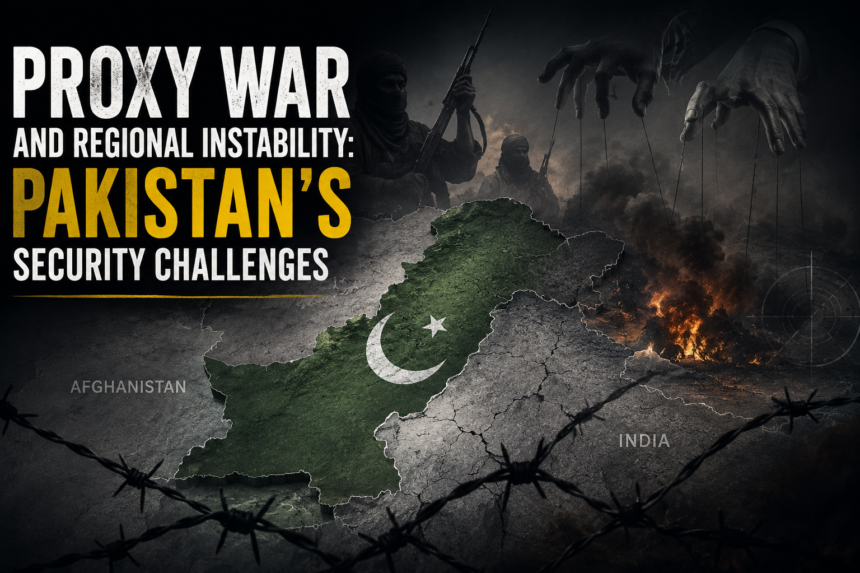

Pakistan’s perspective on regional security, arguing that the country faces a sustained campaign of proxy and hybrid warfare driven primarily by India and enabled by shifting regional dynamics. It contends that Pakistan has borne significant costs in counterterrorism, strengthened its military and diplomatic position, and is adapting to evolving geopolitical alliances while seeking to safeguard its national security and regional stability. It also examines changing power balances in South Asia, the Gulf, and the broader region, and how these developments affect Pakistan’s strategic environment.
Part Two
Asif Haroon Raja
India’s Narratives and Western Partisanship
Since 2003, India has consistently sought to portray Pakistan as the principal sponsor of terrorism in South Asia, presenting both itself and Afghanistan as victims of Pakistan-sponsored militancy.
India’s diplomatic outreach, reinforced by an extensive international media and information campaign, sought to project Pakistan as the epicentre of global terrorism, an unstable and failing state, and a threat to regional and international peace.
The exposure of the Indian Chronicles disinformation network by the EU DisinfoLab, which remained operational undetected from 2006 till 2021, added further controversy to these information operations.
Pakistan maintains that despite repeatedly presenting dossiers and concrete evidence to the United Nations and other international forums regarding India’s involvement in sponsoring terrorism inside Pakistan, its concerns received limited international attention.
Instead, the United States and many Western countries largely endorsed India’s narrative, frequently accusing Pakistan of failing to do enough against terrorism and, at times, questioning its commitment to counterterrorism efforts.
This approach persisted despite Pakistan’s status as a frontline state in the Global War on Terror, a major non-NATO ally, and an important coalition partner of the United States.
Pakistan also viewed the intelligence architecture established in Afghanistan as being heavily tilted against its interests.
While intelligence agencies such as the CIA, MI6, Germany’s BND, India’s RAW, Israel’s Mossad and Afghanistan’s NDS sat under one roof in Kabul and maintained close cooperation, Pakistan’s ISI was left out.
Pakistan believed that its intelligence concerns were largely ignored, forcing its security forces to confront terrorist organisations operating on Pakistani soil at their own with minimal external support.
Islamabad has further argued that the distinction made by the United States between the so-called “good” and “bad” Taliban complicated Pakistan’s counterterrorism campaign.
Throughout the two-decade conflict, Pakistan was repeatedly blamed for instability in Afghanistan despite suffering enormous human and economic costs.
According to Pakistani official estimates, nearly 80,000 Pakistanis lost their lives in the conflict, while the economic cost exceeded US$150 billion.
By comparison, approximately US$20 billion was provided by the United States, including around US$15 billion under the Coalition Support Fund (CSF), much of which represented reimbursement for operational expenses rather than conventional aid.
American assistance remained performance-based and was frequently accompanied by political pressure.
During President Donald Trump’s first administration, security assistance was suspended and Coalition Support Fund reimbursements were withheld.
Following the withdrawal of US and NATO forces from Afghanistan in August 2021, Pakistan once again found itself blamed in many Western policy circles for the collapse of the Afghan government and the Taliban’s return to power.
Instruments of India’s Indirect Strategy
According to Pakistan’s security perspective, India’s indirect strategy employs multiple instruments simultaneously, including:
Proxy warfare through support for militant and separatist groups.
Information warfare and the weaponisation of public opinion through media, cyberspace and social media.
Diplomatic, political, economic and military coercion.
The use of water as a strategic instrument of pressure.
Hybrid warfare combining kinetic and non-kinetic means, including disinformation campaigns, diplomatic isolation, cyber operations and psychological warfare.
Changing Regional Fortunes
Recent geopolitical developments have significantly altered South Asia’s strategic landscape.
From Pakistan’s perspective, the May 2025 India-Pakistan conflict marked an important turning point.
Pakistan believes that the conflict demonstrated its military preparedness, strengthened its deterrence posture and enhanced its diplomatic standing.
Islamabad increasingly portrays itself as a regional stabiliser and security provider, extending its diplomatic outreach to the Middle East while strengthening its role as a bridge linking South Asia, Central Asia and the Gulf region.
Pakistan also argues that its successful mediation during the Iran-US crisis enhanced its international credibility and earned the confidence of both Tehran and Washington.
The conflict further reinforced the Pakistan-China strategic partnership while introducing new complexities into US-India relations and creating opportunities for renewed Pakistan-US engagement.
At the same time, Pakistan believes that the expanding relationship between Kabul and New Delhi has enabled Afghanistan to become a staging ground for anti-Pakistan proxy activities involving Indian intelligence networks.
Impact of the Ongoing Gulf Conflict
The recent Gulf conflict has also altered regional alignments, contributing to closer Pakistan-Iran cooperation while introducing strains into India-Iran relations.
The Pakistan–Saudi Arabia Strategic Defence Pact, signed in September 2025, could mark the beginning of a new Islamic collective security architecture.
Should Türkiye, Egypt, Qatar and Kuwait join the initiative, the alliance may evolve into a cohesive defence bloc comparable to an “Islamic NATO,” dedicated to safeguarding the strategic interests and security of the Muslim world.
India’s Internal Security Challenges
Despite projecting itself as a rising global power, India continues to face multiple internal security challenges.
Pakistan’s strategic community argues that India’s federal structure remains vulnerable to numerous separatist and insurgent movements. These include left-wing extremism, ethnic insurgencies in the Northeast, Sikh separatism, Kashmiri militancy and several regional nationalist movements.
The security situation in India’s Northeast remains particularly complex, with recurring unrest in Manipur, Nagaland, Mizoram and Assam and continuing political tensions across the wider Seven Sisters region.
India-Bangladesh Soured Relations
Political developments in Bangladesh following the change of government in July 2024 have introduced new strategic variables into South Asia.
Relations between New Delhi and Dhaka have experienced increased tensions over political differences, water-sharing arrangements, border management and the Rohingya refugee issue.
Pakistan views the emerging Bangladesh-China relationship, together with improving Pakistan-Bangladesh ties, as a significant geopolitical development with long-term regional implications.
The possibility of China -Pakistan -Bangladesh triangular strategic partnership could turn into a reality.
Sino-Indian Strategic Rivalry
The strategic rivalry between China and India remains one of Asia’s principal fault lines.
Despite periodic diplomatic engagement, the boundary dispute remains unresolved. Military deployments continue along the Line of Actual Control, while both countries have significantly strengthened their infrastructure and force-posture in the disputed Himalayan region.
Competition extends beyond territorial disputes to influence across South Asia and the Indian Ocean Region.
India’s Expanding Security Concerns
India today confronts an increasingly complex security environment.
Its principal long-term strategic challenge continues to be China. Nevertheless, Pakistan maintains that a substantial proportion of India’s military strike formations remain oriented towards Pakistan.
New Delhi is also closely monitoring Pakistan’s expanding strategic partnership with China and its improving relations with the United States, Russia, Iran, the Gulf countries, Central Asian Republics and other regional actors.
Pakistan’s Pro Active Posture
Pakistan further believes that its own military modernisation, together with sustained intelligence-based operations against terrorist organisations—including Operation Azm-e-Istehkam, Operation Ghazab Lil-Haq and the Balochistan-focused Operation Shaban—has significantly degraded the operational capabilities of the TTP and BLA, thereby reducing the effectiveness of externally sponsored proxy warfare against Pakistan.
To be concluded…
About the Author
Brigadier (Retd) Asif Haroon Raja, SI (M) is a war veteran. He is Command and Staff Course and War Course qualified, holds an MSc in War Studies, and served as Defence Attaché in Egypt and Sudan, as well as Dean of the Corps of Military Attachés in Cairo.
He is a defence, security, and geopolitical analyst, columnist, featured columnist of IntelDrop magazine Washington, author of five books, former Chairman of Thinkers Forum Pakistan, Patron-in-Chief of Centre for Development Studies Think Tank, Director of Meesakh Research Centre; he regularly appears on media platforms.