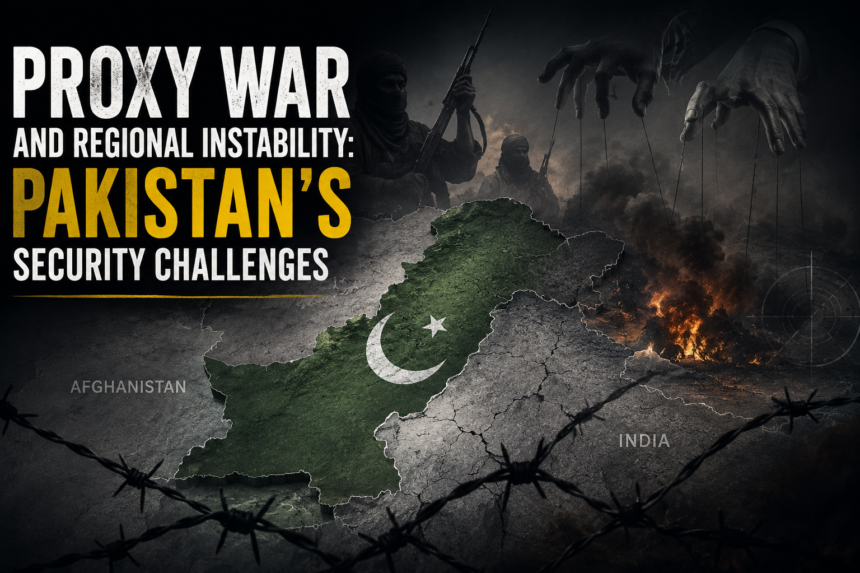

Pakistan’s current security challenges are the result of long-term proxy warfare, regional power rivalry, and geopolitical competition. It claims that external actors particularly India, along with the United States and Israel have pursued policies that undermine Pakistan’s stability through hybrid warfare and support for internal unrest. The author concludes that Pakistan can effectively address these challenges only by strengthening national unity, good governance, economic resilience, military preparedness, and proactive diplomacy.
Asif Haroon Raja
Part One
Executive Summary
This three-part study examines the evolution of proxy warfare against Pakistan, tracing its origins from the post-independence strategic rivalry in South Asia to the contemporary era of hybrid warfare.
It analyses the role of external actors, the transformation of regional geopolitics following the Global War on Terror, and the growing instability in the Middle East.
The paper argues that Pakistan’s security challenges are increasingly interconnected and require a comprehensive national strategy combining military preparedness, diplomatic engagement, economic resilience, technological advancement and national cohesion.
It concludes that Pakistan’s ability to defeat proxy warfare will depend as much on internal stability and good governance as on credible deterrence and proactive regional diplomacy.
India’s Expansionist Ambitions and
Destabilisation Agenda
Following the partition of British India in 1947, many leaders of the Indian National Congress regarded India as the legitimate successor to the British Raj and envisioned the concept of Akhand Bharat (Greater India).
This strategic outlook, according to many analysts, shaped New Delhi’s desire to exercise political and strategic influence over the South Asian region, often through intervention in the internal affairs of neighbouring states.
Pakistan has remained the principal obstacle to India’s regional ambitions. Refusing to accept Indian hegemony, Pakistan has fought three major wars and numerous military confrontations to safeguard its sovereignty and territorial integrity.
During the Cold War, while aligned with the Soviet bloc, India developed and employed covert strategies aimed at exploiting Pakistan’s political, ethnic and socioeconomic fault lines.
Drawing upon Chanakyan principles of statecraft, New Delhi sought to deepen existing grievances in less developed regions, widen societal divisions, and encourage separatist tendencies by supporting dissident elements against the Pakistani state.
These pernicious efforts achieved their greatest success in the former East Pakistan, where political alienation and external intervention culminated in the dismemberment of Pakistan and the emergence of Bangladesh in 1971.
Encouraged by that outcome, India is widely viewed by Pakistanis as having expanded its covert activities into Sindh, Balochistan, Khyber Pakhtunkhwa, South Punjab’s Saraiki belt, Gilgit-Baltistan and Azad Jammu and Kashmir.
Ethnic, sectarian and religious divisions were exploited to fuel instability and weaken national cohesion.
Pakistan has consistently maintained that India’s external intelligence agency, RAW, collaborated with the KGB and Afghanistan’s KHAD during the Baloch insurgency of the 1970s.
Over the years, India has also been accused of extending political or covert support to movements such as the Pakhtunkhwa movement, the Movement for the Restoration of Democracy (MRD), Al-Zulfiqar, PTM, BYC and, more recently, the Joint Action Committee in Azad Jammu and Kashmir.
The Love-Hate Relationship Between the United States and Pakistan
Although Pakistan formally joined the Western alliance system through SEATO and CENTO during 1954-55 and was frequently described as America’s “most allied ally” during the Eisenhower Administration, the United States consistently regarded India as the more important long-term strategic partner.
Successive US administrations largely pursued transactional relations with Pakistan, driven primarily by immediate geopolitical interests rather than enduring strategic commitment.
Following the collapse of the Soviet Union in 1991, India rapidly reoriented its foreign policy towards Washington.
Since then, US-India relations have expanded dramatically across defence, technology, trade and strategic cooperation, supported by numerous bilateral agreements that have transformed the partnership into one of Washington’s most important strategic relationships.
Pakistan’s Security Paradigm Before And After 9/11
Prior to the events of 9/11, Pakistan enjoyed a comparatively stable internal security environment. Following the end of the Baloch insurgency in 1978, Balochistan remained largely peaceful for over two decades.
Likewise, the former Federally Administered Tribal Areas (FATA) and Khyber Pakhtunkhwa were relatively stable.
General Pervez Musharraf’s government had initiated an ambitious seven-point reform and development programme that showed considerable promise for economic growth and institutional reform.
The strategic landscape changed dramatically after the terrorist attacks of 11 September 2001. It fundamentally altered the regional security environment.
Following a telephone conversation in September 2001, during which then US Secretary of State Colin Powell conveyed Washington’s demand that Pakistan decide whether it was “with us or against us,” General Musharraf agreed to support the US-led Global War on Terror.
At the time, many believed that this decision averted a potentially severe confrontation with the United States.
Reports also circulated that George W. Bush Administration had warned Pakistan of devastating consequences if it refused to cooperate, although the precise wording and authenticity of those reports remain disputed.
It was widely hoped that close strategic cooperation with the world’s sole superpower would strengthen Pakistan’s security, improve its economy and help address its longstanding developmental challenges.
Objectives of 9/11
Behind the stated objectives of ‘Freedom’ and ‘Democracy’, the hidden broader objectives of the USA included:
Containing the rise of China and Russia.
Occupying Afghanistan and transforming it into a major Western military base.
Re-shaping the Middle East by invading Iraq and promoting regime change across several Muslim-majority States.
Eliminating Pakistan’s nuclear capability.
Engineering regime change in Iran.
Securing strategic control over the energy resources of the Middle East and Central Asia, thereby dominating Eurasia and the Indian Ocean.
Consolidating Israel’s dominance in the Middle East and India’s pre-eminence in South Asia while creating conditions favourable to the concept of “Greater Israel.”
Preserving American-led unipolarity and global strategic dominance for the foreseeable future.
9/11 Benefitted India and Israel
From Pakistan’s perspective, the post-9/11 situation provided India with an opportunity to intensify diplomatic pressure over Kashmir while simultaneously exploiting Pakistan’s internal security challenges.
The revised international counterterrorism laws suited India and Israel as the freedom movements in Kashmir and Palestine were classified as terrorist movements, thereby strengthening the legal and diplomatic positions of both countries.
Since 2003, Khyber Pakhtunkhwa and Balochistan have experienced prolonged insurgency, terrorism and instability.
The Pakistanis believe that the deteriorating law and order situation in these provinces has not been purely indigenous but has been sustained through external support, with India playing the principal role, aided by hostile intelligence networks operating from Afghanistan and assisted by Israel.
Was 9/11 Stage-Managed?
Since the attacks of 11 September 2001, numerous alternative explanations and conspiracy theories have emerged regarding their origins.
A large number of commentators in the Global South, as well as a minority of commentators in the United States and elsewhere, argue that the attacks were a false-flag operation orchestrated to justify a far-reaching geopolitical agenda.
Sceptics contend that Washington failed to undertake a transparent and comprehensive inquiry capable of conclusively establishing the identities of the 19 alleged hijackers, reconstructing the full sequence of events leading to the attacks on the Twin Towers, and independently verifying that Osama bin Laden, based in Afghanistan, masterminded the operation.
Sceptics have raised numerous technical questions regarding the events of 11 September 2001. They point to the rapid collapse of the Twin Towers and the adjacent Building 7, reports alleging the discovery of traces of specialised explosive materials in the debris, and the circumstances surrounding the aircraft that struck the Pentagon after US air defences had been placed on high alert.
They also note that the impact damaged only a section of the Pentagon and argue that several aspects of the official account remain insufficiently explained.
Furthermore, critics observe that none of the 19 alleged hijackers was an Afghan national, despite Afghanistan becoming the principal target of the subsequent US military intervention.
Pakistan: An Eyesore for the Indo-US-Israel Nexus
India established a strategic partnership with the United States during the early 1990s and further strengthened its relationship with Israel following the establishment of full diplomatic relations in 1992.
These developments gradually evolved into an Indo-US-Israel strategic nexus that continues to shape regional geopolitics.
Pakistan has often remained outside Washington’s preferred regional security framework owing to several factors:
Its Islamic identity, its status as a nuclear weapons state, and its deep strategic partnership with China.
The launch of China’s Belt and Road Initiative (BRI), with the China-Pakistan Economic Corridor (CPEC) serving as its flagship project, further intensified geopolitical competition.
Within Pakistan, it is widely believed that this strategic partnership has increased the determination of hostile powers to obstruct Pakistan’s rise and undermine CPEC through both conventional and hybrid means.
To be continued…
About the Author
Brigadier (Retd) Asif Haroon Raja, SI (M) is a war veteran. He is Command and Staff Course and War Course qualified, holds an MSc in War Studies, and served as Defence Attaché in Egypt and Sudan, as well as Dean of the Corps of Military Attachés in Cairo.
He is a defence, security, and geopolitical analyst, columnist, featured columnist of IntelDrop magazine Washington, author of five books, former Chairman of Thinkers Forum Pakistan, Patron-in-Chief of Centre for Development Studies Think Tank, Director of Meesakh Research Centre; he regularly appears on media platforms.