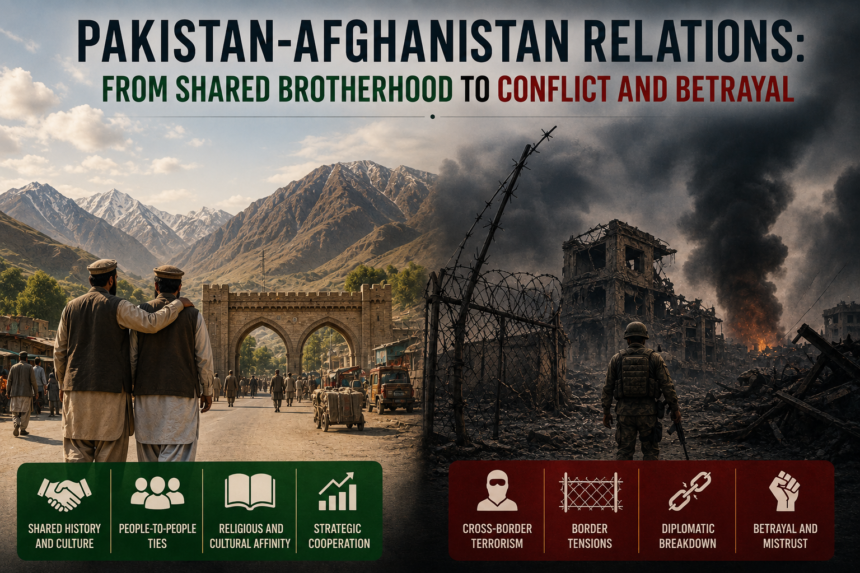

Pakistan–a paradox has shaped Afghanistan relations. Despite Pakistan’s consistent political, economic, and humanitarian support, historical disputes, the Durand Line issue, and Afghanistan’s strategic alignment with India have sustained deep mistrust and recurring tensions.
Part One
Pakistan’s Geopolitical and Security Environment at the Time of Its Birth
Pakistan came into existence on 14 August 1947 under extraordinarily difficult circumstances. The controversial Radcliffe Award, widely regarded in Pakistan as unjust and influenced by the combined interests of the British administration and the Hindu-dominated Congress leadership, partitioned the Muslim-majority provinces of Punjab and Bengal, while also creating conditions that made Jammu and Kashmir (J&K) contiguous with India.
As a result, Quaid-e-Azam Muhammad Ali Jinnah inherited what he described as a “moth-eaten” Pakistan, deprived of many of the resources and territories that had been expected under the partition plan.
In the aftermath of the partition, India rapidly integrated almost all of the 565 Princely States into the Indian Union, including states whose rulers or circumstances, in Pakistan’s view, warranted accession to Pakistan. Pakistan has also maintained that India’s military intervention and subsequent accession of J&K remain legally and politically disputed.
India, unwilling to reconcile itself to the creation of Pakistan, confronted the fledgling state with a multitude of political, economic, administrative, and security challenges. It also pursued policies that Pakistan perceived as aimed at undermining its stability and viability. The unresolved dispute over J&K soon emerged as the principal source of conflict, transforming the two newly independent states into enduring strategic rivals.
Simultaneously, India cultivated close ties with Afghanistan and encouraged Kabul to reject the British-demarcated Durand Line as the international border with Pakistan. Afghanistan laid claims to the Pashtun-majority areas of Pakistan’s then North-West Frontier Province and parts of Balochistan. At the same time, India lent diplomatic support to the Pakhtunistan campaign, thereby opening a second front of pressure against Pakistan.
The Soviet Union, for its part, viewed the emergence of Pakistan with caution, not least because it was the first modern state founded explicitly based on Islamic identity, a development that raised ideological concerns in Moscow. The United States, while enrolling Pakistan in the Western security alliances of SEATO and CENTO during the Cold War, nevertheless regarded India as the more important long-term regional power.
Consequently, Washington sought to maintain close influence over Pakistan’s strategic policies while simultaneously cultivating stronger political and economic ties with India.
Historical Background of Pakistan- Afghanistan Mistrust
The roots of mistrust between Pakistan and Afghanistan date back to the birth of Pakistan in 1947.
Afghanistan was the only country to oppose Pakistan’s admission to the United Nations, largely because of its refusal to accept the Durand Line as the international border and its support for the Pashtunistan movement. These differences continued to cast a shadow over bilateral relations despite the fact that the two countries share deep religious, ethnic, cultural and historical bonds.
The successive regimes in Kabul extended support to the Pakhtunistan Movement and to the Baloch rebels seeking independence. Pakistan repeatedly extended political, economic and humanitarian assistance to Afghanistan, hosted millions of Afghan refugees for over four decades, facilitated Afghan trade and transit, and played a central role in efforts to bring peace and stability to its war-ravaged neighbour.
Afghanistan’s Leaning Towards India
Yet successive governments in Kabul generally remained suspicious of Pakistan’s intentions while seeking closer strategic ties with India. From Pakistan’s perspective, this paradox has been one of the defining features of bilateral relations.
Islamabad has long viewed India’s growing influence in Afghanistan as part of a broader strategy to gain strategic leverage against Pakistan, whereas many Afghan governments have regarded India as a useful political and economic partner. These divergent security perceptions, compounded by external geopolitical rivalries and mutual mistrust, have repeatedly undermined efforts to build a durable and cooperative relationship.
One of the enduring paradoxes of South Asian geopolitics is that successive governments in Kabul have often cultivated closer strategic ties with India—a country with which Afghanistan shares neither a common border nor deep religious or cultural affinities—than with neighbouring Pakistan.
Pakistan’s Support to Afghanistan Ignored
From Pakistan’s perspective, this has been particularly perplexing given the extensive political, diplomatic and economic support Islamabad has extended to Afghanistan over the decades, including hosting millions of Afghan refugees for decades, facilitating international assistance, promoting trade and transit, and supporting various Afghan peace initiatives.
Reasons for Afghanistan’s Animosity
Despite these efforts, relations have repeatedly been overshadowed by disputes over the Durand Line, competing security perceptions, external geopolitical rivalries, and mutual distrust. Understanding this historical contradiction is essential to explaining the recurring cycle of cooperation, confrontation and accusations that has characterised Pakistan-Afghanistan relations. Despite these persistent differences, Pakistan consistently regarded a peaceful and stable Afghanistan as vital to its own national security.
Pakistan’s Strategic Compulsions and Spillover Effects of the First Afghan Jihad
Successive governments in Islamabad believed that instability in Afghanistan would inevitably spill across the long and porous border in the form of refugee influxes, arms and narcotics trafficking, organised crime and militancy.
During the ten years of Soviet occupation of Afghanistan, Pakistan became the principal frontline state, hosting millions of Afghan refugees and supporting the Afghan resistance in partnership with the international community. Following the Soviet withdrawal in February 1989 and the subsequent civil war, Pakistan continued to advocate for a broad-based political settlement.
First Taliban Regime
During the first Taliban government (1996–2001) under Mullah Muhammad Omar, bilateral relations reached their closest point. Pakistan’s western border remained relatively peaceful and the Indian influence waned. This change was for the first time and probably the last time
To be continued
The author, Brigadier (Retd) Asif Haroon Raja, SI (M), is a war veteran. He is Command and Staff Course and War Course qualified, holds an MSc in War Studies, and served as Defence Attaché in Egypt and Sudan, as well as Dean of the Corps of Military Attachés in Cairo. He is a defence, security, and geopolitical analyst, columnist, featured columnist of IntelDrop magazine, Washington, author of five books, former Chairman of Thinkers Forum Pakistan, Patron-in-Chief of Centre for Development Studies Think Tank, Director of Meesakh Research Centre; he regularly appears on media platforms.