
Rimshas saleem
Geoeconomic rivalry and supply chain fragmentation are replacing hyper-globalization with national security-driven trade.
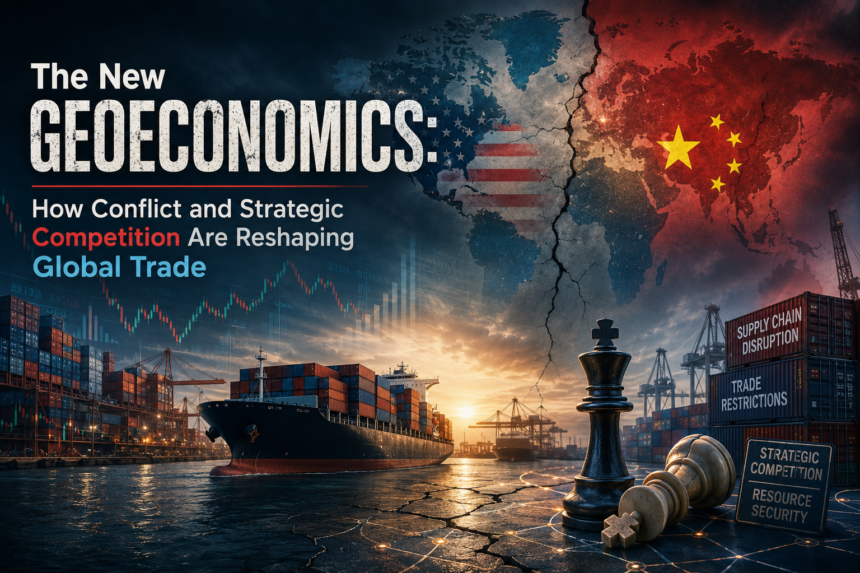
The international economic architecture is undergoing a structural transformation, transitioning away from the market-driven logic of hyper-globalization toward a fragmented model defined by geoeconomic competition and the prioritization of national security over economic efficiency. This shift has been drastically accelerated by the intersection of armed conflicts, sweeping multilateral sanctions of regimes, and a widening technological rivalry between the world’s leading economies. As the IMF’s recent World Economic Outlook notes, global growth is facing severe headwinds from these simultaneous disruptions, with the weaponization of trade and financial networks creating a highly volatile economic landscape that challenges traditional development models.
At the core of this new geoeconomic paradigm is the concept of economic security, which has effectively replaced low cost and just-in-time logistics as the guiding principle of industrial policy in major economies. Western capitals, deeply shaken by pandemic-era supply chain vulnerabilities and the vulnerabilities exposed by energy dependencies, are actively deploying aggressive state interventions. Through reshoring, near-shoring, and “friend-shoring,” states are deliberately redirecting trade flows and capital investments into aligned political blocs. This fragmentation is no longer a theoretical risk; it is a structural reality, visible in the implementation of sweeping industrial subsidies, restrictive export controls on foundational technologies, and rising tariff walls designed to protect domestic ecosystems from external competition.
This restructuring of global supply chains has created a distinct bifurcated pattern of international trade, most visibly within high-tech and strategically vital sectors. The global trade expansion seen in early 2026 was heavily concentrated in artificial intelligence infrastructure, advanced semiconductors, and green technology components, driven by intense competition between East Asian, North American, and European hubs. While this technology race drives immense targeted capital investments, it simultaneously starves non-strategic sectors of investment capital and creates parallel, non-interoperable technological standards. For global corporations, navigating this environment means managing a minefield of compliance regulations, secondary sanctions risks, and the costly requirement to duplicate supply chains to serve politically decoupled markets.
For developing and emerging economies, this geoeconomic fragmentation poses a severe existential challenge. The traditional path to rapid economic development leveraging low-cost manufacturing to integrate into open global markets is being blocked as major economies erect protective barriers under the banner of environmental standards or supply chain resilience. Furthermore, the rising costs of energy and maritime freight, driven by instability in critical maritime transit routes like the Strait of Hormuz, inflict severe balance-of-payments strains on commodity-importing developing states. These countries find their currencies under sustained pressure, their debt-servicing costs escalating, and their fiscal space constrained at the exact moment they need to invest in infrastructure and climate adaptation.
Yet, this geoeconomic realignment also creates specific, tactical opportunities for agile middle powers, including Pakistan. As multinational firms seek to diversify away from direct geopolitical flashpoints, countries that maintain functional relations with both Western markets and the Chinese industrial ecosystem can position themselves as critical geoeconomic bridges. To capitalize on this, Pakistan must execute a comprehensive internal reform agenda focused on upgrading its special economic zones, streamlining regulatory frameworks, and improving trade logistics. By offering a stable, predictable environment for manufacturing diversification, Islamabad can attract redirected capital inflows, particularly in sectors like textiles, component assembly, and IT services, transforming a challenging global environment into a driver of domestic industrial modernization.
Ultimately, navigating the era of geoeconomics requires developing nations to abandon passive economic models in favor of strategic flexibility and resilience. Pakistan’s policy matrix must prioritize reducing its vulnerability to external energy shocks by accelerating investments in domestic renewable energy infrastructure and energy efficiency measures. Concurrently, Islamabad must actively expand its trade relationships within non-aligned regions, deepening economic integration with Central Asia, Africa, and the Middle East to diversify its export base. The era of frictionless global trade has passed; the future belongs to states that can build resilient domestic economic buffers, maintain diplomatic neutrality, and position themselves as indispensable nodes in the newly reconfigured networks of global commerce.