
Rimshsa saleem
NATO’s Ankara Summit marks Europe’s shift toward strategic autonomy and self-reliant defense as American guarantees recedes.
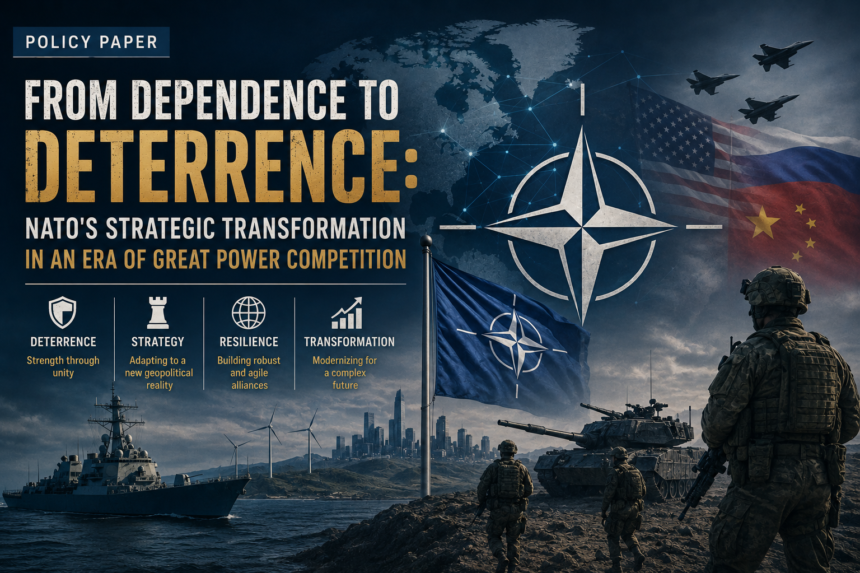
The NATO Ankara Summit of July 2026 will likely be remembered as the moment the Atlantic Alliance was forced to confront the limits of American security guarantees and accelerate its evolution toward structural self-sufficiency. For decades, European strategic autonomy was treated as an academic concept or a niche political aspiration. However, the combination of a structural drawdown of American force postures in Europe and a rapidly expanding Russian war economy along the eastern flank has transformed this debate into an existential necessity. The summit’s primary takeaway is clear: NATO is undergoing a profound structural shift from a model based on American dependence to one anchored in collective, European-led deterrence.
The structural driver of this transformation is a dual-front security challenge that leaves European policymakers with little room for complacency. On one side, Washington’s decision to gradually reduce key military assets from Europe including combat aircraft, long-range strike capabilities, and maritime assets reflects a deep-seated domestic political shift and an urgent strategic requirement to prioritize containment in the Indo-Pacific. On the other side, Russia has successfully transitioned into a resilient war economy, steadily expanding its conventional forces toward a target of 1.5 million active personnel while intensifying hybrid operations, cyber warfare, and sabotage campaigns along NATO’s eastern frontier. This structural imbalance means that Europe can no longer treat its security budget as an optional expense, but must view it as the foundational price of territorial integrity.
At the heart of the Ankara Summit’s agenda was a rigorous evaluation of defense spending commitments and industrial capacity. While the Alliance welcomed the symbolic milestone of a majority of European members meeting or exceeding the 2 percent GDP defense spending benchmark, the analytical focus shifted from budget allocations to industrial output. The newly endorsed Strategy for Industry-NATO Cooperation reflects an understanding that capital allocations are meaningless without a synchronized, deep defense industrial base capable of sustaining long-term, high-intensity conventional warfare. This requires dismantling national procurement barriers, standardizing ammunition and equipment pipelines, and fostering deep transatlantic industrial integration to ensure that European militaries can generate mass, scale, and interoperability without relying on immediate American logistical intervention.
This pivot toward European strategic autonomy carries profound implications for global security dynamics, particularly within the Indo-Pacific. As European allies assume greater responsibility for conventional deterrence along the continent’s eastern flank, Washington gains the operational flexibility required to reinforce its strategic posture in East Asia. This realignment shifts the traditional concept of an indivisible global security matrix into a model of interlinked regional balances, where European stability directly enables American deterrence capabilities in Asia. However, this transition also creates near-term vulnerabilities, as the multi-decade timeline required for Europe to fully bridge its capabilities gaps in strategic lift, satellite reconnaissance, and advanced air defense creates a dangerous window of vulnerability that revisionist powers may seek to exploit.
For peripheral states and traditional partners like Pakistan, NATO’s structural transformation demands a calibrated recalibration of foreign policy. The consolidation of a hyper-militarized Euro-Atlantic bloc focused on long-term systemic competition means that middle powers will face growing pressure to choose sides in a highly polarized international system. Islamabad must avoid getting caught in the diplomatic crossfire of this evolving architecture. This involves maintaining productive, functional security and economic relations with European partners who remain vital export markets while ensuring that these engagements do not compromise Pakistan’s foundational strategic partnerships with China or its developing diplomatic overtures toward Central Asia and Eastern Europe.
The path forward for the Alliance requires turning the political rhetoric of strategic autonomy into operational reality. European leaders must effectively communicate to their domestic electorates that current defense spending increases are not temporary responses to an isolated crisis, but a long-term adjustment to a permanently contested international system. This requires establishing institutional mechanisms within the European Union that complement, rather than duplicate, NATO’s command structures, ensuring that industrial scaling directly enhances front-line combat readiness. Ultimately, the success of this strategic transformation will not be measured by the eloquence of summit declarations, but by the speed with which European capitals can build a credible, independent conventional deterrent capable of preserving peace through undeniable strength.