

Asif Haroon Raja
It is well known that Iran and India have longstanding defence and strategic agreements. During the two-decade-long War on Terror, India’s intelligence agency, RAW, extensively used Iranian territory for activities directed against Pakistan.
It was also extensively reported by the media that during last June’s war, India sided with Israel. RAW in collaboration with Mossad espionage network inflicted extensive harm to Iran’s civil and military leadership, scientists and defence structure on the first and second day of the 12-day war. In the eyes of many observers, India treacherously stabbed Iran in the back.
The same conduct was witnessed during the current conflict, whereas Pakistan openly and wholeheartedly supported Iran on both occasions—a gesture for which Iran continues to express its gratitude.
Throughout the more than three months of war and the ensuing ceasefire negotiations, Pakistan remained the only country that consistently enjoyed the trust and confidence of Iran.
The common expectation was that such developments would lead to a significant shift in Iran’s foreign policy. However, that did not happen. Pakistan and Iran have so far not forged any defence pact or strategic partnership agreement for shared benefits.
Iranian Foreign Minister Abbas Araghchi visited India and engaged warmly with the Indian leadership.
Had matters remained at the level of diplomatic courtesy, it could easily have been understood as normal statecraft.
However, prior to this, India had effectively been pushed out of the Chabahar Port project, and several Indian companies had reportedly been blacklisted.
These companies were accused of working in favour of Israel during the Iran-Israel confrontation and of playing a role in organising and supporting anti-government protests inside Iran, in which Afghan elements were also allegedly utilised.
Following these developments, India quietly withdrew. But Iran soon realised that operating the Chabahar Port without external assistance would be difficult.
There was also concern that prolonged inactivity could benefit Pakistan’s Gwadar Port.
Consequently, Iran once again invited India to return and resume control of Chabahar whenever it wished. In New Delhi, Araghchi declared Chahbahar as the golden gate for India.
India, however, did not provide any clear or satisfactory response. For India, the US patronage and Israeli connection is of greater value than economic cooperation with Iran.
India and the UAE appear to have laboured under the assumption that the US-Israeli attack of 28 February would significantly weaken the Islamic Republic, paving the way for the emergence of a pro-American and pro-Israeli government in Tehran.
However, subsequent developments have shown that the Iranian State proved far more resilient than many had anticipated.
Despite being aware that India had allegedly used Chabahar since 2003 for activities against Pakistan, and for supplying support to anti-state elements in Afghanistan—and that similar activities were still being pursued in cooperation with the UAE— , Iran nevertheless extended the invitation to India.
It could just as easily have offered the opportunity to China instead.
Now, as the clouds of war once again gather over the Middle East, Iranian missile attacks are reportedly damaging Gulf infrastructure, and Kuwait’s airport has been reduced to ruins.
In response, most countries have limited themselves to issuing statements of concern and condemnation.
India, however, has launched what appears to be a coordinated campaign.
Government-linked and proxy social media platforms are actively circulating anti-Iran content.
Casualties from attacks on Kuwait are being highlighted and amplified, while calls for stronger action against Iran are being promoted.
At the same time, various commentators and influencers are openly suggesting ways in which Israel could intensify pressure on Iran and “teach it a lesson.”
These developments suggest that the formation and realignment of global security blocs can no longer be prevented.
The emerging India-Israel-UAE axis appears to operate on a simple principle: regardless of circumstances, its members will support one another.
India seems firmly committed to this approach and, in the process, appears willing to sideline even long-standing partners such as Iran.
If Iran still fails to recognise this face of Prime Minister Modi’s India, then perhaps only God can make it understand. Pakistan, at least, can do little more.
The key question now is how Pakistan chooses to respond to this evolving regional situation.
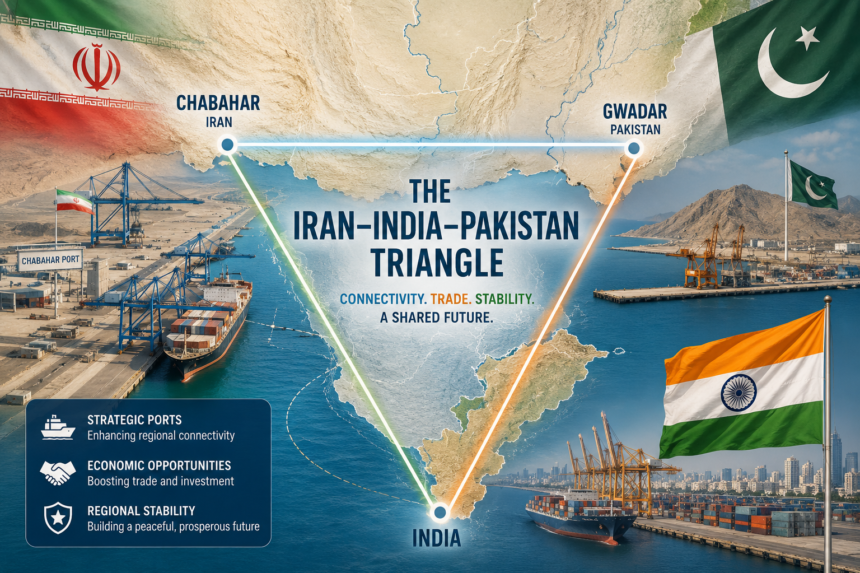
Chabahar – Gwadar Ports Competition
From a purely economic perspective, Iran would arguably benefit more from treating Chabahar and Gwadar as complementary ports rather than strategic rivals.
The two ports are located barely 140 kilometres apart and serve largely overlapping markets in South Asia, Central Asia, Western China, and the Middle East.
Many analysts have long described them as “sister ports” whose integration could create a powerful regional trade network rather than duplicate infrastructure and divide traffic.
By linking Chabahar with Gwadar through road, rail, and maritime connectivity, Iran could gain access to the broader opportunities generated by the China-Pakistan Economic Corridor (CPEC), while Pakistan could benefit from increased regional commerce.
Such cooperation would expand trade volumes, attract greater foreign investment, reduce transportation costs, and transform the Makran coast into a major commercial hub.
Iran must consider whether the Chabahar’s future lies in competing with Gwadar or complementing it.
Geography has already provided the answer. The two ports are natural partners, not natural enemies. A cooperative framework linking Chabahar with Gwadar and CPEC could generate far greater economic returns for Iran than a strategy driven primarily by geopolitical considerations.
While rivalry may satisfy external powers, regional integration would serve the long-term interests of Iran, Pakistan, and the wider region far more effectively.
In the long run, economic cooperation between Chabahar and Gwadar may offer Iran far greater dividends than geopolitical competition.
About the Author
Brigadier (Retd) Asif Haroon Raja, SI (M) is a war veteran. He is Command and Staff Course and War Course qualified, holds an MSc in War Studies, and served as Defence Attaché in Egypt and Sudan, as well as Dean of the Corps of Military Attachés in Cairo.
He is a defence, security, and geopolitical analyst, international columnist, author of five books, former Chairman of Thinkers Forum Pakistan, Patron-in-Chief of Centre for Development Studies Think Tank, Director of Meesakh Research Centre; he regularly appears on media platforms.