
Asif Haroon Raja
Pakistan-Mediated Truce Under Severe Strain
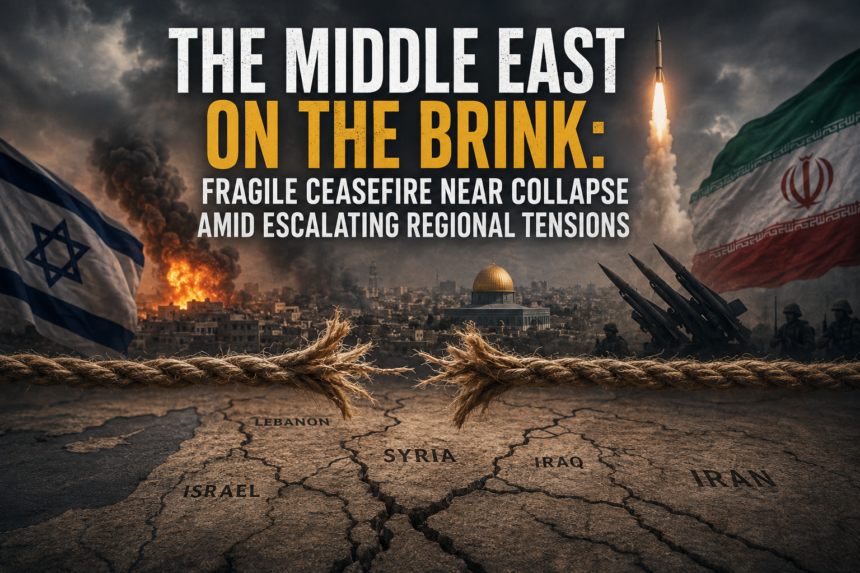
The fragile ceasefire brokered through Pakistan’s mediation on 11 April now appears to be hanging by a thread.
Following a series of military skirmishes and retaliatory actions, the conflict has reached a dangerous tipping point, raising fears that the region may be sliding towards a much wider and more destructive war.
Stumbling Blocks
Two issues remain the principal stumbling blocks preventing a durable settlement:
Iran’s insistence on retaining its uranium enrichment programme and the strategic contest over control and security of the Strait of Hormuz.
Both sides continue to regard these issues as non-negotiable, making diplomatic progress increasingly difficult.
Hawks versus Doves: The Struggle Within the Major Actors
The present crisis is not merely a confrontation between Iran and Israel. It is also a struggle between competing factions within the United States, Israel, and Iran themselves.
The hawkish elements advocate a harder military approach, believing that strategic objectives can only be achieved through coercion and escalation.
In contrast, the more pragmatic and moderate factions continue to push for diplomacy, de-escalation, and a negotiated settlement.
The outcome of this internal contest may prove decisive in determining whether the region moves toward peace or plunges deeper into conflict.
Setbacks to Mediation Efforts
Pakistan’s mediation efforts suffered a major setback after tensions sharply escalated following American attacks on Iran’s Shaqm and Sirik Islands.
Tehran responded through the Islamic Revolutionary Guard Corps (IRGC) by targeting US military facilities in Kuwait and subsequently in Bahrain.
Further tensions arose following a missile strike on Kuwait’s airport, an attack attributed to Iran by some sources but firmly denied by Tehran.
Reports have also surfaced that covert Israeli facilities operating in Iraq may be linked to a series of false-flag operations intended to draw Gulf Cooperation Council (GCC) States more directly into the US-Israeli strategic camp against Iran.
While these claims remain contested, they have added another layer of complexity to an already volatile environment.
Despite these developments, Pakistan has continued to engage all sides in an effort to prevent a complete breakdown of diplomacy.
However, the positions adopted by the UAE and Bahrain increasingly align them with the Israeli-led strategic axis.
Lebanon: The Immediate Trigger
Just when signs of a possible diplomatic breakthrough appeared to be emerging, the situation deteriorated sharply in Lebanon.
Israeli Prime Minister Netanyahu, viewed by many observers as anti-peace and opposed to any accommodation with Iran, intensified military operations in Lebanon.
Israeli forces have expanded their presence and consolidated control over significant portions of southern Lebanese territory, which is in contravention to the ceasefire arrangements reached on 12 April.
After issuing repeated warnings, Tehran launched the first wave of missile strikes against Israel on Sunday night, describing the attacks as retaliation for Israel’s continuing military campaign in Lebanon.
Iranian Missile Barrages and Israeli Emergency Measures
On Monday, 8 June 2026, Iran launched a second wave of missile attacks against Israel. Air raid sirens sounded across Central and Southern Israel as incoming missiles were detected.
The attacks followed missile launches by Yemen’s Houthi movement, highlighting the increasingly interconnected nature of the regional confrontation.
Israeli authorities reported damage to residential areas in Central Israel, while major medical facilities in Nahariya and Poriya shifted to emergency protocols, relocating critical operations underground and into protected facilities.
Simultaneously, senior Israeli military commanders, including Chief of Staff Lieutenant General Eyal Zamir, reportedly directed military operations from hardened command centres as the country prepared for further escalation.
The Israeli Defence Forces (IDF) reiterated that they remained fully prepared to operate across all fronts against perceived threats to Israel’s security.
Trump’s Concern Over Escalation
A significant and potentially revealing dimension of the crisis has emerged from statements attributed to President Donald Trump.
Trump reportedly expressed dissatisfaction with Israel’s attacks in Beirut, arguing that they were undertaken without adequate coordination with Washington and at a time when negotiations with Iran were approaching a breakthrough.
According to Trump, a major agreement with Tehran was potentially only days away from completion before the latest military actions disrupted the diplomatic process.
If accurate, this raises important questions regarding the timing of military operations and whether diplomatic opportunities were sacrificed in favour of immediate strategic objectives.
Supporters of Israel maintain that the strikes were necessary to address pressing security concerns. Critics argue that they may have undermined a rare opportunity to reduce tensions and avoid a broader regional war.
Iran’s Warning of a Larger War
Iranian leaders have made it clear that their recent missile attacks should not be viewed as isolated retaliatory actions.
Senior military commanders and Revolutionary Guard officials have repeatedly stated that the attacks constitute a warning rather than the culmination of Iran’s response.
According to Tehran’s position, Israeli military operations in Lebanon crossed a major red line. Consequently, Iranian officials insist that as long as attacks on Lebanon continue, Iranian retaliation will also continue.
More concerning are statements by senior Iranian military leaders warning that future missile strikes could be significantly more powerful and sustained. Tehran has indicated that operations may continue until Israel halts its military campaign in Lebanon.
These declarations suggest that both sides are preparing for a prolonged confrontation rather than seeking an immediate off-ramp.
The Regionalisation of the Conflict
The conflict is no longer confined to Iran and Israel.
Lebanon, Syria, Iraq, Yemen, the UAE, Bahrain, Oman, Saudi Arabia, Qatar, Egypt, and Turkey are now either directly involved or strategically affected by the unfolding crisis.
Meanwhile, both China and Russia are closely monitoring developments. Although neither appears willing to become openly involved, both powers are reportedly providing varying degrees of diplomatic, economic, and strategic support to Iran while encouraging restraint.
The danger lies in the possibility that localised confrontations could merge into a broader regional war involving multiple state and non-state actors, with potentially severe consequences for global energy markets, international trade, and regional stability.
Pakistan’s Relevance
Power today is not measured solely by military capability, but also by diplomatic credibility. In the current Middle Eastern crisis, countries that can speak to all sides—rather than being locked into one camp—often possess influence disproportionate to their material strength.
Pakistan’s growing diplomatic relevance stems not merely from its geography, but from its increasing ability to communicate with rival camps that no longer trust one another.
In an increasingly polarised region, that may be one of the most valuable strategic assets a State can possess.
Pakistan is no longer merely a matter of geography; it has become geopolitic itself.
Final Outcome: A Narrow Window Before a Wider War
The Middle East stands at one of its most dangerous crossroads in recent years. The Pakistan-mediated ceasefire that once offered hope for de-escalation is under unprecedented strain.
Military actions in Lebanon, reciprocal Iranian-Israeli missile exchanges, growing involvement of regional actors, and deep divisions within the major powers have created conditions ripe for miscalculation.
The central question is no longer whether tensions exist, but whether diplomacy can regain momentum before events acquire a logic of their own.
If negotiations can be revived and military operations are curtailed, the region may still avoid catastrophe.
However, if retaliatory cycles continue unchecked, the Middle East could soon witness a wider conflict stretching from the Eastern Mediterranean to the Persian Gulf, drawing in multiple regional powers and transforming an already volatile crisis into a major international confrontation.
Irony of Middle East Conflicts
The irony of many Middle Eastern conflicts is that major escalations often occur precisely when negotiations appear to be making progress.
History shows that peace processes are frequently most vulnerable when the parties begin to perceive that a compromise may alter the strategic balance to their disadvantage.
In the present context, three indicators will likely determine the direction of events:
- Whether Israel expands or limits its operations in Lebanon and elsewhere.
- Whether Iran confines its response to calibrated military signalling or broadens the theatre of conflict.
- Whether the United States prioritises diplomatic engagement over military pressure and succeeds in restraining its regional partners.
- A fourth factor, often overlooked, is the role of middle powers. Pakistan’s mediation efforts, together with the quiet diplomacy of countries such as Oman and Qatar, may prove more important than many analysts currently appreciate.
Concluding Remarks
The Middle East has entered a decisive phase where diplomacy and military escalation are racing against each other.
The outcome remains uncertain, but one reality is increasingly clear: no regional actor, however powerful, can secure lasting stability through force alone.
Whether the coming weeks bring a negotiated settlement or a wider conflagration will depend upon the wisdom of leaders, the restraint of armed forces, and the willingness of all parties to place peace above short-term strategic gains.
Wars begin when leaders believe they can control escalation; they end when they discover that escalation has acquired a momentum of its own.
The Middle East today stands perilously close to that threshold. Wisdom, restraint, and diplomacy must prevail before events outrun the intentions of those who set them in motion.”
The tragedy of the Middle East is that peace often appears closest just before a fresh round of hostilities pushes it further away.
The coming days will determine whether diplomacy regains the initiative or whether the region slides into a conflict whose consequences will extend far beyond its borders.
About the Author
Brigadier (Retd) Asif Haroon Raja, SI (M) is a war veteran. He is Command and Staff Course and War Course qualified, holds an MSc in War Studies, and served as Defence Attaché in Egypt and Sudan, as well as Dean of the Corps of Military Attachés in Cairo.
He is a defence, security, and geopolitical analyst, international columnist, author of five books, former Chairman of Thinkers Forum Pakistan, Patron-in-Chief of Centre for Development Studies Think Tank, Director of Meesakh Research Centre; he regularly appears on media platforms.
.