
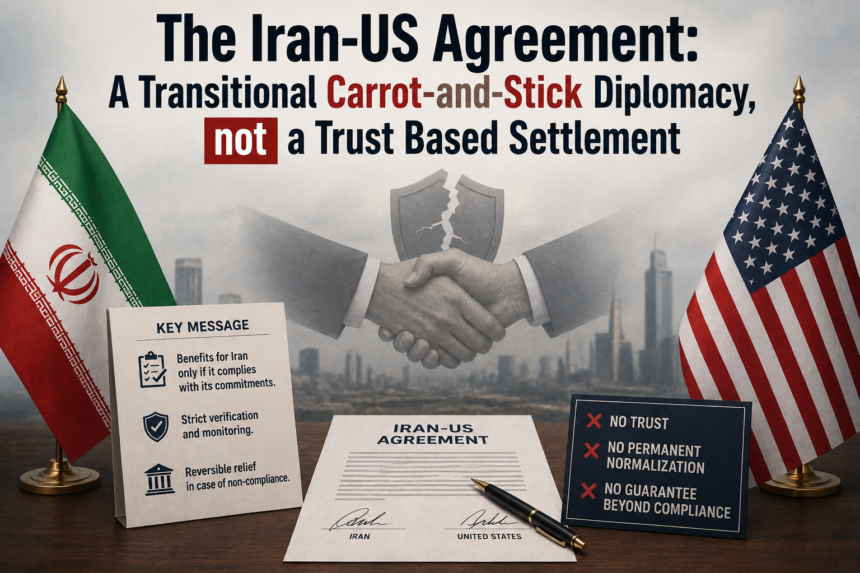

The 14-point Memorandum of Understanding (MOU) ending the US-Iran war seems a structural bet, not a treaty. According to the deal, the US permitted Iran to sell oil again right away and offered to lift sanctions eventually. These concessions were bigger than what Obama’s 2015 nuclear deal gave Iran, with reconstruction and economic development of the country, money that could reach $300 billion.
Nevertheless, the bigger number isn’t the real story. However, the President Trump administration said that this agreement would be “performance-based.” Iran will receive benefits only if it meets its obligations. But this deal does not seem like a partnership that can be built on trust. It’s a system that is built to manage someone they don’t trust.
It helps to compare this to 2015. The idea was that this relief would buy Iran’s long-term cooperation. It didn’t work out that way. Trump pulled the US out of that deal in 2018, Iran stopped following its rules, and by 2025, European countries had reimposed UN sanctions because Iran had stockpiled too much enriched uranium and blocked inspectors.
But why has Iran resumed its nuclear activities? Iran resumed in retaliation for the US departure and for deadly attacks on prominent Iranians in 2020, including one by the US. In the era of President Joe Biden, talks regarding the Joint Comprehensive Plan of Action (JCPOA) were often interrupted by frequent pauses. Countries reached no compromise. Moreover, Iran wanted the JCPOA for relief from international sanctions, which ruined its economy. Research paper titled, Impact of Financial Sanctions: The Case of Iran 2011-2016” discussed this financial crisis, is available at www.federalreserve.gov/pubs/ifdp/.
In early 2016, when the International Atomic Energy Agency (IAEA) approved that Iran had met its initial pledges, the US, EU, and UN suspended their sanctions. The US president Barak Obama’s administration repealed secondary sanctions on the oil sector. The US and many European states also unfroze about $100 billion of frozen Iranian assets.
However, this new deal was signed in different circumstances. Iran has already suffered heavy losses at the hands of the US and Israel. Instead of paying Iran in advance, the relief comes in stages and can be reversed. Iranian media reported around $24 billion in frozen funds tied to the current 60-day window, yet the US disputes that number and says no money moves until Iran actually follows through. Nothing is given away on good faith. So, every dollar will be held back as leverage.
What does Iran’s government actually want? It wants security guarantees and to be treated as a serious regional power, not just a weak and vulnerable state. Iran’s negotiator has already stated that the Strait of Hormuz “won’t go back to how it was before the war” and that Iran will start charging ships a fee to pass through. That’s not a money issue; it’s a power and respect issue. And the hardest question of all, whether Iran gets to keep enriching uranium on its own soil, still hasn’t been settled. It’s been pushed into the next 60 days of talks.
There is one more problem that this whole system only works if the US keeps its word too. And the track record there isn’t great either because the same president offering relief based on phases now is the one who tore up the last deal and brought sanctions back without warning. A system built on mutual incentives only works if both sides actually stick to it.
The MOU between the US and Iran featuring $300 billion for reconstruction and economic development initiatives in Iran has already triggered political turmoil in the US. But this isn’t really about money. It’s an attempt to replace trust with a system because after a war that killed Iran’s own leader, nobody expects the two sides to actually believe each other.
They just need a way to predict what the other side will do next. Whether that holds up for 60 days, let alone for years, is the real question now. So here this agreement seems a transitional carrot-and-stick diplomacy and not a trust based settlement
The author is a senior researcher at CDS and a PhD scholar in Peace and Conflict Studies. Her research focuses on terrorism and extremism. Her work also focuses on peace-based approaches to economic development, growth, and regional cooperation. She also writes on geopolitics, regional security, and global power dynamics.