

Nuzhat Nazar
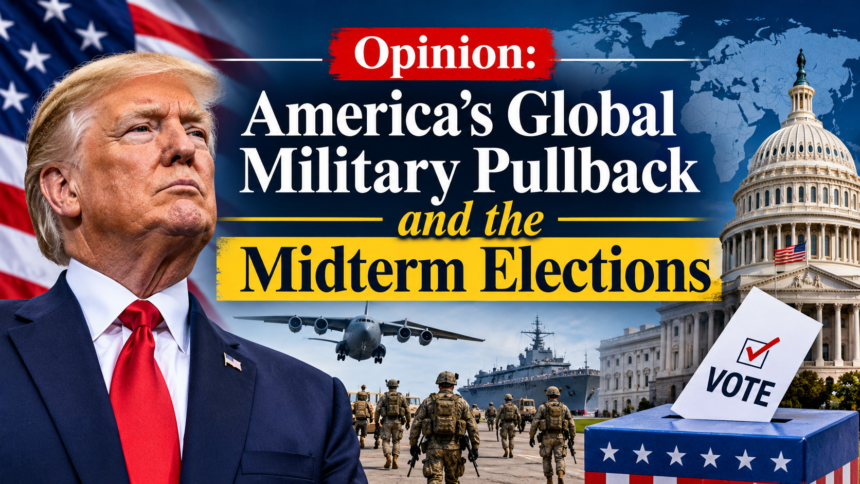
America’s changing military footprint is not just a question of global strategy. It is increasingly becoming a question of domestic politics, particularly as the United States heads into the November 3 midterm elections.
President Donald Trump faces a difficult political balancing act. On one hand, his administration wants to project American military superiority, confront emerging threats and demand greater defence spending. On the other, American voters are increasingly concerned about the cost of living, federal debt and economic security.
This creates a fundamental contradiction in Washington’s approach. How can an administration promise to prioritise America at home while continuing to finance an expensive military presence across the world?
The withdrawal of forces from Iraq and Syria, adjustments to deployments in Europe and a more selective approach to international institutions can be presented as evidence that Trump is delivering on his promise to avoid prolonged overseas commitments.
But the political calculation is more complicated.
If these moves are perceived as strategic efficiency, they could strengthen Trump’s argument that America can remain powerful without bearing the financial burden of policing the world. However, if they are interpreted as a retreat that allows China, Iran or Russia to expand their influence, Democrats could use them to question the administration’s foreign policy leadership.
There is also an important distinction between military spending and military strategy. Reducing permanent deployments does not necessarily mean reducing military expenditure. Washington may instead be shifting towards more technologically advanced, flexible and potentially more expensive forms of warfare.
The midterm elections therefore become an important political test of Trump’s foreign policy. Although voters are likely to focus primarily on economic issues, the administration’s ability to justify its overseas commitments could influence the broader debate over national priorities.
History suggests that great powers rarely lose their influence simply because they close military bases. The greater danger emerges when their international ambitions become disconnected from their economic capacity and domestic political support.
For Trump, the challenge is not merely to demonstrate that America remains the world’s strongest military power. It is to convince American voters that maintaining that power serves their interests.
And perhaps that is the defining question ahead of the midterms: Can Trump sell a smaller overseas military footprint as a stronger America, or will his opponents portray it as the beginning of American decline?
The answer could shape not only the balance of power in Congress but also Washington’s ability to sustain its global strategy during the remainder of Trump’s presidency.