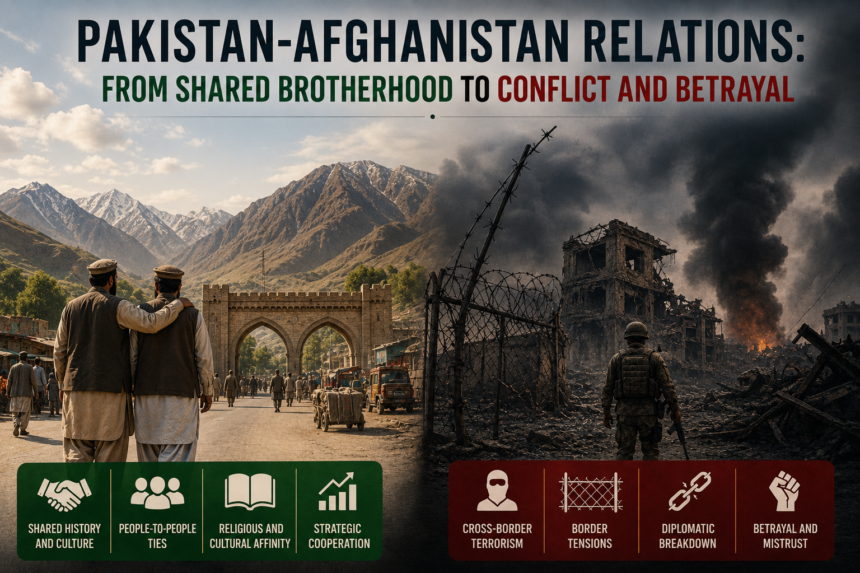

Pakistan’s expectations of improved relations after the Afghan Taliban returned to power in 2021 were undermined by the continued presence and expansion of the TTP and other militant groups operating from Afghan soil
Part Two
9/11 and the Post-9/11 Era
The events of 11 September 2001in the USA fundamentally transformed Pakistan’s security environment. Although Pakistan joined the US-led coalition against terrorism and served as the principal frontline state throughout the two-decade-long War on Terror, it simultaneously found itself under sustained pressure from multiple directions.
While facilitating coalition operations in Afghanistan, Pakistan also became a target of hostile designs emanating from Afghan territory. During this period, Pakistan maintained that India’s intelligence agency, RAW, orchestrated an extensive covert campaign against Pakistan from its network of consulates and intelligence facilities in Afghanistan.
According to Pakistan’s assessment, the two successive US-backed governments in Kabul, supported by the National Directorate of Security (NDS) and in close coordination with several Western intelligence agencies, pursued policies aimed at destabilising Pakistan, fomenting internal unrest, and ultimately weakening its strategic and nuclear capabilities.
Even after the post-9/11 U.S.-led intervention transformed Afghanistan into the epicentre of a prolonged international conflict, Pakistan continued to facilitate peace efforts, supported successive reconciliation initiatives, and played a key role in the negotiations that culminated in the Doha Agreement.
The 2nd Afghan Taliban Regime and the Unravelling of Pakistan–Afghanistan Relations
It was therefore natural that, following the return of the Taliban to power in August 2021, Islamabad hoped that a new era of trust, cooperation and secure borders would finally emerge. Pakistan’s Expectations from the Taliban Government and why those Expectations were not met?
Pakistan was among the first countries to welcome the establishment of the Interim Afghan Government of Haibatullah Akhundzada and consistently advocated constructive engagement with Kabul rather than its diplomatic isolation. Islamabad expected the new leadership to honour its assurances that Afghan soil would not be allowed to be used by any individual or group to threaten the security of another country.
It also anticipated meaningful cooperation in border management, counterterrorism and regional connectivity. However, despite repeated bilateral engagements and high-level exchanges, these expectations gradually gave way to growing frustration as the Tehreek-e-Taliban Pakistan (TTP) not only found sanctuary inside Afghanistan but also expanded its operational capabilities.
Instead of addressing Pakistan’s legitimate security concerns, the Kabul authorities were increasingly perceived in Islamabad as either unwilling or unable to restrain the TTP leadership and dismantle its infrastructure. This marked the beginning of a rapid deterioration in bilateral relations.
Intensified Cross-border Terrorism
From 2022 onwards, the TTP dramatically intensified its cross-border terrorist campaign in Khyber Pakhtunkhwa (KP) and Balochistan. Splinter factions such as Jamaat-ul-Ahrar were reintegrated into the organisation, while separatist groups including the Baloch Liberation Army (BLA), its suicidal wing Majeed Brigade and Baloch Liberation Front (BLF) developed closer operational linkages with the TTP.
These organisations also established contacts with Al-Qaeda, Islamic State of Khurasan Province ( IS-KP) and other militant networks operating from Afghan territory. The recruitment of former Afghan security personnel and other experienced fighters further strengthened their capabilities, while access to abandoned Western military equipment following the withdrawal of U.S. and NATO forces significantly enhanced their operational effectiveness.
How did the Insurgency Expand Geographically and become more Sophisticated?
Armed with sophisticated American-made weapons, advanced satellite communications equipment, night vision devices, thermal imagery and secure sanctuaries across the border, the TTP and its allied groups substantially enhanced their operational capabilities. Their attacks grew in frequency, sophistication and lethality, targeting military cantonments, security installations, public infrastructure and civilians.
Large parts of Southern Khyber Pakhtunkhwa and Southwestern Balochistan emerged as the principal theatres of violence, while terrorist incidents spread across the former tribal districts and several adjoining regions. By 2025 and the first half of 2026, the intensity of terrorism had reached its highest level in years. Suicide bombings, ambushes, attacks on military convoys and railway infrastructure, and attempts to disrupt major communication routes became increasingly common. Use of quadcopters and drones is the latest phenomenon.
In Balochistan, ethnic tensions were deliberately inflamed through targeted killings of non-Baloch settlers, particularly Punjabis, in an apparent effort to deepen social divisions and weaken the writ of the state.
The Internal Facilitators
From Pakistan’s standpoint, the persistence of terrorism was not attributable solely to cross-border sanctuaries. Equally troubling was the existence of facilitators, handlers and sympathisers operating within Pakistan, who provided logistical support, intelligence, recruitment networks and propaganda platforms for militant organisations.
Islamabad also viewed certain political and ethno-nationalist groups as creating political space that indirectly benefited separatist and extremist elements, thereby complicating the state’s counterterrorism efforts and undermining national cohesion. Pashtun Tahafuz Movement (PTM) and Baloch Yekjehti Movement (BYC) became the political faces of the TTP and BLA, respectively.
Through extensive media coverage and favourable portrayal, the Indo-Israeli-Western media amplified the public profile of Dr. Mahrang Baloch, leader of the BYC (actually hailing from the Lango tribe), making her one of the most widely recognised figures in Balochistan.
The Regional Geopolitical Dimension
The deterioration in Pakistan-Afghanistan relations cannot be viewed in isolation from the wider regional geopolitical contest. Following the return of the Taliban to power, several regional and extra-regional actors sought to protect or expand their strategic interests in Afghanistan.
From Pakistan’s perspective, the principal challenge arose from India’s efforts to regain the strategic space it had lost after the collapse of the Ghani government. The Indian intelligence agencies gradually re-established links with elements of Afghanistan’s intelligence apparatus and renewed contacts with anti-Pakistan militant organisations operating from Afghan territory.
This, Pakistan feared, would once again expose it to a two-front security challenge. Pakistan also viewed the growing convergence of interests among India, Israel and certain other external actors with increasing concern. It is believed that these alignments sought not only to contain Pakistan strategically but also to undermine the strategic partnership between Pakistan and China, thereby reinforcing the broader Indo-Pacific strategy designed to counter China’s expanding regional influence.
In Islamabad’s assessment, the objective was to keep Pakistan internally preoccupied through sustained terrorist violence while simultaneously maintaining military pressure along its eastern border. Russia, meanwhile, pursued a different set of strategic objectives.
Concerned about the spread of the IS-KP and the security of Central Asia, Moscow gradually expanded diplomatic and security contacts with Kabul. It also appeared interested in preventing Afghanistan from once again becoming a platform for renewed American military influence in the region, particularly through the strategically important Bagram Air Base.
Iran likewise remained an important factor in the evolving regional equation. While Tehran and Kabul experienced periodic tensions over border management, water rights and the treatment of Afghan refugees, both also recognised the common threat posed by extremist organisations operating in the region.
For Pakistan, maintaining constructive relations with Iran became increasingly important, both to strengthen regional stability and to deny hostile external powers any opportunity to exploit differences among the three neighbouring states. Thus, Afghanistan increasingly became the focal point of competing regional interests, with local security challenges becoming intertwined with broader geopolitical rivalries.
To be continued
The author, Brigadier (Retd) Asif Haroon Raja, SI (M), is a war veteran. He is Command and Staff Course and War Course qualified, holds an MSc in War Studies, and served as Defence Attaché in Egypt and Sudan, as well as Dean of the Corps of Military Attachés in Cairo. He is a defence, security, and geopolitical analyst, columnist, featured columnist of IntelDrop magazine, Washington, author of five books, former Chairman of Thinkers Forum Pakistan, Patron-in-Chief of Centre for Development Studies Think Tank, Director of Meesakh Research Centre; he regularly appears on media platforms.
.