
Nuzhat Nazar
Introduction
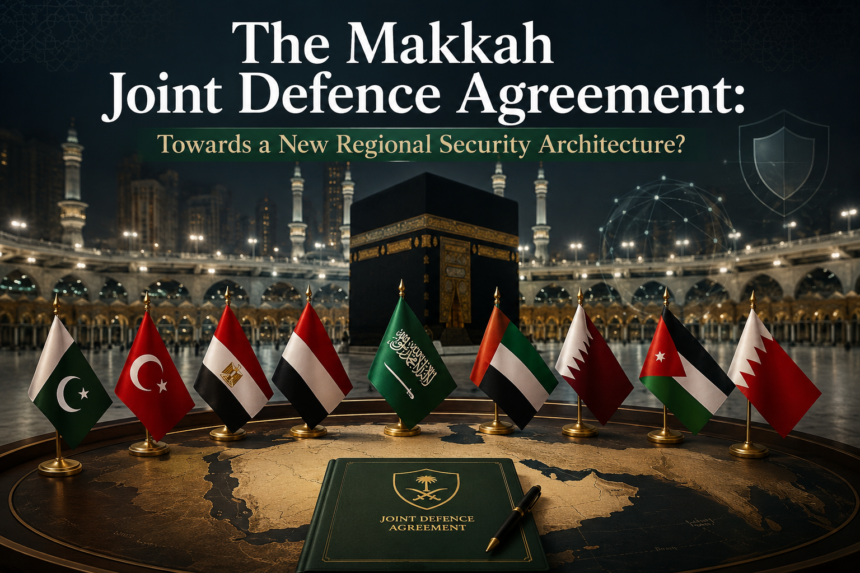
The signing of the Makkah Joint Defence Agreement by Saudi Arabia, Pakistan and Türkiye on 7 August 2026 marks an important development in the evolution of regional security cooperation in the Middle East. Signed during the Makkah Al-Mukarramah Summit for Joint Defence, the agreement commits the three countries to strengthening collective security and defence cooperation while stipulating that an armed attack against one member shall be regarded as an attack against all three.
Collective-defence clauses are not unprecedented in international politics. What distinguishes the Makkah agreement is the strategic profile of its signatories. Together, Pakistan, Saudi Arabia and Türkiye represent significant military capability, growing defence-industrial capacity, economic influence and geopolitical reach across South Asia, the Gulf and the Eastern Mediterranean. More importantly, the agreement formalises decades of bilateral military cooperation into a trilateral strategic framework.
The agreement should therefore not be viewed merely as another defence accord. It reflects a broader shift in regional security thinking, where middle powers are increasingly seeking to complement traditional external security partnerships with indigenous mechanisms capable of protecting shared strategic interests. Whether the Makkah Joint Defence Agreement ultimately develops into a durable regional security architecture will depend not only on political commitment but also on its ability to evolve into an institutional framework supported by military interoperability, defence-industrial integration and sustained strategic coordination.
Why Now?
The agreement emerges against one of the most volatile regional security environments in recent history.
Since the outbreak of the Israel-Gaza conflict in October 2023, the Middle East has experienced an unprecedented series of interconnected crises. Direct military exchanges between Israel and Iran, repeated attacks on maritime shipping routes, disruptions around the Red Sea and the Strait of Hormuz, and the widespread use of drones, ballistic missiles and cyber capabilities have fundamentally changed the character of regional conflict.
These developments have demonstrated that contemporary security threats are no longer confined within national borders. A missile strike, maritime disruption or cyberattack against one state can rapidly affect neighbouring economies, energy markets and regional stability.
At the same time, uncertainty surrounding the long-term security commitments of extra-regional powers has encouraged several Middle Eastern states to strengthen indigenous defence capabilities while pursuing greater strategic autonomy. This does not necessarily imply a departure from existing partnerships with the United States or other global actors. Rather, it reflects recognition that regional powers must increasingly assume greater responsibility for managing their own security environment.
The Makkah Joint Defence Agreement should be understood within this broader strategic transition.
From Bilateral Cooperation to Trilateral Security
Pakistan, Saudi Arabia and Türkiye have each maintained close defence relations for decades.
Pakistan and Saudi Arabia have long cooperated in military training, intelligence coordination and defence dialogue. Pakistan and Türkiye have steadily expanded cooperation in naval modernisation, aerospace, defence production, military education and joint exercises. More recently, Saudi Arabia and Türkiye have deepened defence-industrial cooperation, particularly in advanced technologies and unmanned systems.
Until now, however, these relationships largely remained bilateral.
The Makkah Joint Defence Agreement fundamentally changes that dynamic by placing these existing partnerships within a single trilateral framework. Rather than creating three separate channels of cooperation, it establishes an overarching political structure through which consultation, defence planning and strategic coordination can gradually become institutionalised.
This distinction is significant.
Defence cooperation focuses on collaboration. Collective security establishes shared responsibility.
By formally linking their security interests, the three countries have moved beyond ad hoc cooperation towards a framework that encourages long-term strategic coordination. The agreement therefore represents the institutionalisation of strategic trust rather than simply the expansion of military cooperation.
Whether this framework eventually develops into a more comprehensive regional security architecture will depend upon implementation, but the political foundation has now been established.
Collective Deterrence Rather than Bloc Politics
Perhaps the most debated provision of the agreement is its collective-defence clause.
Comparisons with NATO have emerged almost immediately, largely because both arrangements contain commitments relating to collective security. Such comparisons, however, should be approached with caution.
NATO evolved over more than seven decades through integrated military commands, permanent headquarters, standardised planning procedures, intelligence structures and extensive operational interoperability. None of these institutional mechanisms currently exist under the Makkah Joint Defence Agreement.
Nor does the agreement seek to replicate them.
The official declaration repeatedly emphasises collective security, peace, stability and prosperity rather than confrontation. It does not identify any state as an adversary, nor does it describe the framework as an exclusive military bloc.
Its strategic logic is therefore better understood through the concept of collective deterrence.
Deterrence seeks to discourage aggression by increasing its potential costs rather than preparing for inevitable conflict. By signalling that an attack on one member would carry broader regional consequences, the agreement aims to reduce incentives for coercion while strengthening political solidarity among its members.
This approach also preserves diplomatic flexibility. Pakistan maintains relations with Saudi Arabia, Türkiye, Iran, China and the United States. Saudi Arabia continues to pursue regional de-escalation alongside strategic partnerships with Western powers. Türkiye remains a NATO member while expanding its strategic engagement across the Middle East, Central Asia and Africa.
The agreement therefore reflects a strategy of balancing rather than bloc formation.
The Three Pillars of the Partnership
The strength of the agreement lies in the complementary capabilities of its three members.
Pakistan contributes extensive operational military experience developed through decades of conventional deterrence, counterterrorism operations and strategic planning. It also possesses one of the region’s most experienced armed forces and an established defence manufacturing capability.
Türkiye contributes technological innovation and an increasingly sophisticated indigenous defence industry. Over the past decade, Turkish companies have emerged among the world’s leading producers of unmanned aerial systems, naval platforms, missiles, electronic warfare technologies and advanced aerospace systems. This technological transformation has significantly enhanced Ankara’s strategic influence well beyond its immediate neighbourhood.
Saudi Arabia contributes a different but equally important dimension. As the largest economy in the Arab world and one of the world’s leading defence investors, the Kingdom possesses the financial resources, strategic geography and political influence necessary to sustain long-term defence cooperation. Through Vision 2030, Riyadh is also seeking to localise defence production and reduce dependence on imported military technologies.
These capabilities are complementary rather than competing.
Pakistan provides operational experience.
Türkiye contributes technological innovation.
Saudi Arabia offers financial strength, industrial investment and regional influence.
Together, they create the foundations for a partnership whose long-term significance may extend well beyond traditional military cooperation.
Defence Industrial Integration: The Agreement’s Strategic Centre of Gravity
Although the agreement’s collective-defence clause has attracted immediate political attention, its most transformative impact may emerge through defence-industrial cooperation.
Contemporary warfare has underscored the importance of domestic production capacity. Conflicts in Ukraine and the Middle East have demonstrated that the ability to manufacture drones, missiles, electronic warfare systems and precision-guided munitions is increasingly as important as possessing them. Supply-chain resilience, technological innovation and industrial sustainability have become essential components of national security.
The Makkah Joint Defence Agreement creates an opportunity to combine three complementary strengths.
Türkiye has developed one of the world’s fastest-growing indigenous defence industries, exporting unmanned aerial systems, naval platforms, armoured vehicles and missile technologies to an expanding number of countries. Pakistan possesses established capabilities in aerospace engineering, missile production, defence manufacturing and operational testing under real-world conditions. Saudi Arabia’s Vision 2030 seeks to localise half of its defence expenditure by expanding domestic manufacturing and attracting advanced technologies through international partnerships.
The agreement creates the political framework for these capabilities to converge.
Rather than remaining buyers of defence technology, the three countries could gradually develop an integrated defence-industrial ecosystem encompassing joint procurement, collaborative research, technology transfer, licensed production and co-development of advanced military platforms.
Such cooperation would not only strengthen deterrence but also reduce dependence on external suppliers, enhance industrial resilience and create long-term economic opportunities extending beyond the defence sector.
If institutionalised effectively, defence-industrial integration could become the agreement’s most enduring strategic legacy.
Regional and Global Implications
The Makkah Joint Defence Agreement also carries implications beyond its three signatories.
For the Middle East, it introduces a new model of security cooperation centred on regional ownership rather than exclusive dependence on external powers. This reflects an emerging recognition that many of the region’s contemporary security challenges—maritime security, terrorism, cyber threats, missile proliferation and protection of critical infrastructure—require sustained cooperation among regional actors themselves.
The agreement also reflects the growing importance of minilateralism in international politics. Rather than relying exclusively on broad multilateral organisations, states are increasingly forming smaller partnerships based on shared strategic interests and practical cooperation. Similar approaches can be observed in other regions through frameworks such as AUKUS and the Quad, although their objectives, membership and strategic environments differ substantially from the Makkah framework.
The agreement is also likely to attract close attention from major regional and global powers.
For the United States, it demonstrates that traditional partners are seeking to strengthen indigenous security arrangements while continuing broader strategic relationships with Washington. Rather than replacing existing alliances, the agreement may ultimately complement them by increasing the capacity of regional partners to contribute to their own security.
China is also likely to view the agreement with interest. Beijing has consistently advocated greater regional stability to protect trade routes, energy supplies and Belt and Road investments. A more coordinated regional security framework that contributes to stability would broadly align with those interests, provided it does not intensify geopolitical confrontation.
For Iran, the agreement presents both opportunities and uncertainties. While Tehran will inevitably monitor its military implications, the official text deliberately avoids identifying any adversary and emphasises regional peace and stability. Pakistan’s continued diplomatic engagement with Iran may therefore help ensure that the agreement is viewed as a mechanism for deterrence rather than containment.
India is also likely to assess the agreement carefully. Although the pact is not directed at New Delhi, Pakistan’s formal participation in a broader collective-security arrangement inevitably adds another dimension to South Asia’s evolving strategic environment. Whether this influences regional deterrence will depend largely on how the agreement develops institutionally over time.
From Political Commitment to Strategic Capability
The signing of any defence agreement represents only the beginning of a much longer process.
History suggests that collective-security arrangements derive their credibility not from treaty language but from institutional development.
Several practical questions remain unanswered.
Will the three countries establish permanent strategic consultation mechanisms?
How will intelligence-sharing be institutionalised?
Will joint military exercises evolve into integrated operational planning?
How will emerging threats—including cyberattacks, hybrid warfare, proxy conflicts and attacks by non-state actors—be addressed under the agreement’s collective-security framework?
These questions are not weaknesses of the agreement; they represent the next stage of its evolution.
The agreement has established the political architecture. Its long-term credibility will depend upon building the institutions capable of translating political intent into operational capability.
Conclusion
The Makkah Joint Defence Agreement should not be viewed simply as another defence cooperation accord, nor should it be prematurely characterised as an Islamic equivalent of NATO. It represents something more nuanced: the institutionalisation of a trilateral collective-security framework among three influential regional powers at a time when the Middle East’s strategic landscape is undergoing profound transformation.
Its importance lies not merely in the commitment to collective defence but in the recognition that regional security increasingly requires regional solutions. By formalising strategic cooperation, Pakistan, Saudi Arabia and Türkiye have acknowledged that deterrence, resilience and long-term stability can no longer depend exclusively on external security guarantees. Instead, they have begun constructing a framework based upon complementary capabilities, strategic trust and shared responsibility.
Whether the agreement evolves into a broader regional security architecture will depend upon sustained political commitment, institutional continuity and practical cooperation across military, industrial and diplomatic domains. The framework now exists; its credibility will ultimately be determined by implementation.
This assessment is reinforced by regional strategic experts. Brigadier (Retd.) Ashfaq Hassan argues that the agreement’s most important contribution is the institutionalisation of strategic trust among three countries whose capabilities complement one another. In his assessment, Pakistan contributes military experience and strategic deterrence, Türkiye offers technological innovation and an advanced defence-industrial base, while Saudi Arabia provides economic strength, investment capacity and geopolitical centrality. Rather than viewing the agreement as a “Muslim NATO”, he sees it as the foundation of an evolving regional security framework whose immediate priority should be translating political commitments into practical mechanisms for defence cooperation, intelligence coordination and defence-industrial integration.
A similar conclusion is reached by Dr. Mehmet Özkan, Professor of International Relations at the Turkish National Defence University. He describes the Makkah Joint Defence Agreement as one of the most significant strategic developments in the Middle East since the outbreak of the Israel-Gaza conflict in October 2023. According to Özkan, the agreement marks an important shift in cooperation among Muslim-majority states—from political coordination and economic engagement towards institutionalised security cooperation. He argues that if the framework evolves through defence-industrial collaboration, joint military exercises and a shared strategic outlook, it could establish an important precedent for future regional security cooperation.
The ultimate significance of the Makkah Joint Defence Agreement will therefore not be measured by the symbolism of its signing but by its ability to create durable institutions capable of enhancing deterrence, strengthening regional resilience and promoting long-term stability. If implemented effectively, the agreement may come to be seen not merely as a trilateral defence pact, but as the first substantive step towards a more self-reliant and cooperative regional security order.