

Asif Haroon Raja
Highlights of the War in Yemen
Operation Dawn of Yemen
The Yemeni government forces and the Saudi-led coalition have liberated the world’s most important commercial maritime passage, the Bab Al-Mandab Strait, from the Houthi rebels. Houthis are encircled.
Who Confirmed This Victory?
This is not an ordinary social-media rumour. It has reportedly been confirmed by major international and regional media organisations: Al Arabiya English; Yemen’s official news agency, SABA; Reuters; Arab News; South China Morning Post (SCMP)
How Was This Victory Achieved?
Yemeni President Rashad Al-Alimi announced “Operation Dawn of Yemen” on the morning of 5 October.
According to Yemeni military spokesman Brigadier General Majid Al-Nazili:
*The Giants Brigades and Nation’s Shield Forces launched the ground operation.
*The Saudi-led coalition provided air support with 100 fighter aircraft.
*In 1,122 targeted airstrikes, 364 Houthi vehicles, rocket launchers and weapons depots were destroyed.
*1,747 Houthi fighters were rendered ineffective.
*The Houthis have been completely encircled in Dhubab District and Mayun Island, while government forces are advancing towards Mokha Port.
The First Major Success of the Makkah Accord
This victory is, in fact, the first major practical success of the Makkah Accord. The Accord brought Yemen’s various factions—including the Giants Brigades, Nation’s Shield Forces and Popular Resistance Forces—into a united front.
It was this unity that made an operation previously considered almost impossible possible.
By gaining control of Bab Al-Mandab, the Saudi-led coalition has not only secured an important part of Yemen, but has also helped safeguard one of the world’s most vital maritime trade routes.
The Houthis’ control of this route last month had reportedly caused global oil prices to surge. God willing, peace and stability will now return to the Red Sea.
This is a battle against terrorism and for the protection of global trade and maritime security.
A Wider Strategic Contest Around Bab Al-Mandab
On 4 October, while the Yemen offensive was unfolding, Egypt, Eritrea, Somalia and Sudan held a high-level summit in New Alamein.
The four States have significant differences with Ethiopia over the Red Sea, Nile waters, territorial questions and competing regional interests.
The timing was striking. Renewed fighting in Ethiopia’s Tigray region had reportedly escalated since 23 September, while relations between Ethiopia and Eritrea had deteriorated sharply.
Addis Ababa has accused Eritrea, Egypt and Sudan of supporting an anti-government alliance—allegations that they deny. At the same time, Ethiopia has once again been pressing its demand for access to the Red Sea.
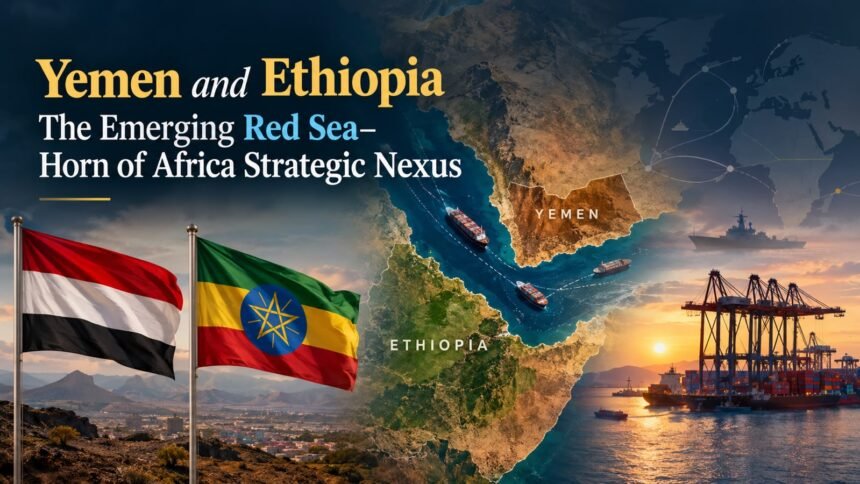
These developments suggest that Yemen and Ethiopia are increasingly becoming interconnected theatres within a broader Red Sea–Horn of Africa strategic contest.
One Strategic Theatre on Both Sides of Bab Al-Mandab
Geographically, the region can be viewed as a single strategic arc:
Saudi Arabia/Yemen → Bab Al-Mandab → Eritrea/Djibouti → Somaliland/Somalia → Ethiopia → Sudan/Egypt.
The two shores of Bab Al-Mandab are therefore strategically inseparable. Developments on the Yemeni side inevitably affect Eritrea, Djibouti, Somalia and Somaliland on the African side, and vice versa.
This has become particularly important because the Houthis have sought to establish leverage over the Bab Al-Mandab and the wider Red Sea maritime route.
The Saudi-backed Yemeni offensive is now attempting to reverse that equation and restore freedom of navigation.
At virtually the same time, Ethiopia has been experiencing renewed internal tensions, while its relationship with Eritrea has deteriorated dramatically.
If the Ethiopian crisis expands into a wider regional confrontation, the consequences could extend well beyond Ethiopia’s borders and affect the security architecture of the entire Horn of Africa.
The Egypt–Eritrea–Somalia–Sudan Factor
One of the most significant developments is the coordination among Egypt, Eritrea, Somalia and Sudan. Their joint call for peaceful solutions to regional conflicts is important because all four have substantial strategic concerns regarding Ethiopia.
Egypt is opposed to what it regards as Ethiopian unilateralism over the Nile and the Grand Ethiopian Renaissance Dam (GERD), while also having a direct interest in Red Sea security.
Eritrea is particularly sensitive to Ethiopia’s renewed interest in Red Sea access, especially because of the strategic importance of its ports at Assab and Massawa.
Somalia opposes arrangements that could undermine its territorial sovereignty, particularly agreements involving Somaliland.
Sudan, despite being consumed by its own devastating civil war, remains strategically important because of its geographical position between Egypt, the Red Sea and the Horn of Africa.
Together, these States could constitute an important regional counterweight to Ethiopia’s expanding ambitions.
Ethiopia’s Search for Sea Access
Ethiopia’s maritime aspirations are rooted in geography. Following Eritrea’s independence in 1993, Ethiopia became landlocked and has since remained dependent on neighbouring States for access to the sea.
Prime Minister Abiy Ahmed has repeatedly emphasised that reliable access to the Red Sea is strategically vital to Ethiopia’s economic and national interests. This explains Addis Ababa’s growing interest in securing maritime access through the Horn of Africa.
However, Ethiopia’s pursuit of such access has generated considerable anxiety among neighbouring countries, particularly Eritrea and Somalia.
Where Does Somaliland Fit In?
Somaliland is another crucial piece of this strategic puzzle. Its coastline lies directly opposite Yemen and along the approaches to the Gulf of Aden and Bab Al-Mandab.
Ethiopia has historically sought maritime access through Somaliland, while Somalia regards Somaliland as part of its sovereign territory.
Consequently, any Ethiopian-Somaliland arrangement involving a military or naval presence has the potential to aggravate tensions between Ethiopia and Somalia.
The issue becomes even more complicated because external powers—including Türkiye, the UAE and Israel—have significant and sometimes competing interests in the maritime geography of the Horn of Africa.
When Israel and the UAE recognised Somaliland, speculation arose that the two countries might seek to use Somaliland as a base for covert operations against the Houthis.
The situation has now potentially been reversed. Under the changed circumstances, Somaliland could instead be used as a logistical or military platform to provide support to the Houthis and strengthen their capacity to confront the Yemeni government and Saudi-backed forces.
Under changed circumstances, Somaliland could theoretically acquire a different strategic utility:
It could become a logistical or military platform for supporting forces operating against the Houthis—or,
conversely, it could become part of a wider contest for influence over the Houthi-controlled side of the Red Sea.
Much would depend upon the policies adopted by Somaliland, Somalia, Ethiopia and external powers.
This Creates an Extraordinary Strategic Triangle:
Ethiopia seeks maritime access → Somaliland offers geographical access → Somalia rejects arrangements that compromise its sovereignty → Egypt and Eritrea remain wary of expanding Ethiopian influence in the Red Sea.
Could Iran Be Behind the Ethiopian Crisis?
This is an area where caution is essential.
There is presently insufficient evidence to conclude that Iran deliberately engineered the Ethiopian crisis to divert attention from the Houthi battlefield.
Nevertheless, from Tehran’s strategic perspective, instability in Ethiopia would certainly complicate the environment confronting Saudi Arabia, Egypt and other states seeking to establish a more secure Red Sea order.
If the Yemen campaign succeeds in pushing the Houthis away from Bab Al-Mandab, pressure on Iran’s ability to use the Red Sea as a strategic lever would increase.
A Simultaneous Crisis on the African Side could:
*Stretch Saudi and Egyptian strategic attention.
*Complicate efforts to secure Red Sea maritime traffic.
*Increase pressure on Eritrea and Djibouti.
*Generate instability around Somaliland and Somalia.
*Complicate Turkish and Saudi regional calculations. And
*Delay the emergence of a stable security architecture around Bab Al-Mandab.
It is therefore more prudent to describe the emerging relationship as strategic convergence rather than proven orchestration.
The Bigger Picture
What may be unfolding is considerably larger than two unrelated conflicts.
The Red Sea–Horn of Africa strategic system is becoming increasingly interconnected and militarised.
Yemen, Sudan and Ethiopia are geographically distinct conflicts, but their consequences converge around the same strategic questions: control of maritime routes, access to the Red Sea, port facilities, regional alliances, energy security and freedom of navigation.
There is also an important strategic irony.
The Makkah Accord, by bringing greater unity to the anti-Houthi camp on the Arabian side of Bab Al-Mandab, may be changing the balance of power around the strait.
At the same time, instability on the African side could create a new set of vulnerabilities.
Therefore, if the objective of the Makkah Accord is ultimately to secure Bab Al-Mandab and the Red Sea, Saudi Arabia, Türkiye and Pakistan cannot afford to view Yemen in isolation. They will have to closely monitor developments in Eritrea, Ethiopia, Somalia, Somaliland, Sudan and Egypt.
My Assessment
The emerging strategic picture can be summed up as follows:
“The battle for Bab Al-Mandab is no longer confined to Yemen. It is gradually becoming a struggle over the entire Red Sea–Horn of Africa strategic complex.”
If Ethiopia’s internal conflict expands into a wider confrontation involving Eritrea, Egypt, Sudan and Somalia, the African shore of Bab Al-Mandab could become as strategically important as the Yemeni shore.
The future of the Red Sea may therefore be determined not merely by what happens in Yemen, but by how the competing powers manage the increasingly interconnected security equations of the entire Red Sea–Horn of Africa region.
About the Author
Brigadier (Retd) Asif Haroon Raja, SI (M) is a war veteran. He is Command and Staff Course and War Course qualified, holds an MSc in War Studies, and served as Defence Attaché in Egypt and Sudan, as well as Dean of the Corps of Military Attachés in Cairo. He commanded the largest brigade in Kashmir.
He is a defence, security, and geopolitical analyst, columnist, featured columnist of IntelDrop magazine Washington, author of five books, former Chairman of Thinkers Forum Pakistan, Patron-in-Chief of Centre for Development Studies Think Tank, Director of Meesakh Research Centre; he regularly appears on media platforms.