
Asif Haroon Raja
A Strategic Turning Point at Bab Al-Mandab
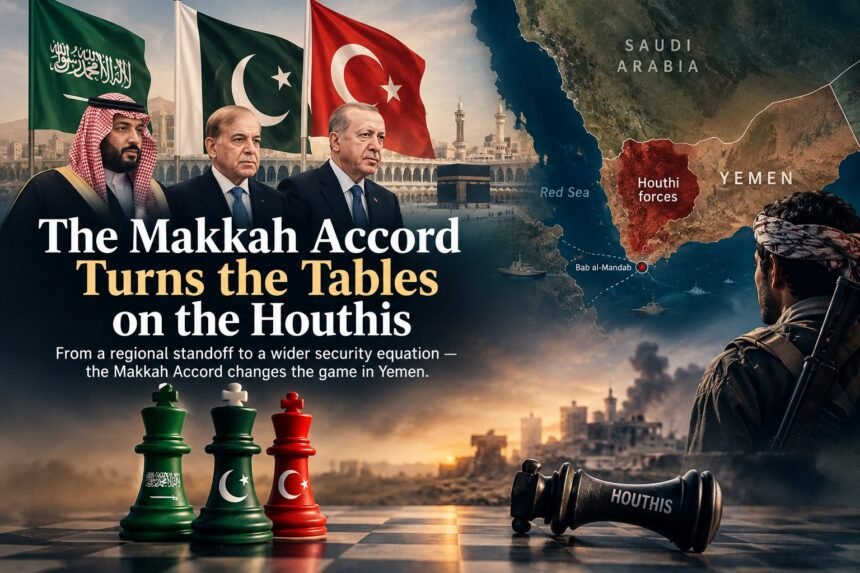
The strategic situation in Yemen appears to have entered a decisive new phase. The trilateral Makkah Accord between Pakistan, Saudi Arabia and Türkiye has begun translating from a political and security framework into concrete strategic action.
Significantly, this has been achieved without the physical deployment of Pakistani, Saudi or Turkish ground troops into Yemen.
The reported launch of Operation Fajrul Yemen on 5 October marks a potentially important turning point. The operation was initiated by Yemeni government forces while the Makkah Accord partners were meeting in Riyadh.
According to reports, the ground offensive was conducted under intensive air cover provided by the Royal Saudi Air Force, with approximately 100 fighter aircraft striking Houthi positions in and around the islands adjoining the strategic Bab Al-Mandab waterway. Sana’a, Saada and Taiz were also targeted.
The reported destruction of hundreds of Houthi targets, including missile and drone launch sites, military vehicles and other military infrastructure, has severely disrupted the Houthis’ ability to threaten maritime traffic through this vital choke point.
Reports of large Houthi casualties, including thousands of fighters trapped in the confined island areas, indicate the intensity of the operation. The remaining Houthi elements have reportedly been given the choice of surrendering or facing destruction.
Bab Al-Mandab: The Strategic Prize
The significance of Bab Al-Mandab cannot be overstated. Connecting the Red Sea with the Gulf of Aden and the wider Indian Ocean, the waterway is one of the world’s most important maritime choke points.
Any sustained Houthi ability to threaten shipping there has consequences extending far beyond Yemen.
The control or effective denial of Bab Al-Mandab provides enormous strategic leverage. It can disrupt international trade, increase shipping and insurance costs, threaten energy supplies and force commercial vessels to undertake much longer routes around the Cape of Good Hope.
The reported reversal of the Houthi position around the waterway therefore represents more than a battlefield setback. If sustained, it could amount to a major strategic defeat for the Houthi movement and its external sponsors.
Iran’s Strategic Dilemma
The developments also create a difficult dilemma for Tehran. When Islamabad previously urged Iran to restrain the Houthis, Tehran maintained that it had no direct control over the movement.
Yet Iran has long regarded the Houthis as an important component of its regional network of influence. The loss of Houthi leverage over Bab Al-Mandab would consequently represent a significant strategic setback for Iran.
Tehran had considerable interest in maintaining pressure on the United States and its regional partners through the second major maritime choke point after the Strait of Hormuz, while simultaneously imposing economic and strategic costs on Saudi Arabia.
The weakening of the Houthi position therefore reduces Iran’s ability to employ Yemen as a pressure point against both Saudi Arabia and Western maritime interests.
The Makkah Accord’s First Major Test
The emerging Yemeni developments could become the first major practical demonstration of the Makkah Accord’s strategic utility.
The importance of the arrangement lies precisely in its ability to generate military effects without requiring the three partners to introduce their own ground forces into another country’s civil war.
Saudi Arabia provides decisive air power; Türkiye contributes its growing regional strategic weight and defence capabilities; Pakistan provides diplomatic, political and potentially wider security support.
Yemeni government forces, meanwhile, remain the principal ground instrument. Reportedly arms, equipment and technical support had been transported to Aden from Riyadh before the start of the operation.
This division of roles potentially offers the coalition a sustainable model: local forces conduct the ground fighting while regional partners provide the capabilities, coordination and strategic backing required to change the balance of power.
The Next Battle: Taiz and Sana’a
The Houthis, having suffered setbacks around Bab Al-Mandab, appear to be shifting their focus towards Taiz. The battle for Taiz could therefore become the next critical phase of the campaign.
Taiz occupies considerable strategic importance because of its geographical position and its influence over routes linking Yemen’s western and southern regions.
According to Yemeni security and military sources, Ansarallah (Houthi) forces have seized the Al-Safiya area and cut the main road linking Taiz and Aden.
The development has effectively encircled Taiz, Yemen’s third-largest city, which had remained connected to Aden through this vital supply route.
Reports say traffic on the road has been halted and fighting is continuing in the area. The Houthis have also reportedly captured the nearby strategic town of Al-Turbah, further restricting the ability of government-aligned forces to reinforce or resupply positions around Taiz. The battlefield situation is rapidly changing.
If the Yemeni government forces succeed in consolidating their gains around Bab Al-Mandab and subsequently break the Houthi position around Taiz, the military pressure on the movement’s heartland would increase substantially.
The ultimate strategic objective would inevitably be Sana’a. However, capturing and holding the capital would be considerably more difficult than securing isolated positions around Bab Al-Mandab.
The Houthis retain deep-rooted political, tribal and military networks, and any attempt to dislodge them from their principal stronghold could produce prolonged resistance.
The campaign should therefore not be judged solely by the initial battlefield successes. The real test will be whether the coalition can convert tactical gains into durable territorial control and a sustainable political settlement.
A New Strategic Equation
If the reported developments are confirmed and sustained, the strategic equation in Yemen has indeed changed dramatically.
The Houthis had previously exploited geography, asymmetric warfare, missiles and drones to impose costs on a much stronger coalition.
The Makkah Accord appears to have introduced a different equation: coordinated regional power, local Yemeni ground forces and concentrated air superiority.
The immediate objective is to neutralise the Houthi threat to Bab Al-Mandab. The broader objective, however, is potentially much larger: to dismantle the Houthis’ capacity to operate as a strategic proxy, restore the Yemeni government’s authority over the country’s vital maritime approaches and prevent Yemen from becoming a permanent platform for threatening regional and international shipping.
Future Prospects
The coming weeks will determine whether Operation Fajrul Yemen becomes a tactical success or the beginning of a fundamental transformation of the Yemeni conflict.
The Houthis may respond through asymmetric attacks, missile and drone strikes, guerrilla warfare or attempts to widen the conflict.
The coalition will therefore need to combine military pressure with diplomacy, humanitarian considerations and a credible political roadmap for Yemen. A purely military victory without a political settlement could create another cycle of instability.
Nevertheless, the reported developments around Bab Al-Mandab suggest that the Houthis may have lost an important strategic advantage. The dice appear to have turned against the Houthis and, by extension, against those who have relied upon them as a regional instrument of pressure.
If the Makkah Accord partners maintain unity and momentum, Yemen could be entering a new phase—one in which the strategic initiative has shifted decisively from the Houthis to the Yemeni government and its regional partners.
End Note: The sudden eruption of a civil war in Ethiopia might have a connection with the developments in Yemen. My assessment on the new development will be published by tomorrow.
About the Author
Brigadier (Retd) Asif Haroon Raja, SI (M) is a war veteran. He is Command and Staff Course and War Course qualified, holds an MSc in War Studies, and served as Defence Attaché in Egypt and Sudan, as well as Dean of the Corps of Military Attachés in Cairo. He commanded the largest brigade in Kashmir.
He is a defence, security, and geopolitical analyst, columnist, featured columnist of IntelDrop magazine Washington, author of five books, former Chairman of Thinkers Forum Pakistan, Patron-in-Chief of Centre for Development Studies Think Tank, Director of Meesakh Research Centre; he regularly appears on media platforms.