
By Rimsha Saleem
With a fragile ceasefire nearing collapse and oil markets already on edge, Pakistan finds itself navigating a crisis it did not create but cannot escape. As the April 22 deadline for the current de-escalation window approaches, the recent diplomatic engagements by the Chief of Army Staff, General Asim Munir, in Tehran signal a shift toward a more proactive, military-led mediation.
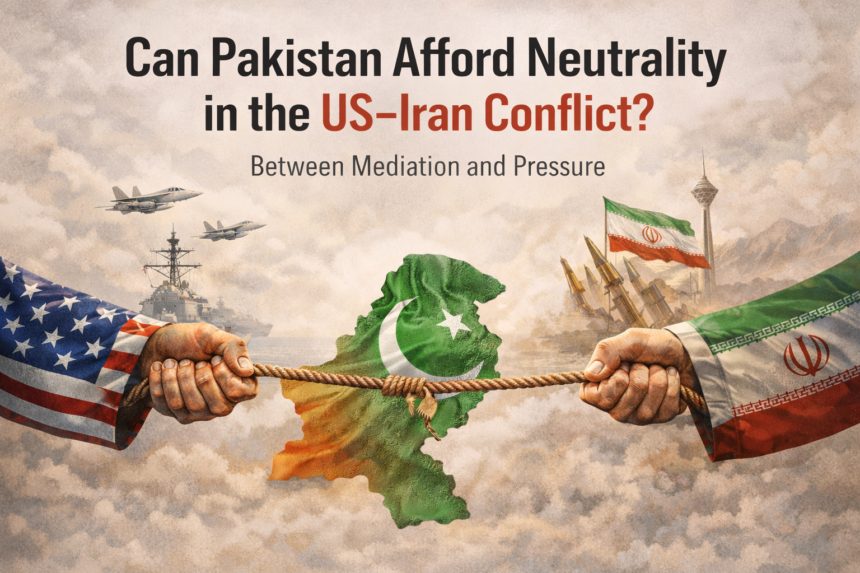
For a country navigating a delicate economic recovery under the structural oversight of international lenders, the question of whether Pakistan can afford neutrality is no longer about choosing a side. It is about managing the consequences of a regional volatility that threatens to undo years of fiscal stabilization. That is the risk.
Neutrality, in the Pakistani context, is often misunderstood as a passive withdrawal from regional disputes. In practice, however, it functions as a diplomatic circuit breaker, a necessary mechanism to prevent a regional conflagration that would effectively paralyze the domestic economy.
This “active neutrality” requires Islamabad to serve as a high-stakes courier, translating the rigid security requirements of Washington into a framework that respects the strategic sensitivities of the Iranian leadership. In an era where the Strait of Hormuz has become a theater for maritime brinkmanship, the directness of a backchannel has become the only currency that retains its value. When formal diplomatic protocols stall, the military-to-military link remains the last line of defense against total escalation.
The primary challenge to this stance lies in Pakistan’s competing alignments, a geopolitical reality that offers very little margin for error. The United States remains a foundational partner, particularly in the economic sphere, where its influence over global financial institutions is a prerequisite for Pakistan’s fiscal stability.
Simultaneously, Iran is a neighbor with whom Pakistan shares a sensitive border and deep-rooted cultural ties. To lean too far in either direction is to invite a crisis: either financial strangulation from the West or a permanent security nightmare on the western frontier. There is also the uncomfortable reality that Pakistan’s mediation may matter less to the eventual outcome than it does to its own survival.
The economic dimension of this conflict adds a layer of moral urgency to Pakistan’s mediation. As a net importer of energy, Pakistan is among the most vulnerable to the oil shocks triggered by disruptions in global supply routes. For the average citizen already grappling with historic inflation, the “strategic” nuances of the US–Iran standoff are felt most acutely at the petrol pump and in electricity bills.
This is the human cost of a failed mediation. If the ceasefire expires without an extension, the resulting surge in energy prices would jeopardize the internal social contract. In this sense, Pakistan’s diplomatic efforts are not merely about regional prestige; they are a direct attempt to shield a vulnerable population from the fallout of a distant confrontation. And the margin for error is thin.
A critical insight into this role suggests that Pakistan’s mediation is less about the luxury of choice and more about the diplomacy of constraint. Islamabad is not intervening as a global superpower seeking to project its values, but as a pivotal state seeking to protect its own jugular vein.
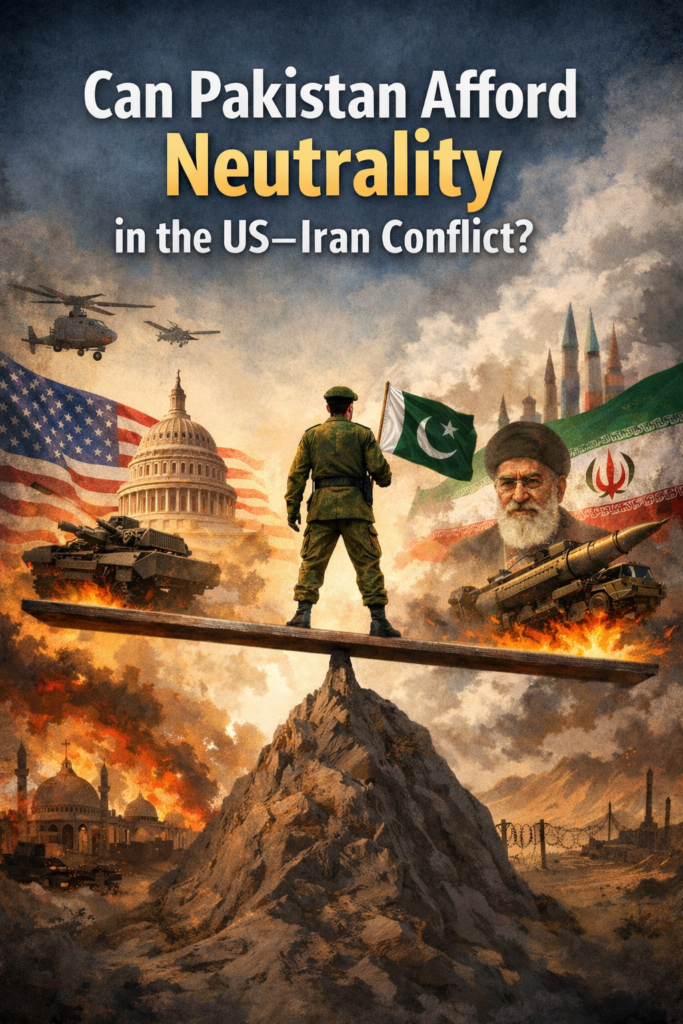
By leveraging its unique dual-access, communicating with both the Pentagon and the Iranian security apparatus, Pakistan is reclaiming a strategic relevance that ensures it remains “too pivotal to ignore.” This is a high-wire act of sovereignty practiced under immense external pressure, where the mediation process itself becomes the primary tool for maintaining regional equilibrium.
The risks associated with this path are substantial. There is a persistent danger of “neutrality fatigue” among global allies who may eventually view mediation as a stalling tactic rather than a solution. Furthermore, the internal management of such a policy is complex, requiring a careful balance of domestic public opinion and sectarian sensitivities.
Should the mediation fail to produce a tangible reprieve, Pakistan faces the prospect of being blamed for the impasse by both protagonists. Balancing the demands of a Washington that holds the keys to financial survival against a neighbor that can influence internal security is a brutal, exhausting task. One miscalculation, and the bridge that Islamabad has painstakingly built could collapse.
However, the opportunities for Pakistan’s foreign policy are equally significant. If Islamabad can facilitate even a temporary extension of the de-escalation window, it demonstrates that mid-tier powers can shape global outcomes through persistent, nuanced engagement. This is not about idealistic regional leadership; it is about cold, hard survival and the pursuit of a predictable neighborhood. By aligning its efforts with other regional stakeholders, including the Gulf states, which also fear an unchecked escalation, Pakistan is weaving itself into a new, more integrated regional security architecture.
In the final analysis, the question is not whether Pakistan can afford neutrality, but whether it can afford the alternative. A total commitment to one camp would invite immediate and devastating blowback from the other. Pakistan is effectively trapped in a state of “forced mediation,” serving as the only consistent voice for de-escalation in a room defined by maximalist rhetoric. The COAS’s mission in Tehran is an exercise in the art of a professional, calculated effort to ensure that common sense prevails before the next spark. Whether this diplomacy of necessity will be enough to prevent a regional storm remains the defining question of the hour. In a region defined by brinkmanship, Pakistan’s neutrality is not a position of comfort; it is a necessity forged under pressure, where even success carries a cost.
Rimsha Saleem is a researcher at the Centre for Development and Stability (CDS)