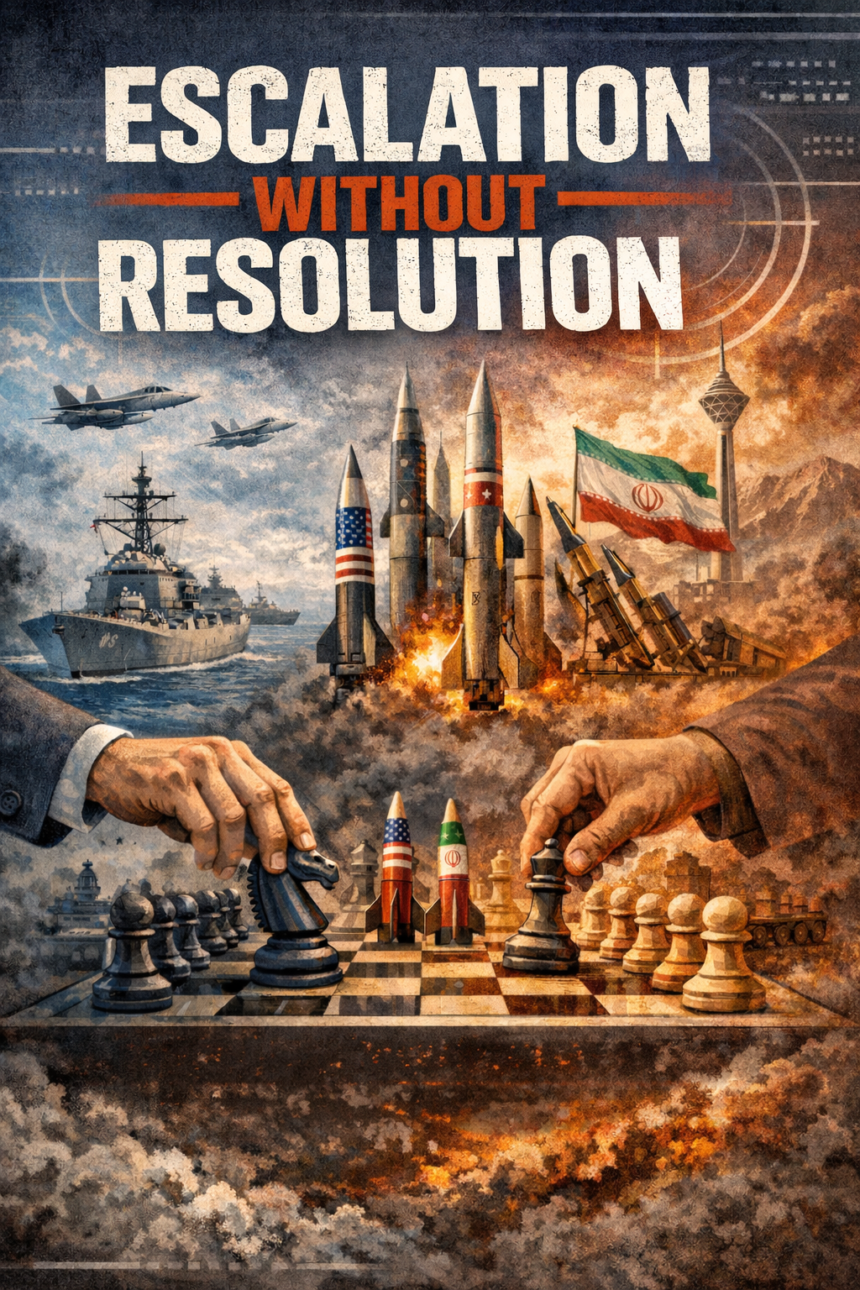

With a naval blockade tightening in the Gulf and missile batteries shifting across Iran, the US–Iran standoff is no longer moving toward resolution; it is being deliberately sustained. It is a fragile, high-stakes ceasefire that feels less like a prelude to peace and more like a choreographed performance of strategic intent. As the April 22 deadline for the current de-escalation window draws near, it is clear that this conflict isn’t being driven by a desire for finality. Instead, it’s being managed through a complex language of signals; a state of perpetual brinkmanship where military posture has effectively replaced political decision-making.That is the illusion of control.
In the modern geopolitical theater, signaling has emerged as the primary currency of power. It is the art of moving a carrier strike group or conducting a missile test not necessarily to start a war, but to draw a line in the sand. For the United States, expanding its naval presence and calibrating economic pressure are more than just punitive measures. They are tactical sentences meant to convey the costs of regional defiance. Conversely, Iran’s drone repositioning and maritime maneuvers serve as counter-arguments. The objective for both sides is deterrence through display keeping the opponent off-balance without crossing into a full-scale conflagration.
This reliance on signaling suggests a fundamental shift in how 21st-century regional friction is conducted. We are no longer in an era defined by grand, irreversible strategic decisions that lead to a total “win” or “loss.” The political and human costs of a full-scale war are simply too high for the White House, just as the risk of systemic instability is too great for Tehran. At some level, this is not conflict management, it is conflict avoidance dressed as strategy.
Consequently, both sides have settled into a pattern of “controlled escalation.” They are managing the tension rather than resolving the grievances behind it. This isn’t a failure of diplomacy, but a pragmatic replacement of a landscape where the positioning of a destroyer carries more weight than the drafting of a treaty.
For the average person in the region, however, this “managed” tension is far from an abstract policy exercise. In Pakistan, the fallout of this signaling is felt in the volatility of energy markets and the relentless pressure on the national economy. When maritime blockades expand, global oil markets react instantly, driving up costs that manifest as inflation in local markets. The human cost is a state of permanent economic uncertainty. We are living in a neighborhood where the “signals” sent by global powers are often paid for by vulnerable populations in the form of rising fuel prices and diminished purchasing power.
Pakistan’s role as a mediator in this environment is uniquely challenging. Islamabad is more than just a messenger; it is the “connective tissue” in a conflict driven by indirect communication. By keeping the channels open between the Pentagon and the Iranian security apparatus, Pakistan provides the necessary context to these military maneuvers. Without a neutral interlocutor to clarify intent, a routine missile test or a naval repositioning could easily be misread as a casus belli. General Asim Munir’s direct diplomacy in Tehran is a pragmatic effort to ensure that the signals being sent are actually understood as intended. And that is where it becomes dangerous.
There is a profound risk in sustaining a conflict through signaling rather than decisions. The margin for error is razor-thin. When a conflict is managed through military posturing, a single technical malfunction or a mid-level commander’s misjudgment can trigger an escalation that neither leadership intended. History is often shaped by “accidental” wars started by signals that were misread. In the current climate, the signaling provides the appearance of control, but it is a stability that can be disrupted by a single spark in the Persian Gulf.
One must consider whether this state of affairs represents a deliberate strategy of leverage or a simple lack of political appetite for finality. To make a decision whether it is full military engagement or a comprehensive diplomatic settlement requires a commitment to an outcome that is politically risky. Signaling, by contrast, allows both leaderships to maintain their domestic standing while avoiding the catastrophic consequences of an actual war. It is a method of deferring the inevitable, hoping that the other side will eventually blink. But as the strategic stakes rise, the road for such deferment is narrowing.
From a different perspective, one could argue that signaling is actually a sophisticated form of contemporary conflict management. By allowing both sides to project strength through calibrated military displays, the signaling process may act as a pressure valve, preventing the build-up of the kind of tension that leads to total war. In this view, the naval blockade and the missile tests are a “war of symbols” that satisfies the need for posture without the need for casualties. It is a skeptical interpretation of stability, but in a region defined by maximalist rhetoric, it might be the only form of equilibrium currently available.
The reality for Pakistan remains one of strategic vulnerability. Islamabad cannot afford the luxury of viewing this conflict as a symbolic game. As a mid-tier power with a sensitive border and a fragile economy, Pakistan has to live with the tangible consequences of these signals. Every time the naval blockade expands, Pakistan’s strategic space shrinks. Every time Tehran repositions its assets, Pakistan’s western flank becomes more volatile. The mediation effort is, therefore, an act of sovereign self-defense. We are mediating because we are the most exposed to the noise.
As we look toward the expiration of the ceasefire, uncertainty remains the defining characteristic. The US–Iran conflict has settled into a “managed tension” state that appears designed to persist. Both sides have mastered the art of the signal, but neither seems willing to undertake the heavy lifting of a final decision. This ambiguity is not a temporary phase; it is becoming the new normal. We are entering an era where regional peace is not the absence of conflict, but the successful management of its symbols.
Ultimately, the visit of the COAS to Tehran serves as a reminder that the world still requires the human element to navigate military noise. While Washington and Tehran may communicate through carrier groups and drone positioning, the risk of a misread signal remains an existential threat to regional peace. Pakistan’s mission is to ensure that these signals do not become a self-fulfilling prophecy of war. In a region defined by brinkmanship, Pakistan’s neutrality is not a position of comfort it is a necessity forged under pressure, where even success carries a cost. Ambiguity may be the new normal, but it is a normal that carries a heavy price for those caught in the middle. And in a conflict governed by signals, the greatest risk is that one of them is finally taken at face value.
Author: Rimsha Saleem
A writer with a keen interest in people, ideas, and the forces shaping everyday life, with a focus on thoughtful and grounded analysis.