
(By: Nuzhat Nazar)
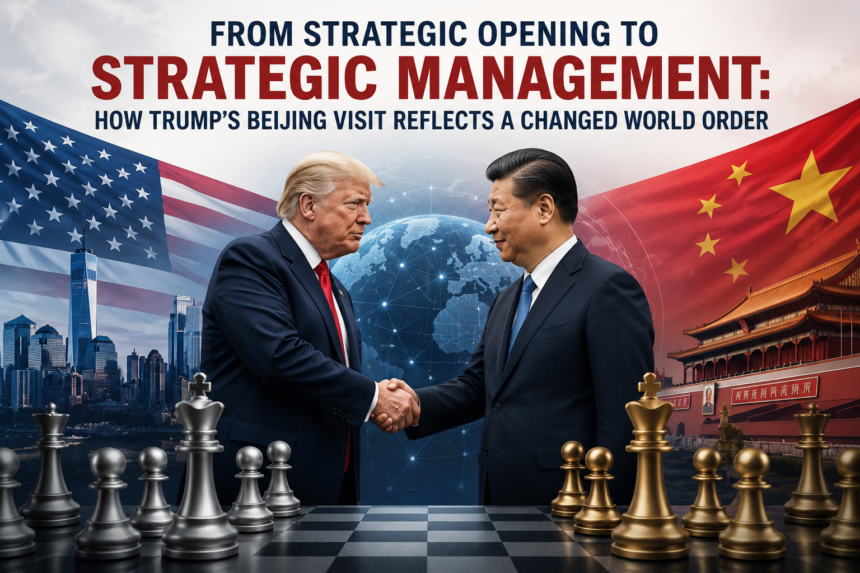
Donald Trump’s latest visit to Beijing was important not because it transformed US-China relations, but because it exposed how fundamentally those relations have changed over time.
When former US President Richard Nixon travelled to China in 1972, the objective was historic rapprochement. The United States wanted to pull China closer to the Western camp against the Soviet Union, while Beijing sought diplomatic legitimacy and an escape from international isolation. That visit reshaped the Cold War balance and opened the door for China’s integration into the global economic system.
Trump’s 2026 Beijing visit carried a completely different purpose.
This was not a journey aimed at opening relations. It was an effort to prevent the world’s most consequential bilateral relationship from slipping into uncontrolled confrontation.
That distinction matters because it reflects the transition from an American-led unipolar world to a far more competitive and fragmented international system.
In Nixon’s era, China was the weaker side seeking access, technology and recognition. Today, Beijing hosts American presidents from the position of a global economic and technological power capable of directly challenging Washington’s influence in trade, manufacturing, artificial intelligence, energy corridors and international diplomacy.
The atmosphere surrounding the latest summit reflected that shift clearly.
Unlike earlier decades where optimism shaped US-China engagement, the current relationship is defined by strategic caution. The language of cooperation still exists, but beneath it lies deep mistrust over Taiwan, semiconductors, cyber security, military influence in the Indo-Pacific and the future structure of the global economy.
This also marks a major departure from Xi Jinping’s own 2015 visit to Washington during the Obama administration.
At that time, both countries still publicly believed economic interdependence could stabilize the relationship. Despite disagreements over cyber espionage and trade imbalances, the dominant framework remained cooperation mixed with competition. Business ties, investment flows and supply chains were viewed as anchors preventing strategic breakdown.
A decade later, those same economic links are increasingly viewed through a national security lens.
Trade is now tied to geopolitical leverage. Technology competition has become central to statecraft. Artificial intelligence, semiconductor controls and industrial supply chains are no longer simply commercial issues; they are instruments of strategic power.
That is why the Trump-Xi summit produced limited concrete breakthroughs despite its massive diplomatic visibility.
The significance of the visit lay less in agreements and more in the message both sides attempted to send: competition will continue, but neither side currently wants escalation.
This became even more important because the summit unfolded during heightened tensions in the Middle East and uncertainty surrounding Iran and the Strait of Hormuz. Global markets were watching closely for signs that instability could further disrupt energy flows, shipping routes and already fragile supply chains.
In this context, Beijing and Washington appeared less like ideological rivals and more like competing powers trying to prevent simultaneous geopolitical and economic crises.
China, in particular, used the summit to project an image of strategic composure. Beijing’s messaging consistently emphasized predictability, dialogue and long-term stability. For China, this was not only about America; it was also directed toward global markets and developing countries seeking stability in an increasingly polarized world.
Trump, meanwhile, approached the engagement more transactionally, focusing on trade balances, economic concessions and practical understandings. The contrast highlighted a broader reality: China increasingly presents itself as a long-term systemic actor, while American diplomacy under Trump continues to operate around tactical bargaining and immediate outcomes.
Perhaps the clearest indication of how much the relationship has evolved was the level of institutional suspicion visible even during engagement. Reports surrounding heightened cyber security precautions and strict communication protocols during the visit reflected a relationship where dialogue continues, but trust has eroded significantly. Yet despite these tensions, both countries still recognize a central geopolitical truth: neither can afford direct confrontation.
The United States understands that economic decoupling from China carries massive global costs. China understands that prolonged instability with Washington could damage its economic ambitions and international positioning. This mutual vulnerability is now shaping a new phase of global diplomacy.
Unlike the Cold War, the US and China are not separated by isolated economic blocs. They remain deeply interconnected even as they strategically compete. This creates a far more complicated international environment where rivalry and cooperation coexist simultaneously.
That is why Trump’s Beijing visit should not be viewed as a breakthrough summit in the traditional sense.
It was something far more revealing.
Nixon’s visit symbolized the beginning of engagement between two countries that needed each other strategically. Trump’s visit symbolized the emergence of a world where two competing superpowers may no longer trust each other, yet still need each other enough to avoid collapse.
That may ultimately define the next phase of the international order.