
Institutional Paralysis, Geopolitical Fragmentation, and the Erosion of Normative Legitimacy
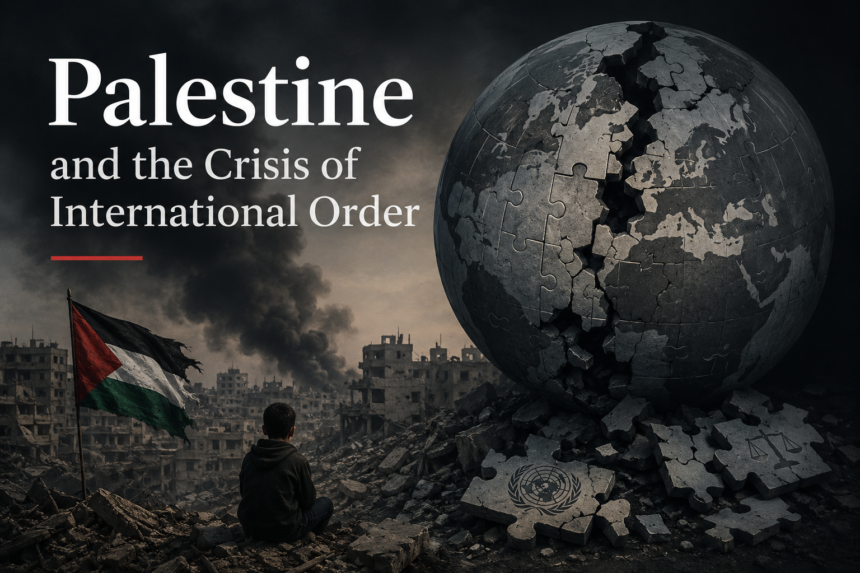
The escalating violence, widespread displacement, and profound civilian suffering in Palestine present an acute humanitarian crisis that commands urgent global attention. Beyond the immediate devastation, however, the prolonged conflict has evolved into a structural test case for contemporary international order. The systemic shockwaves extending from the Gaza Strip do not merely threaten regional stability; they directly challenge the operational assumptions of global governance. The conflict functions as a diagnostic mirror, reflecting the widening fractures within international systems. Consequently, the crisis in Palestine exposes the structural limitations of international institutions, challenges the enforcement credibility of international law, and signals a deeper crisis of legitimacy within the rules-based global order.
The historical roots of the Palestine question are inextricably linked with the evolution of the post-Second World War international architecture. For decades, the unresolved status of Palestinian statehood has persisted as a legacy of incomplete decolonization and competing nationalist frameworks, resisting numerous diplomatic iterations from the Oslo Accords to subsequent multilateral initiatives. This endurance is not merely regional; the issue retains a unique capacity to polarize global politics because it intersects with critical maritime trade routes, global energy security, and the strategic alignment of Middle Eastern powers. By remaining unaddressed, the conflict continuously injects instability into transnational networks, ensuring that localized escalations inevitably compel responses from external state actors.
This persistent volatility directly undermines the normative framework of international humanitarian law. Recent hostilities have intensified debates surrounding the protection of non-combatants, proportionality in state self-defense, and the accessibility of vital humanitarian corridors. While international legal bodies including the International Court of Justice and the International Criminal Court have been mobilized to assess compliance and accountability, a stark perception gap has emerged between established legal principles and practical enforcement mechanism realities. This divergence creates a corrosive precedent where international law is increasingly viewed not as a universal standard, but as an instrument applied selectively based on geopolitical alignment. The resulting erosion of confidence extends far beyond the immediate theater, weakening the compliance pull of international law globally.
These legal frictions are compounded by deep geopolitical divisions among the world’s major powers, which effectively stymie unified diplomatic action. The United States continues to navigate a complex balancing act, shielding historic regional partnerships while managing the systemic fallout of regional escalation on its broader containment strategies. Conversely, China has utilized its diplomatic positioning to advocate for immediate ceasefires and a comprehensive two-state solution, leveraging the crisis to project itself as a pragmatic mediator and expand its influence across the developing world. Russia’s response seeks to capitalize on Western diplomatic vulnerabilities, positioning the conflict as evidence of flawed unipolar leadership. Meanwhile, the European Union remains fragmented, with member states split between historic responsibilities and contemporary security priorities, preventing a cohesive continental posture.
This major-power fragmentation directly paralyzes the machinery of global governance, most visibly within the United Nations Security Council. The frequent exercise of the veto power has resulted in an institutional deadlock, preventing the enforcement of binding resolutions and rendering multilateral diplomacy largely ineffective. This paralysis exposes a fundamental structural flaw: the mechanisms designed to maintain international peace and security are structurally dependent on a great-power consensus that no longer exists. As the United Nations is repeatedly seen as incapable of intervening decisively to protect civilian populations or enforce its own mandates, the structural credibility of global governance suffers a profound setback, accelerating a shift toward minilateralism and fragmented security arrangements.
For the Global South, and Pakistan in particular, the impasse carries significant strategic and normative implications. The Palestine issue resonates deeply across developing nations as a symbol of historical injustice and systemic double standards within the international hierarchy. Pakistan has consistently maintained a principled diplomatic stance, anchored in UN Security Council resolutions, advocating for a viable, independent Palestinian state based on pre-1967 borders with Al-Quds Al-Sharif as its capital. The perceived failure of the international community to resolve this crisis reinforces a broader skepticism within the Global South regarding the fairness of global institutions, intensifying calls for a democratization of international decision-making bodies.
To mitigate this systemic decline and address the immediate crisis, the international community must pivot toward structural reforms. This requires transitioning from unilateral mediation toward expanded, inclusive contact groups that integrate key regional stakeholders and major powers from the Global South to ensure balanced diplomatic pressure. Additionally, establishing institutional mechanisms within the United Nations to decouple humanitarian access from Security Council political consensus is vital to prevent the weaponization of vetoes during acute civilian crises. Finally, supporting the independent verification mechanisms of international judicial bodies without geopolitical interference remains essential to reinforce the universal application of international humanitarian law.
Ultimately, the crisis in Palestine is no longer just a localized territorial dispute; it is an active deconstruction of the post-Cold War institutional consensus. The systemic inability to secure a sustainable political settlement reflects the broader decay of international legitimacy, where power politics increasingly eclipses normative rules. If the international order remains paralyzed, the future of conflict resolution will shift irreversibly toward raw power projection and unchecked unilateralism. Restoring stability in Palestine is therefore essential not only for regional peace, but for rescuing the foundational credibility of global governance itself.