
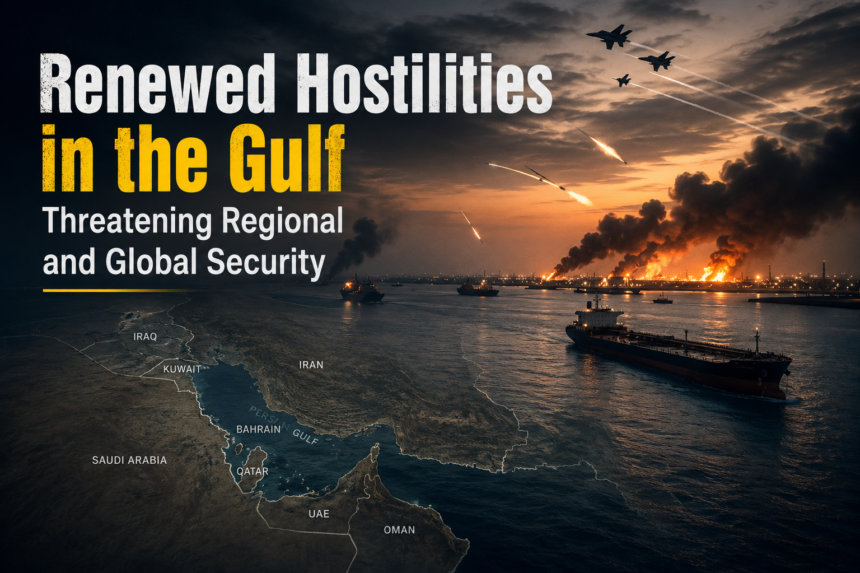

The article argues that the collapse of the U.S.–Iran agreement has reignited tensions in the Gulf, with the Strait of Hormuz once again becoming the main flashpoint. It highlights how failed diplomacy, strategic rivalries, and renewed military confrontation threaten regional stability, global energy security, and the international economy.
Part One
Asif Haroon Raja
Signing of the Memorandum of Understanding
Field Marshal Syed Asim Munir and Prime Minister Shehbaz Sharif worked tirelessly to bring the United States and Iran to the negotiating table. Their first initiative culminated in a summit in Islamabad in April 2026.
Although that effort failed to produce an agreement, sustained diplomatic engagement, supported by Qatar, eventually paved the way for a second round of negotiations in Switzerland.
The talks concluded with the signing of a 14-point Memorandum of Understanding (MoU) on 17 June 2026. The agreement sought to establish technical working groups to resolve the most contentious issues and to arrive at a mutually acceptable settlement within two months.
Short-Lived Euphoria
The signing of the MoU generated widespread optimism. The international community welcomed the agreement as a significant diplomatic breakthrough, particularly after months of escalating confrontation between Washington and Tehran.
Brokered by Pakistan and Qatar, the accord raised hopes that a wider regional war had been averted.
The prolonged closure of the Strait of Hormuz had severely disrupted global energy supplies, shipping routes, and international markets, making an early resolution economically imperative.
The optimism, however, proved short-lived. Within days, the painstakingly negotiated agreement began to unravel, disappointing its principal mediators.
Pakistan, despite its considerable diplomatic investment, has for the time been compelled to step back as tensions once again escalated.
Hormuz Once Again Becomes the Flashpoint
Control of the Strait of Hormuz has once again emerged as the central point of contention, with neither side willing to compromise.
Iran has repeatedly declared the strategic waterway to be a non-negotiable red line central to its national security.
Geographically, Iran dominates the northern approaches to the Strait of Hormuz, while Oman controls the southern approaches through the Musandam Peninsula.
Although the Strait is an international waterway governed by the principle of transit passage, Iran’s geographical position, control of strategically located islands, and deployment of coastal missile systems, naval assets, and asymmetric capabilities provide it with significant leverage over one of the world’s most critical maritime choke points.
This strategic advantage enables Iran to influence the security environment of the Gulf and impose substantial strategic and economic costs on any adversary seeking unrestricted access through the Strait, particularly during periods of heightened regional tension.
Maritime navigation follows designated shipping lanes jointly regulated under international arrangements, although the strategic significance of the waterway has made it a persistent source of military friction.
Both Washington and Tehran accuse each other of violating the provisions of the MoU.
Even before the agreement could gain momentum, Iran reportedly intercepted or attacked three cargo vessels from Saudi Arabia, Qatar, and another Gulf State transiting the Strait on 27 June, alleging that they had deviated from the prescribed navigation corridor.
The Collapse of Diplomacy
A closer examination suggests that diplomacy steadily lost ground to strategic calculations.
While Israel appeared determined to prolong military confrontation with Iran, Tehran maintains that it was ultimately Washington’s actions that reignited the conflict.
Iran claims it exercised restraint despite provocative statements made by President Donald Trump during the funeral of Supreme Leader Imam Ali Khamenei.
According to Tehran, it remained committed to implementing the MoU, but viewed Washington’s rhetoric as evidence that the United States was unwilling to honour either the spirit or the letter of the agreement at a time when Iranian public sentiment was deeply emotional and demands for retaliation were widespread.
Convinced that Washington lacked genuine commitment to the agreement, Iran declared the 14-point MoU null and void.
Its collapse has once again placed regional stability and the global economy in jeopardy.
The United States has reportedly reinstated its naval blockade, while Iran has reimposed restrictions on maritime traffic through the Strait of Hormuz.
The Gulf has once again become a geopolitical powder keg. Unless urgent diplomatic efforts succeed in reversing the current trajectory, the region could slide into a far broader and more destructive conflict.
Fears and Strategic Aspirations
The roots of the present crisis stretch back several decades. Following the 1979 Islamic Revolution, the United States supported Iraq during the Iran-Iraq War, viewing revolutionary Iran as a challenge to the existing regional order.
The prolonged conflict weakened both countries and created conditions that enabled Israel to destroy Iraq’s Osirak nuclear reactor in 1981.
During this period, Saddam Hussein was portrayed in much of the Western media as an unpredictable regional aggressor.
After Iraq’s invasion of Kuwait in 1990, the Gulf monarchies welcomed a large-scale American military deployment, allowing the United States to establish a long-term military presence across the region.
Washington successfully capitalised on Arab security concerns, further strengthening its strategic footprint.
By highlighting the perceived Iranian threat and the broader Sunni-Shia rivalry, the United States consolidated military partnerships with Gulf States, while becoming the principal supplier of advanced weaponry to the region.
From Iran’s perspective, however, the development of strategic relationships with armed groups in Lebanon, Syria, Iraq, Gaza, and Yemen has been driven not only by ideological affinity but also by its perception of an expanding Israeli military threat.
Tehran regards these alliances as a forward defence strategy designed to deter external aggression and counter what it considers Israel’s expansionist ambitions.
The Role of the Spoilers
Israel remains the dominant military power in the Middle East and continues to pursue policies that many critics describe as expansionist.
Consequently, its adversaries argue that enduring regional peace will remain elusive unless the underlying political disputes are addressed.
Similarly, India under the BJP has been described by its critics as pursuing an assertive nationalist agenda, with references to the concept of Akhand Bharat frequently featuring in political discourse.
The growing strategic partnership among the United States, Israel, and India reflects converging geopolitical and security interests.
Critics argue that all three have, at different times, been willing to employ coercive policies to advance their strategic objectives and have been accused of selectively interpreting international law and United Nations resolutions.
To be concluded
About the Author
Brigadier (Retd) Asif Haroon Raja, SI (M) is a war veteran. He is Command and Staff Course and War Course qualified, holds an MSc in War Studies, and served as Defence Attaché in Egypt and Sudan, as well as Dean of the Corps of Military Attachés in Cairo.
He is a defence, security, and geopolitical analyst, columnist, featured columnist of IntelDrop magazine Washington, author of five books, former Chairman of Thinkers Forum Pakistan, Patron-in-Chief of Centre for Development Studies Think Tank, Director of Meesakh Research Centre; he regularly appears on media platforms.