
Rimsha saleem
Security Council paralysis and bloc politics reveal a collapsing global order, leaving middle powers vulnerable.
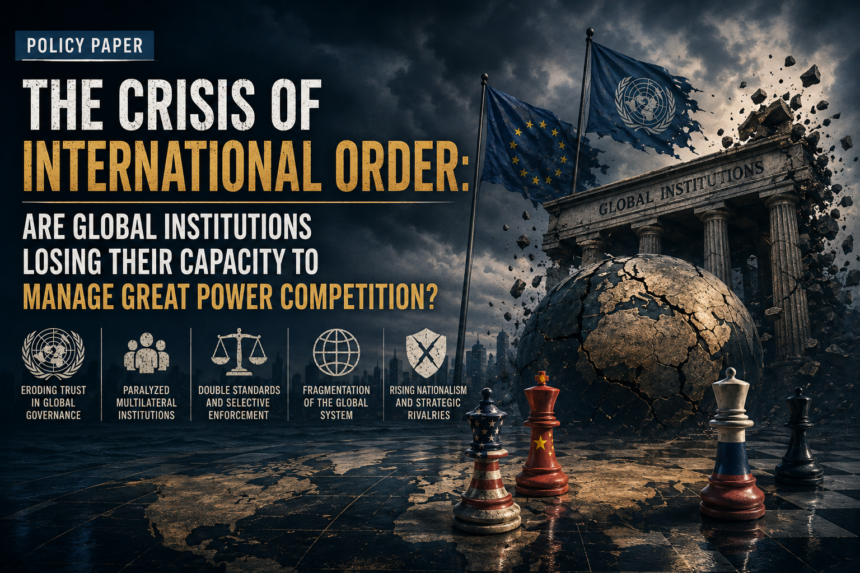
The contemporary international system is experiencing a profound structural crisis, characterized by the visible erosion of institutional architecture designed to maintain global peace and security since the end of the Second World War. The simultaneous escalation of conflicts across West Asia, Europe, and the Indo-Pacific has exposed a deep deficit in the authority of multilateral organizations. The United Nations, once envisioned as the foundational anchor of collective security, increasingly finds itself reduced to a diplomatic arena for rhetorical sparring rather than an effective mechanism for conflict resolution, raising urgent questions about whether today’s international institutions are structurally obsolete in an era of resurgent great power competition.
The core vulnerability of the current liberal international order lies in the paralysis of its primary decision-making organs, most notably the United Nations Security Council. The structural design of the Council—built upon the veto power of five permanent members—was premised on the assumption that a baseline of consensus among great powers was achievable on matters of global survival. However, as the structural rivalry between the United States, China, and Russia deepens into systemic confrontation, the veto has been continuously deployed to shield client states and validate unilateral actions. This institutional paralysis has transformed the Council into a reactive body, capable of passing rhetorical resolutions but structurally unable to enforce compliance, deter aggression, or protect vulnerable populations in active conflict zones.
In response to the paralysis of universal multilateral institutions, the global governance landscape is fracturing into a complex network of monoliteral arrangements and exclusive regional blocs. Forums such as the G7, NATO, AUKUS, and the Quad on one side, and the expanded BRICS grouping and the Shanghai Cooperation Organisation on the other, are increasingly functioning as parallel diplomatic and security architectures. While these smaller groupings offer their members enhanced agility and greater ideological alignment, they inherently accelerate the polarization of the international system. Bilateralism treats global governance not as a collective endeavor, but as a zero-sum exercise in coalition-building, further undermining the legitimacy of universal norms and international law.
This structural fragmentation inflicts a disproportionate cost on developing and middle powers, who rely on the predictability of a rules-based international order to defend their sovereignty and advance their development. In a world where institutional guardrails are failing, international relations revert to a classic realist matrix where power dictates outcomes, and international law is applied selectively. The erosion of global norms regarding territorial integrity, maritime freedom, and non-proliferation leaves smaller states highly vulnerable to external coercion, forcing them to divert scarce national resources away from human development, climate adaptation, and poverty alleviation toward defensive militarization and costly security alignments.
For Pakistan, a country historically integrated into the multilateral system, this institutional crisis requires a sophisticated, multi-directional diplomatic posture. Islamabad cannot afford to retreat into isolation or tie its geopolitical fate exclusively to a single competitive bloc. Pakistan must continue to champion the relevance of universal multilateral forums, utilizing its diplomatic capital within the UN framework to advocate for equity, international law, and structured conflict resolution. At the same time, Islamabad must deepen its functional engagement with emerging regional bodies like the SCO and expand its institutional footprints within forums like BRICS, ensuring that it retains a voice in the alternative governance structures that are being built to challenge the traditional Western-led architecture.
Reclaiming the capacity for global governance requires a fundamental shift away from the illusion of a return to the post-Cold War status quo toward a realistic model of multi-polar management. The universal institutions of the mid-twentieth century cannot survive without structural reforms that reflect the contemporary distribution of demographic and economic power, particularly through the expansion of permanent representation for underrepresented regions. Great powers must recognize that unmitigated systemic competition without basic institutional guardrails is a recipe for catastrophic systemic failure. The primary challenge of our time is not to defeat an adversary within the existing order, but to collectively construct a flexible, inclusive multilateral framework capable of managing great power rivalry before institutional collapse gives way to total systemic conflict.