
By Nuzhat Nazar
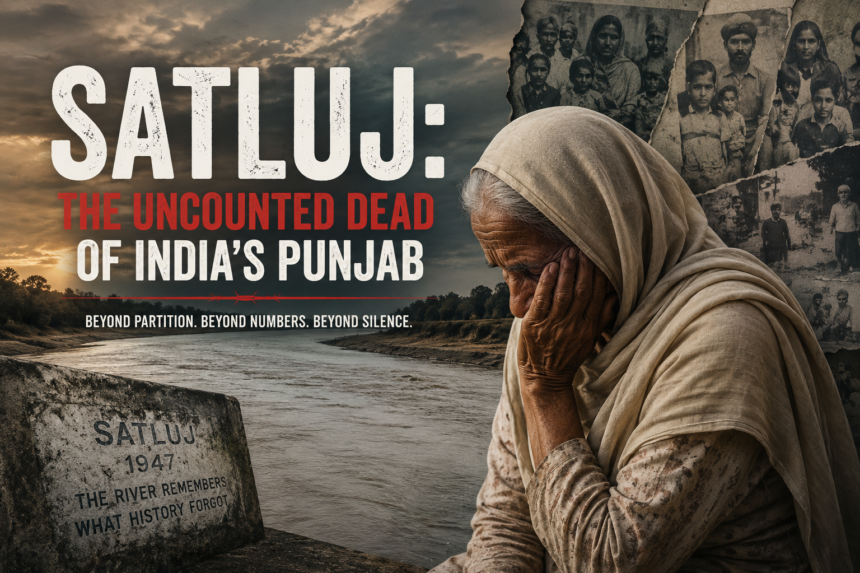
Satluj is not about the politics of Khalistan. It is about human rights, truth and accountability. By revisiting documented allegations of enforced disappearances, extrajudicial killings and illegal cremations in India’s Punjab, the film raises a fundamental question: can a democracy claim to uphold human rights while suppressing scrutiny of one of the darkest chapters in its own history?
The counterinsurgency in India’s Punjab during the 1980s and 1990s remains one of the darkest and least examined chapters of independent India’s history. Long before Satluj became the subject of a censorship controversy, the questions at the heart of the film had already haunted thousands of families: Who disappeared? Who ordered the killings? Who protected the perpetrators? And how many victims never entered any official record at all?
To understand this tragedy, it is necessary to understand the historical context in which the Khalistan movement emerged. The demand for Khalistan did not arise in isolation, nor can it be reduced to one explanation. It evolved over decades of political, economic and religious grievances among sections of India’s Sikh community, including concerns over federal autonomy, river-water sharing, linguistic and cultural identity, and the implementation of key provisions of the 1973 Anandpur Sahib Resolution. For many Sikhs, these were questions of representation, dignity and constitutional rights within the Indian Union.
The overwhelming majority of Sikhs pursued their grievances through political, constitutional and democratic means. However, by the late 1970s and early 1980s, a smaller armed separatist current had also emerged, advocating an independent Sikh homeland. As that insurgency escalated, India’s Punjab state witnessed assassinations, bombings and attacks on civilians, while New Delhi responded with an increasingly militarised counterinsurgency campaign.
The crisis reached a defining moment in June 1984 with Operation Blue Star, when the Indian Army entered the Golden Temple complex in Amritsar to remove armed separatists. Although the operation achieved its immediate military objective, it left a profound wound on Sikh religious sentiment worldwide. Months later, Prime Minister Indira Gandhi was assassinated by her Sikh bodyguards, triggering anti-Sikh violence in Delhi and several other cities in which thousands of Sikhs were killed. For many Sikhs, those events deepened the perception that justice was uneven and state protection conditional.
The central question, however, is not whether India faced a security challenge. It did. The question is whether the state remained within the limits of law while confronting that challenge. A democracy has the right to protect its citizens from armed violence, but it does not have the right to disappear people, torture suspects, stage unlawful killings or erase bodies from the record.
According to Human Rights Watch, counterinsurgency operations in Punjab between 1984 and 1995 involved arbitrary detention, torture, extrajudicial execution and the enforced disappearance of thousands of Sikhs. In numerous cases, young Sikh men were detained on allegations of links to separatist militancy, while their families were later told they had never been taken into custody.
It was in this environment that Jaswant Singh Khalra’s work assumed historic significance. He was neither a politician nor an armed figure. He was a human-rights activist who followed records. Working alongside Jaspal Singh Dhillon, he examined official cremation-ground registers and uncovered evidence suggesting that the Punjab Police had secretly cremated numerous individuals as “unidentified” or “unclaimed.” His investigation suggested that many families had been denied even the most basic right: to know what had happened to their loved ones.
The numbers themselves expose the limitations of the official narrative. The CBI’s sealed investigation identified 2,097 illegal cremations at just three cremation grounds in Amritsar district of India’s Punjab state — then only one of the state’s thirteen districts. Khalra himself had spoken of more than 6,000 suspicious cremations in Amritsar alone. Human Rights Watch also cited testimony from cremation-ground workers indicating that, on some occasions, multiple bodies were cremated using the quantity of firewood normally required for a single body.
That is the question Satluj revives. If more than 2,000 illegal cremations emerged from a limited official inquiry covering only part of one district, what about those who never appeared in any register? What happened in the remaining districts of India’s Punjab? How many custodial deaths were officially recorded as “encounters”? How many families spent decades searching for sons they were told had gone abroad when, in reality, they may never have left police custody?
The tragedy was not only the loss of life. It was also the systematic erasure of identity. A son became an “unidentified body.” A father became an “unclaimed corpse.” A citizen became an “encounter.” Once a human being is reduced to an administrative label, accountability becomes easier to evade. Families are left without answers, without graves and often without closure.
The gravity of the allegations eventually reached India’s Supreme Court, which transferred the mass cremations case to the National Human Rights Commission after the CBI inquiry disclosed what it described as “flagrant violations of human rights on a mass scale.” Yet the inquiry remained limited, focusing largely on specific cremation grounds in Amritsar district. It acknowledged part of the tragedy but left broader questions about the scale of abuses, institutional responsibility and the chain of command unanswered.
Khalra understood what was at stake. His investigation challenged not merely individual police officers but the official memory of the state itself. He had transformed grief into documentary evidence. Shortly after making his findings public in 1995, he was abducted and never seen alive again. Years later, Punjab Police officials were convicted for his abduction and murder. Yet the broader questions he raised have never been comprehensively answered.
That is why the controversy surrounding Satluj matters. The film is not sensitive simply because it tells the story of one man. It is sensitive because it asks how many lives were erased, how much truth remains buried, and why a history documented in court proceedings, official investigations, human-rights reports and family testimony continues to provoke censorship decades later.
Its reported removal from ZEE5 within roughly forty-eight hours only deepens those questions. For India, this is no longer merely a debate about cinema. It is a test of democratic confidence. Democracies strengthen themselves not by suppressing uncomfortable chapters of history but by confronting them openly. A state that speaks of human rights internationally must also allow scrutiny of alleged human-rights violations within its own borders.
The point is not to adjudicate the politics of Khalistan, nor to cast an entire community through the lens of militancy. The point is more fundamental: no democracy can claim moral authority while leaving mass allegations of enforced disappearance, illegal cremation and extrajudicial killing unresolved.
Khalra’s enduring legacy is that he did not build his case on rhetoric. He built it on records. He demonstrated that even when bodies disappear, documents can preserve the truth. If more than 2,000 illegal cremations emerged from a limited official investigation, the number of those whose names never entered any official record may represent an even deeper historical wound.
History has a way of resurfacing, no matter how long it is suppressed. Records survive. Families remember. Court files remain. Cinema gives those memories a new audience. Satluj therefore represents more than a film; it reflects an unresolved chapter in India’s democratic journey. Whether that chapter is confronted through transparency or obscured through censorship will shape not only how the past is remembered, but also how future generations judge the resilience of India’s democratic institutions.
Nuzhat Nazar is a journalist and strategic affairs analyst with more than ten years of experience reporting on foreign policy, defence, and economic developments. Based in Islamabad, she focuses on geopolitics, regional security dynamics, and Pakistan’s positioning in a shifting global order.