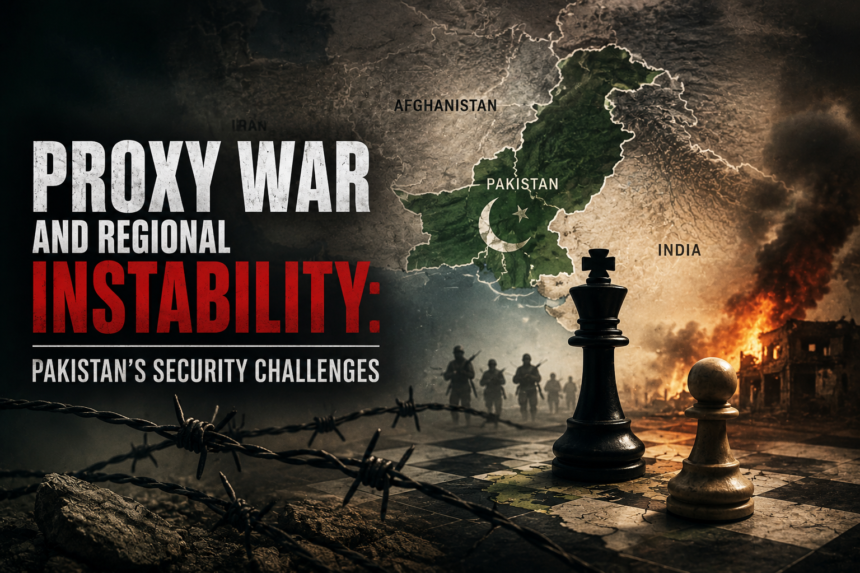

Pakistan faces an increasingly complex security environment shaped by proxy warfare, regional instability, and great-power competition. It emphasizes that Pakistan’s long-term security depends not only on military strength but also on balanced diplomacy, national unity, economic resilience, intelligence-led counterterrorism, and regional cooperation. The author concludes that by avoiding external conflicts, strengthening internal stability, and pursuing a balanced foreign policy, Pakistan can counter hybrid threats and contribute to peace and stability in South Asia and the Middle East.
Part Three
Asif Haroon Raja
The Middle East at the Crossroads of a Wider War
The renewed military confrontation between the United States and Iran is pushing an already volatile Middle East towards a dangerous tipping point.
Since early July, missile and drone exchanges have intensified, increasing the risk of a broader regional conflict with potentially grave consequences for global peace, energy security and the international economy.
In response to US strikes against Iranian military, energy and transportation infrastructure, reportedly launched from American military facilities in several Gulf Cooperation Council (GCC) States, Iran’s Islamic Revolutionary Guard Corps (IRGC) has retaliated by targeting US military installations across the region.
A notable feature of the current conflict is the relative restraint shown by both Iran and Israel in engaging each other directly.
Most reported Iranian strikes have focused on American military assets in the GCC States rather than Israeli territory. Iran has also avoided striking the US naval armada deployed closer to the Persian Gulf.
Israel has largely relied upon intelligence operations and covert activities instead of overt military engagement. Israel’s aggressive acts are focused on Lebanon and Gaza.
Iran warned that any attack on its critical infrastructure—including power generation, energy facilities or water systems—would invite massive retaliation capable of disrupting essential services throughout the Gulf region.
Iranian officials also cautioned countries hosting American military bases against facilitating further attacks, asserting that they possess an extensive list of strategic targets.
In response to continued US military operations, Iran threatened to disrupt maritime trade routes, including the Bab al-Mandab Strait, potentially through allied groups such as the Houthis.
Any prolonged disruption of this vital shipping lane would severely affect global energy supplies and international commerce.
The Gulf monarchies, while maintaining close security relations with Washington, are increasingly concerned that further escalation could draw them directly into the conflict despite their recent efforts to improve relations with Tehran.
Domestically, Iranian public opinion has hardened following recent events, strengthening the resolve of the country’s leadership to sustain resistance despite mounting military and economic pressures.
Meanwhile, Israel has reiterated that it will respond forcefully to any direct Iranian attack, while persistent reports continue to circulate regarding efforts aimed at political destabilisation and possible regime change inside Iran. The continuation of cross fire between the US and Iran suits Israel, which is anti-peace.
Any collapse of ongoing peace efforts between Saudi Arabia and the Houthis could widen the conflict further. A closure of the Bab al-Mandab Strait or disruption of maritime traffic would carry serious strategic implications for the wider region.
President Trump’s diplomatic outreach to Iraq’s newly elected President Ali Zaidi, reportedly aimed at countering Iranian influence, and his engagement with Syrian leader Ahmed al-Sharaa to support Israel’s efforts against Hezbollah in Lebanon, risk broadening the regional conflict and drawing additional actors into the confrontation.
Pakistan in a Quandary
Pakistan consequently finds itself in a delicate strategic position. Its longstanding defence commitments with Saudi Arabia, coupled with its traditionally cordial relations with Iran, require Islamabad to pursue an exceptionally balanced foreign policy that avoids military entanglement while promoting regional stability.
The uncertainty surrounding the conflict has already contributed to heightened volatility in global financial markets, rising oil prices and growing concerns over the security of international supply chains.
China’s Response
China’s Concerns
China has sharply criticised the United States, accusing Washington of pursuing interventionist policies that have contributed to instability in several regions of the world.
Beijing argues that excessive reliance on military alliances, sanctions and coercive diplomacy has undermined rather than strengthened international peace and security.
These exchanges reflect the broader strategic rivalry between China and the United States over the future global order.
Washington’s Perspective
The United States rejects such accusations, maintaining that its forward military presence protects allies, preserves freedom of navigation and deters regional aggression.
At the same time, the United States has accused China and Russia of providing Iran with intelligence on military targets, adding another dimension to the already complex geopolitical confrontation.
Nevertheless, critics of American foreign policy contend that prolonged military interventions and regime-change policies have often generated instability instead of durable peace.
The Calculus of Regional Spoilers
India and Israel are carefully monitoring developments in the Middle East, recognising that prolonged regional instability could reshape the strategic balance across Asia.
From Pakistan’s perspective, both countries would prefer Islamabad to become militarily embroiled in any widening conflict involving Saudi Arabia, Iran or the Houthis, thereby diverting Pakistan’s strategic attention and resources.
Avoiding such a scenario remains one of Pakistan’s foremost national security priorities.
Pakistan’s Diplomatic Challenge
The evolving regional crisis underscores the urgent need for proactive diplomacy led by the Muslim world.
Pakistan, working closely with Saudi Arabia, Türkiye, Iran, Qatar and other influential regional actors, is well placed to facilitate dialogue and confidence-building measures aimed at preventing a wider regional war.
Recent diplomatic engagements by Pakistan’s leadership, including high-level contacts with Türkiye and other friendly countries, together with indications from senior US officials favouring renewed negotiations, provide a window of opportunity that should be fully exploited before the conflict reaches an irreversible stage.
Both warring parties have once again been given signals to resume negotiations and the peace process, with a proposed two-week ceasefire aimed at preventing the conflict from escalating into a full-scale war.
Meanwhile, Iran’s Interior Minister is visiting Islamabad at the invitation of his Pakistani counterpart, underscoring the continued engagement between the two neighbouring countries.
Conclusions
Pakistan today confronts one of the most complex security environments in its history.
It simultaneously faces externally sponsored proxy warfare, hybrid threats, cross-border terrorism and an increasingly volatile regional geopolitical landscape stretching from South Asia to the Middle East.
The country’s security challenges can no longer be viewed solely through a military prism. Success will depend upon integrating military preparedness with diplomatic activism, economic resilience, technological advancement, information warfare capabilities and national cohesion.
The greatest strength of any proxy strategy lies in exploiting internal divisions.
Conversely, Pakistan’s greatest defence lies in strengthening national unity, improving governance, accelerating socioeconomic development and denying hostile actors the opportunity to exploit domestic grievances.
At the regional level, Pakistan must continue pursuing a policy of balanced diplomacy—maintaining strategic partnerships with China, strengthening relations with the United States where interests converge, deepening cooperation with the Muslim world and supporting peaceful engagement with all neighbouring states.
The emerging multipolar world presents Pakistan with both opportunities and risks.
By pursuing prudent diplomacy, maintaining credible military deterrence and strengthening internal stability, Pakistan can not only defeat externally sponsored proxy warfare but also emerge as a net regional stabiliser and an indispensable contributor to peace and security in South Asia, Central Asia and the Middle East.
Recommendations:
Sustain intelligence-led operations against terrorist networks.
Strengthen border management with Afghanistan and Iran.
Enhance cyber, information and cognitive warfare capabilities.
Build national cohesion through inclusive governance and balanced provincial development.
Accelerate economic reforms and CPEC-related connectivity projects.
Deepen strategic partnerships with China, Türkiye, Saudi Arabia, the GCC and Central Asian Republics while maintaining constructive engagement with the United States.
Continue exposing hostile disinformation campaigns through evidence-based diplomacy.
Develop an integrated National Hybrid Warfare Strategy combining military, diplomatic, economic and informational instruments.
Concluded
About the Author
Brigadier (Retd) Asif Haroon Raja, SI (M) is a war veteran. He is Command and Staff Course and War Course qualified, holds an MSc in War Studies, and served as Defence Attaché in Egypt and Sudan, as well as Dean of the Corps of Military Attachés in Cairo.
He is a defence, security, and geopolitical analyst, columnist, featured columnist of IntelDrop magazine Washington, author of five books, former Chairman of Thinkers Forum Pakistan, Patron-in-Chief of Centre for Development Studies Think Tank, Director of Meesakh Research Centre; he regularly appears on media platforms.