
Part One
Asif Haroon Raja
Strategic Importance of Badakhshan, Zebak and the Wakhan Corridor
Badakhshan has emerged as one of the most strategically important provinces in Afghanistan. It borders Tajikistan, China and Pakistan, making it the gateway between South Asia, Central Asia and China’s Xinjiang region.
Whoever exercises effective control over Badakhshan can influence regional connectivity, trade routes and cross-border security.
Within Badakhshan, the Zebak district occupies a particularly important position because it links the province with the Wakhan Corridor.
The Wakhan Corridor is a narrow strip of Afghan territory extending nearly 350 kilometres to China’s Xinjiang Autonomous Region while separating Pakistan from Tajikistan.
Historically it served as a buffer between the Russian and British Empires during the Great Game. Today it has regained strategic significance because it provides the shortest land access between Afghanistan and China.
The Wakhan Corridor also overlooks Pakistan’s Gilgit-Baltistan region and lies close to the strategically sensitive junction where Afghanistan, Pakistan, China and Tajikistan converge. Any instability or hostile control in this area has implications far beyond Afghanistan’s borders.
Pakistan’s Strategic Concerns:
Pakistan views stability in Afghanistan as indispensable to the security of its western frontier.
Islamabad remains concerned over the continued presence of the Tehreek-e-Taliban Pakistan (TTP) and other anti-Pakistan militant groups operating from Afghan territory, cross-border terrorism, illegal movement of weapons and militants, and the influx of refugees.
The Afghan Taliban regime under Haibatullah Akhundzada is anti-Pakistan and has forged strategic partnerships with India and Israel. The trio is jointly abetting cross border terrorism against Pakistan.
Pakistan has exercised considerable restraint and consistently pursued a policy of peaceful engagement, diplomatic accommodation, humanitarian assistance, and mediation with the Afghan Taliban government.
However, these conciliatory initiatives have not been matched by reciprocal action from Kabul.
Islamabad remains gravely concerned that Afghan territory continues to serve as a sanctuary for terrorist organisations, particularly the TTP and its affiliates, enabling them to launch cross-border attacks against Pakistan with increasing frequency and sophistication.
After exhausting diplomatic channels and repeated requests for decisive action, Pakistan has adopted a policy of calibrated and intelligence-driven kinetic operations against imminent terrorist threats emanating from across the border, asserting its inherent right of self-defence under international law.
Pakistan maintains that these actions are directed solely against terrorist infrastructure and not against the Afghan state or its people.
Nevertheless, sustainable peace and regional stability will remain elusive unless the Kabul authorities fulfil their international obligations by dismantling terrorist safe havens, denying the use of Afghan soil for attacks against neighbouring states, and engaging in genuine security cooperation based on mutual trust, reciprocity, and respect for sovereignty.
China’s Concerns
China views stability in Badakhshan and the Wakhan Corridor as a vital national security interest. Beijing’s foremost concern is preventing militant organisations, particularly the East Turkestan Islamic Movement (ETIM), from infiltrating Xinjiang through Afghanistan.
China is also concerned about the possibility of anti-Chinese militant groups exploiting Afghanistan’s security vacuum to threaten Belt and Road Initiative (BRI) projects in Pakistan and Central Asia.
Any prolonged instability in Northern Afghanistan could undermine the China-Pakistan Economic Corridor (CPEC), regional trade, and China’s long-term economic investments.
For these reasons, China prefers a stable, inclusive and internationally responsible government in Kabul capable of preventing Afghanistan from becoming a sanctuary for transnational terrorist organisations.
Central Asian Implications
Northern Afghanistan directly affects the security of Tajikistan, Uzbekistan and Turkmenistan. Any deterioration in Badakhshan could facilitate the movement of extremist groups, narcotics traffickers and illegal arms across porous borders.
The Central Asian Republics remain concerned that instability may generate another wave of refugees while disrupting regional connectivity projects linking Central Asia with South Asia through Afghanistan.
A weakening Taliban grip over Northern Afghanistan could encourage anti-Taliban resistance groups to establish permanent bases in the region, increasing the risk of prolonged conflict with wider regional consequences.
Supply Routes
Northern Afghanistan serves as the principal logistical corridor linking Kabul with Badakhshan and the Wakhan Corridor.
The mountainous terrain offers only a limited number of roads, making supply lines highly vulnerable to disruption by insurgent attacks, landslides or adverse weather.
Control of these communication routes is essential for sustaining military operations, transporting supplies and maintaining administrative authority.
If anti-Taliban forces succeed in interdicting these routes, Taliban garrisons in the northeast could become increasingly isolated, reducing the regime’s ability to reinforce, resupply and govern the region.
From a broader strategic perspective, the security of these routes also affects China’s western frontier, Central Asian stability, and future regional connectivity initiatives, making them important not only for Afghanistan but for the wider Eurasian region.
An Analysis of the Emerging Challenge to Taliban Rule
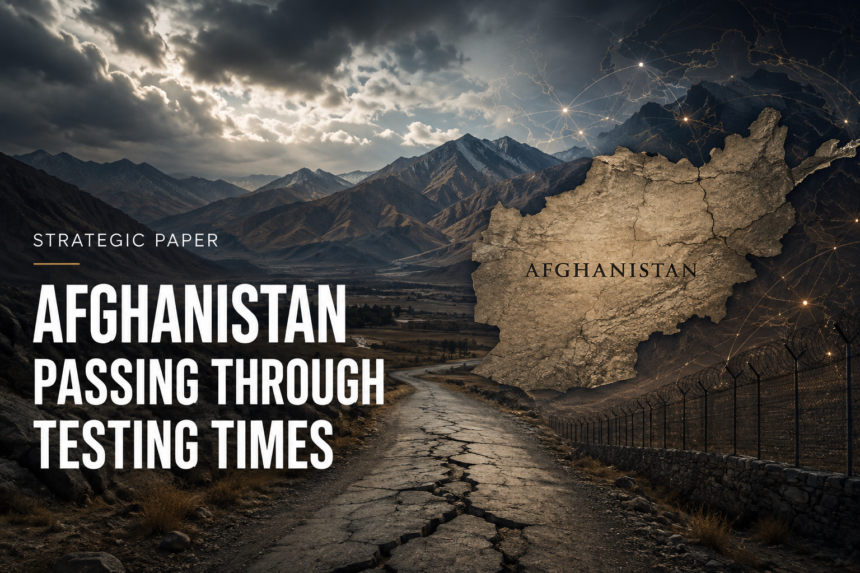
Afghanistan is passing through one of the most difficult phases in its modern history. Decades of conflict, weak governance, economic collapse, and prolonged political instability have left the country deeply fractured.
Five years after returning to power, the Taliban administration continues to grapple with mounting internal and external challenges while facing growing criticism over its governance, security policies, and failure to restore normalcy.
The Taliban government has been repeatedly accused of failing to curb the activities of numerous terrorist groups operating from Afghan territory.
Cross-border militancy has remained a major source of regional instability, particularly for Pakistan, which has consistently urged Kabul to prevent Afghan soil from being used for terrorist activities against its neighbours.
The regime has also been criticised for failing to fulfil key commitments associated with the February 2020 Doha Agreement, particularly with regard to preventing terrorism and moving towards a broad-based and inclusive political order.
At the same time, restrictions on women’s education, employment, and civil liberties have attracted widespread international condemnation, contributing to Afghanistan’s continued diplomatic isolation.
The deteriorating security environment, coupled with economic decline, has produced a severe humanitarian crisis. High unemployment, widespread poverty, food insecurity, inflation, and a shortage of foreign exchange have pushed millions of Afghans into extreme hardship.
Meanwhile, drug trafficking, smuggling, and the influence of armed groups continue to undermine state authority and economic recovery.
Pakistan maintains that the Taliban regime has failed to act decisively against terrorist organisations responsible for attacks inside Pakistan.
Consequently, Islamabad has intensified counterterrorism operations both within its own territory and, in recent months, against terrorist hideouts and launch pads across the border in Afghanistan.
These developments have coincided with increasing signs of internal fragmentation within the Taliban movement itself.
Rivalries between the Kandahar-based leadership and the Haqqani faction have become more pronounced, while armed opposition groups have expanded their activities in Northern Afghanistan.
To be concluded
About the Author
Brigadier (Retd) Asif Haroon Raja, SI (M) is a war veteran. He is Command and Staff Course and War Course qualified, holds an MSc in War Studies, and served as Defence Attaché in Egypt and Sudan, as well as Dean of the Corps of Military Attachés in Cairo.
He is a defence, security, and geopolitical analyst, columnist, featured columnist of IntelDrop magazine Washington, author of five books, former Chairman of Thinkers Forum Pakistan, Patron-in-Chief of Centre for Development Studies Think Tank, Director of Meesakh Research Centre; he regularly appears on media platforms.