
Part Two
Asif Haroon Raja
The Emerging Challenge to Taliban Rule
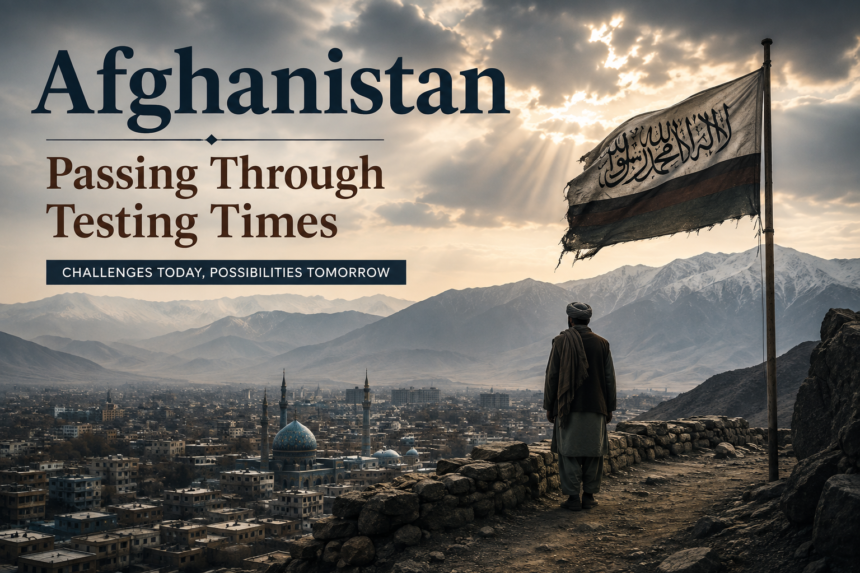
The security and political landscape in Afghanistan is entering a new and potentially decisive phase.
Five years after the Taliban’s return to power in August 2021, the movement is confronting a combination of challenges unprecedented since its takeover of Kabul.
Political isolation, economic decline, humanitarian distress, internal factionalism, and the resurgence of organised armed resistance are collectively placing increasing pressure on the regime.
While the Taliban continues to exercise authority over most of Afghanistan, its ability to maintain long-term stability is being questioned with growing frequency.
The movement has yet to secure international recognition, revive the economy, establish an inclusive political order, or eliminate the threat posed by competing militant organisations.
At the same time, its failure to prevent Afghan territory from being used by transnational terrorist groups has strained relations with neighbouring countries, particularly Pakistan.
These mounting pressures have coincided with renewed resistance activity in Northern Afghanistan.
Unlike the sporadic local uprisings witnessed immediately after the Taliban’s return to power, the present phase is characterised by increasing coordination among former commanders of the Afghan National Army (ANA), intelligence officials, and political leaders who seek to establish a credible alternative to Taliban rule.
Although the operational capabilities of these resistance groups remain the subject of debate, their expanding presence in strategically important provinces such as Badakhshan, Takhar, Baghlan, and Panjshir suggests that Afghanistan may once again be entering a prolonged period of political and military contestation.
General Yasin Zia and the Afghanistan Freedom Front
Among the most prominent figures leading the emerging resistance is General Yasin Zia, one of the former Islamic Republic’s most respected military commanders.
During the previous government, he served as Chief of the General Staff of the Afghan National Army, held senior appointments within the Ministry of Defence, and served as Governor of Takhar Province.
His extensive military experience and familiarity with Northern Afghanistan have enabled him to emerge as one of the principal organisers of armed opposition to the Taliban.
Following the Taliban’s assumption of power in August 2021, General Yasin Zia established the Afghanistan Freedom Front (AFF), an organisation that combines political objectives with an armed resistance campaign.
The movement seeks not merely to oppose Taliban rule but to promote the establishment of a representative political system based upon constitutional governance, national reconciliation, and international engagement.
The AFF argues that Afghanistan’s long-term stability cannot be achieved through exclusive rule by any single movement or ethnic constituency.
It advocates the formation of an inclusive government representing all major Afghan communities while restoring fundamental civil liberties, expanding educational opportunities for women, and rebuilding national institutions weakened by decades of conflict.
From a security perspective, the AFF also maintains that Afghanistan must cease serving as a sanctuary for transnational terrorist organisations.
It contends that lasting regional stability depends upon denying extremist groups the ability to use Afghan territory to threaten neighbouring states, particularly Pakistan, China, and the Central Asian Republics.
General Yasin Zia’s military background, combined with his political credibility among former Afghan security personnel, has enabled the AFF to attract experienced officers and soldiers who previously served in the Afghan National Army.
Although precise figures remain difficult to verify independently, the movement is widely regarded as one of the most organised components of the expanding anti-Taliban resistance.
To be concluded
About the Author
Brigadier (Retd) Asif Haroon Raja, SI (M) is a war veteran. He is Command and Staff Course and War Course qualified, holds an MSc in War Studies, and served as Defence Attaché in Egypt and Sudan, as well as Dean of the Corps of Military Attachés in Cairo.
He is a defence, security, and geopolitical analyst, columnist, featured columnist of IntelDrop magazine Washington, author of five books, former Chairman of Thinkers Forum Pakistan, Patron-in-Chief of Centre for Development Studies Think Tank, Director of Meesakh Research Centre; he regularly appears on media platforms.