
Part One
Asif Haroon Raja
From the Ottoman Collapse to a Fragmented Muslim World
After the fall of the Ottoman Empire in 1924, the imperial powers ensured that the Muslim world remained divided, politically weak and strategically dependent.
The Arab territories that had assisted Britain and France during the First World War were not united under the promised arrangements. Instead, the Arab world was fragmented into numerous states, eventually forming the 22 Arab countries that exist today.
The colonial policy of divide and rule was subsequently carried forward, in different forms, by the United States after the Second World War.
Secular and authoritarian regimes were frequently supported when they served Western strategic interests, while political leaders who became liabilities were often abandoned.
This pattern has contributed to the widespread perception that, in international politics, the United States can be a powerful ally but an equally formidable adversary.
Repeated Attempts at Muslim Unity
The Muslim world has repeatedly attempted to develop collective mechanisms for political and security cooperation.
These efforts included the Arab League in 1945, the Baghdad Pact in 1955, the Organisation of Islamic Cooperation (OIC) in 1969, the Gulf Cooperation Council (GCC) in 1981, and, more recently, the proposed Islamic Military Counter Terrorism Coalition, comprising dozens of Muslim countries and headed by Gen Raheel Sharif.
Yet none of these initiatives succeeded in producing a genuinely integrated Muslim security architecture.
The principal reason has been the persistence of political divisions, competing national interests, sectarian differences, economic dependencies and divergent strategic alignments.
External powers have also exploited these divisions through a familiar policy of carrot and stick, rewarding cooperation while pressuring or isolating states that resisted their strategic objectives.
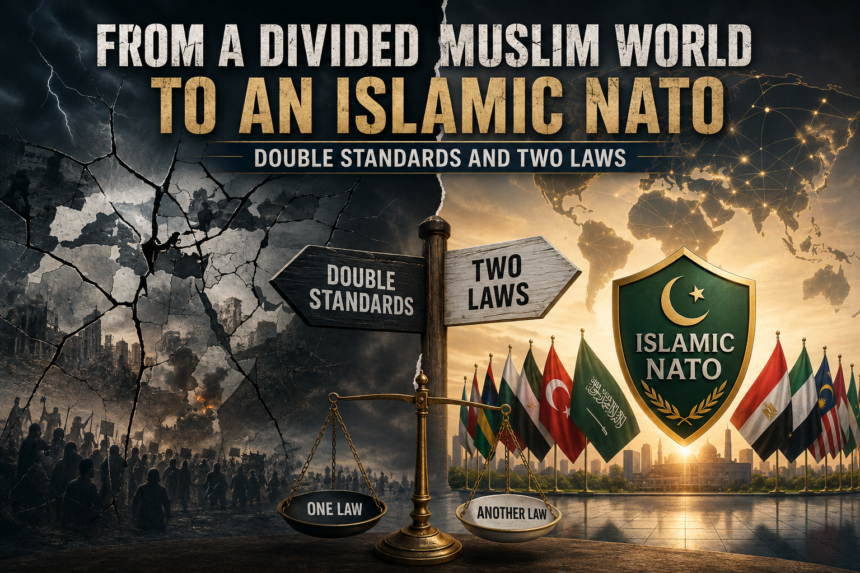
Double Standards and Two Laws
Saddam Hussein was once regarded as an important regional partner of the West. He was subsequently accused of violating United Nations resolutions, and the United States-led intervention overthrew his government.
He was later executed following a highly controversial trial.
In contrast, successive Israeli governments, including those led by Benjamin Netanyahu, have been accused of violating numerous UN resolutions and international humanitarian-law norms, yet Israel and its senior leadership have not faced comparable consequences from the international system.
This contrast raises a fundamental question:
Is international law applied equally to all states, or does its application depend upon political power, strategic alliances and geopolitical influence?
For nearly eight decades, Israel and India have remained at the centre of two of the world’s longest-running unresolved disputes—Palestine and Jammu & Kashmir.
Despite numerous UN resolutions calling for political settlements, both disputes remain unresolved.
This continuing impasse has raised serious questions about the effectiveness, consistency and impartiality of the international system.
Critics argue that Israel’s military operations in Gaza and the occupied Palestinian territories, as well as India’s policies and security operations in Indian-administered Jammu & Kashmir, have resulted in extensive human suffering and serious allegations of human-rights violations.
Yet, from this perspective, meaningful international action has remained limited.
Such perceptions reinforce the belief that international law is often applied selectively. Smaller and weaker states can face sanctions, military intervention or diplomatic isolation, while powerful states and their close allies sometimes appear capable of avoiding comparable consequences.
The American Military-Industrial Complex and Global Power
The United States, which presents itself as the principal defender of the rules-based international order, has itself participated in or supported numerous wars, military interventions, proxy conflicts, covert operations and regime-change efforts during the past several decades.
These actions have frequently attracted criticism for bypassing international law, undermining state sovereignty and producing prolonged humanitarian consequences.
Driven by geopolitical competition, strategic dominance and economic interests, Washington has repeatedly employed military power to protect what it considers vital national interests.
Since the end of the Second World War, the United States has participated in, or supported, military interventions across Europe, Asia, the Middle East, Africa and Latin America.
The Military-Industrial Complex (MIC) and NATO, both emerging in 1949, had different but interconnected strategic dimensions. The MIC developed around the relationship between defence requirements, government expenditure and private industry, while NATO was established principally as a collective-security alliance to deter a possible Soviet attack on Western Europe.
The Soviet Union and Communism were portrayed as the principal threats to the Western-led international order and the capitalist system.
Since both superpowers possessed nuclear weapons and increasingly sophisticated missile capabilities, direct confrontation was largely avoided and the Cold War continued until the dissolution of the Soviet Union in 1991.
The United States regarded the Western Hemisphere as a vital sphere of strategic interest, while the oil-rich Middle East became another critical theatre of great-power competition.
Much of what was then called the Third World became an arena for proxy conflicts and competition between the superpowers.
Critics have described this system as a modern form of neo-colonialism, in which direct colonial rule was replaced by political, economic and military influence.
America’s vast military capabilities, economic strength, technological superiority, diplomatic reach and alliance networks—particularly NATO—enabled Washington to project power globally and shape regional conflicts in accordance with its strategic priorities.
To be Concluded
About the Author
Brigadier (Retd) Asif Haroon Raja, SI (M) is a war veteran. He is Command and Staff Course and War Course qualified, holds an MSc in War Studies, and served as Defence Attaché in Egypt and Sudan, as well as Dean of the Corps of Military Attachés in Cairo.
He is a defence, security, and geopolitical analyst, columnist, featured columnist of IntelDrop magazine Washington, author of five books, former Chairman of Thinkers Forum Pakistan, Patron-in-Chief of Centre for Development Studies Think Tank, Director of Meesakh Research Centre; he regularly appears on media platforms.