
Asif Haroon Raja
Political History of Imran Khan
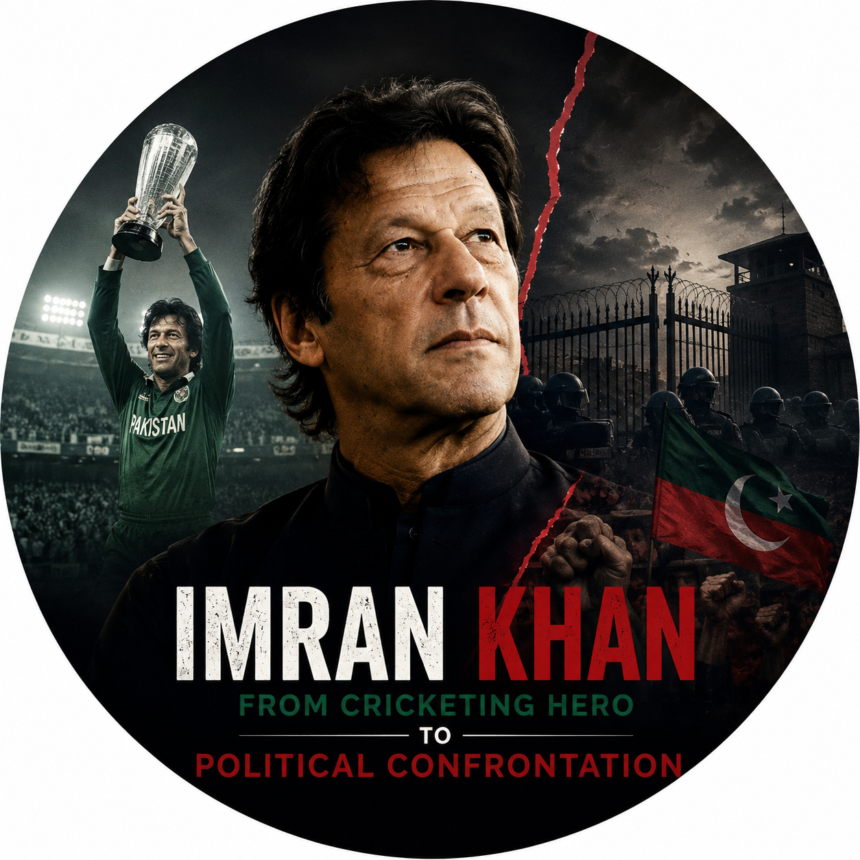
The cricketer Imran Khan earned worldwide fame after leading Pakistan to victory in the 1992 Cricket World Cup. His popularity increased further when he raised funds to establish a cancer hospital in Lahore in memory of his late mother, Shaukat Khanum, who had died of cancer.
After retiring from cricket, he entered politics and initially joined Air Marshal Asghar Khan’s Tehreek-e-Istiqlal.
In 1996, he founded his own party, Pakistan Tehreek-e-Insaf (PTI). For several years, however, the party remained politically marginal. In the 2002 general elections, Imran Khan won a single National Assembly seat from his home constituency in Mianwali.
During Gen Pervez Musharraf’s rule, Imran Khan was reportedly offered a place in the cabinet and was also sounded out for the office of prime minister.
He reportedly demanded around 100 National Assembly seats for his party, a condition that was not feasible, and consequently remained outside the government.
He once again found himself politically isolated while the leaders of the PPP and PML-N, Benazir Bhutto and Nawaz Sharif, both in exile since 1999, signed the Charter of Democracy in 2006, pledging to cooperate and avoid confrontation with one another.
The controversial National Reconciliation Ordinance (NRO), promulgated by Gen Musharraf in October 2007, paved the way for political reconciliation, particularly with the PPP.
The assassination of Benazir Bhutto in December 2007, however, transformed the political landscape.
Her husband, Asif Ali Zardari, subsequently became co-chairman of the PPP and later President of Pakistan, while the PPP led the federal government for the next five years. PTI did not contest the March 2008 general elections.
The PPP’s five-year rule under Zardari was widely criticised for corruption, poor governance and the politicisation of state institutions.
Critics alleged that merit gave way to nepotism and favouritism, public debt increased substantially, and a nexus among political, criminal and militant elements contributed to worsening insecurity and terrorism.
These practices further weakened the economy and increased Pakistan’s dependence on the IMF.
The devolution of powers to the provinces through the 18th Amendment, although constitutionally significant, also generated controversy over the distribution of authority and resources.
Against this backdrop, the traditional two-party political system increasingly came to be viewed as having failed to deliver effective governance.
It was in these circumstances that the Establishment appeared to favour a third political experiment centred on the previously marginal PTI and its charismatic leader, Imran Khan.
From 2011 onward, Imran Khan was gradually brought to the centre stage of national politics. In the 2013 elections, PTI won Khyber Pakhtunkhwa with a two-thirds majority and made significant inroads into Punjab and Karachi.
The PPP was reduced largely to a Sindh-based regional force, while the PML-N formed the federal government with a comfortable majority.
Imran Khan maintained an aggressive campaign against the PML-N, alleging that the 2013 elections had been rigged.
The Sharif and Zardari families were repeatedly portrayed as corrupt, while the two major parties were blamed for Pakistan’s political and economic predicament.
Race to Premiership
In 2017, Imran Khan became closely associated with Bushra Bibi, who was later popularly referred to as Pinki Peerni by his followers and critics because of claims surrounding her spiritual practices.
Imran Khan reportedly came to believe that her spiritual guidance had contributed to his eventual attainment of the prime minister’s office in August 2018.
Critics subsequently alleged that she exercised undue influence over important decisions during and after his premiership.
At the same time, Lt Gen Faiz Hameed, then serving as DG-C of the ISI, emerged as one of Imran Khan’s most influential institutional allies. Former Chief Justice Saqib Nisar was also perceived by PTI opponents as sympathetic to Imran Khan.
Despite the economic and developmental gains claimed by the PML-N government, Nawaz Sharif was removed from office in 2017 and subsequently jailed on corruption charges.
The PML-N was politically weakened ahead of the 2018 elections, while political engineering and shifting alliances enabled PTI to form the federal government as well as governments in Punjab and Khyber Pakhtunkhwa.
PTI’s electoral success was also facilitated by Imran Khan’s populist and ambitious promises of creating a new Pakistan.
The honeymoon between the Establishment and PTI, however, proved short-lived.
Economic difficulties, the IMF programme, weaknesses in governance and financial management, and controversial choices in the appointment of provincial chief ministers compounded the government’s problems.
Imran Khan focused more on neutralising his political opponents and less on reforms, governance and fulfilment of his rosy promises.
Critics also accused Bushra Bibi and Lt Gen Faiz Hameed of exercising excessive influence over state affairs. The deteriorating economic situation brought Pakistan dangerously close to default.
Gradual Fall of PTI
Alarmed by the worsening economic crisis and political instability, the military leadership gradually withdrew its overt political support.
In November 2022, Gen Qamar Javed Bajwa reiterated that the army would no longer interfere in politics and would remain politically neutral.
This shift strengthened the Pakistan Democratic Movement (PDM), a coalition of opposition parties, and encouraged it to move a vote of no confidence against Imran Khan on 8 March 2022 under Article 95.
Vote of No Confidence
PTI lost its majority in the National Assembly after 24 dissident PTI MNAs left the party and took refuge in the Sindh House in Islamabad, while several of PTI’s coalition partners also shifted to the opposition camp.
On 27 March, Imran Khan waved a copy of the diplomatic cipher before a public gathering and alleged that a US conspiracy was behind the move to remove him from office.
Subsequent investigations and the emergence of an audio recording reportedly suggested that Imran Khan had decided to use the cipher for political purposes.
On 3 April, PTI’s Deputy Speaker, Qasim Suri, dismissed the no-confidence motion on the grounds that it was linked to a foreign conspiracy and prorogued the National Assembly indefinitely.
In response to an appeal by the opposition, a five-member Supreme Court bench headed by Chief Justice Umar Ata Bandial restored the National Assembly on 7 April and ordered it to proceed with the no-confidence motion in accordance with the Constitution.
On the same day, Prime Minister Imran Khan and President Arif Alvi, while at the Prime Minister’s House, initiated the process for the dissolution of the National Assembly. President Alvi subsequently dissolved the Assembly on the advice of the Prime Minister.
The Supreme Court’s intervention, however, prevented the dissolution from bringing the parliamentary process to an end.
The National Assembly was restored, the no-confidence motion was put to a vote, and Imran Khan was removed as prime minister after the motion secured the required majority.
Following the mass resignations of PTI legislators from the National Assembly, Shehbaz Sharif, leader of the PML-N, was elected prime minister and formed a coalition federal government.
Nawaz Sharif, Shahbaz Sharif and other PML leaders were cleared of corruption cases by the law courts.
Politics of Victim hood and Agitation by PTI
After its removal from power, PTI increasingly adopted a politics of agitation and confrontation, declaring the new government illegitimate.
Imran Khan, portraying himself as a victim of political victimisation and as the country’s most popular leader, chose a confrontational course and expected to return to power with a two-thirds majority through early elections, which he repeatedly demanded.
His campaign included more than sixty public gatherings and rallies.
He continued to ridicule and demonise the leaders of the two mainstream political parties, branding them thieves, looters and, at times, servants of the United States.
Maulana Fazlur Rehman was derisively labelled “Diesel”.
Imran Khan also increasingly criticised the military leadership, accusing Gen Bajwa of betrayal, while senior ISI officers were subjected to public criticism and ridicule.
Rhetoric of Genuine Freedom
His rhetoric increasingly mobilised his followers around the language of resistance, revolution and “real freedom”.
PTI supporters were encouraged to prepare for what was portrayed as a decisive struggle against the existing political order.
The creation of a so-called Cheetah Force and the alleged deployment of armed supporters around his residences in Bani Gala and Zaman Park further heightened concerns about the party’s increasingly militant posture.
9 May Vandalism, IK’s Incarceration and PTI’s Strategy of Violence
There were allegations that retired Lt Gen Faiz Hameed advised Imran Khan or his supporters to launch coordinated attacks on military installations during the events of 9 May. These allegations remain a matter of intense political controversy.
Following Imran Khan’s incarceration in August 2023 in connection with the 9 May violence, PTI’s political strategy continued to revolve around defiance, confrontation, non-cooperation and street mobilisation.
Punishments
More than 180 cases were reportedly registered against Imran Khan before civil and military courts, while numerous other PTI leaders and workers were also arrested and jailed.
Imran Khan and his wife, Bushra Bibi, were convicted and sentenced to 14 and 11 years’ imprisonment, respectively.
Separately, Lt Gen (Retd) Faiz Hameed was court-martialled by a military court and sentenced to 14 years’ imprisonment.
Reliance on Social Media
The party also relied heavily on social media and on support from Pakistani expatriates, particularly in the West.
Supporters used digital platforms extensively to glorify Imran Khan while portraying the government, state institutions and particularly the military in a negative light.
Those who launched the harshest attacks against the armed forces often gained prominence within the PTI’s digital ecosystem.
Divergence from Lawful Course
Imran Khan increasingly distanced himself from parliamentary politics, democratic conventions and institutional engagement, relying instead on street mobilisation and his personal popularity.
Underestimating the coalition government as a fragile “house of cards”, PTI supporters repeatedly attempted to storm Islamabad.
The situation was further complicated by the presence of militant elements and allegations concerning the involvement or facilitation of the TTP and Afghan-based militants.
The successive long marches originating largely from Khyber Pakhtunkhwa nevertheless failed to bring down the government.
Resort to Fake News and Sit-ins
To generate public sympathy for Imran Khan, PTI’s social media machinery also circulated numerous allegations regarding his treatment in prison.
To build pressure on the government and attract crowds from the twin cities, Khyber Pakhtunkhwa and Punjab, Imran Khan’s three sisters, the Chief Minister of KP, and his lawyers staged sit-ins outside Adiala Jail and held daily press briefings.
However, despite their repeated efforts, they failed to muster more than one to two thousand people.
Stories were repeatedly propagated that he was being kept in a “hellhole”, tortured or even slowly poisoned in an attempt to break his will. At various points, rumours even circulated that he had died or was on the verge of death.
These narratives were sharply contested by accounts of the facilities and privileges reportedly available to him in prison.
According to such accounts, he had access to a furnished cell, additional adjoining cells, a walking area, a green compound, exercise equipment, a kitchen and a bathroom with dedicated assistance.
He was also reportedly provided regular medical check-ups, meals of his choice, juices and dry fruits, as well as meetings with family members and visitors twice a week.
While continuing to pressure the government for his release, his devoted supporters portrayed him as a heroic leader who had remained steadfast and refused to capitulate.
Health Issues Politicised
More recently, relatives and supporters have emphasised his alleged multiple health problems and demanded that he be shifted to a hospital. Shifa International Hospital in Islamabad was reportedly their preferred facility for his medical examination and treatment.
Amid mounting pressure, a three-member Supreme Court bench directed that Imran Khan be shifted to Shifa for medical examination and treatment.
The government questioned the legal basis of the order and sought its reconsideration rather than immediately challenging it before the Constitutional Bench.
In the meantime, however, the authorities proceeded to comply with the court’s direction.
To Hospital and Back to Adiala
Imran Khan was taken from Adiala Jail around midnight on the night of 20/21 August, and the convoy initially proceeded towards Shifa hospital, where arrangements had reportedly been made for his reception and examination.
As news of his transfer spread, large numbers of PTI supporters rushed towards the hospital in cars and on motorcycles. Traffic was disrupted, the hospital was surrounded and slogans were raised in support of their leader.
Many appeared to believe that a political deal had been reached, that PTI had achieved a major victory, and that the government and military leadership had yielded to pressure ahead of the long march announced for 27 September.
The situation created serious law-and-order and security concerns. In such a charged environment, the possibility of an attempt by hostile elements to exploit the situation, harm Imran Khan or facilitate an unauthorised escape could not reasonably be ignored.
The law-enforcement agencies therefore reportedly informed the government that it was not feasible to safely proceed towards Shifa hospital under the prevailing circumstances and advised that the transfer be postponed or the venue changed.
The government consequently decided to shift the venue of the medical examination from Shifa to PIMS Hospital.
Imran Khan was subsequently taken to PIMS, where he was examined by a team of specialists, reportedly including doctors from Shifa. His sister was also present during the examination. He was declared medically fit by the evaluating doctors and sent back to Adiala jail at 5 a.m. in the morning on 21 August.
The change of venue, however, did not fit the expectations of PTI supporters. They alleged that the government had deceived them and began portraying the episode as a violation of the court’s order and a possible contempt-of-court matter.
Some also alleged that the original plan had been deliberately disrupted to prevent Imran Khan from being shifted to Bani Gala, or Peshawar, or abroad.
Anticlimax of the Melodrama
Whatever the political narratives surrounding the episode, the immediate medical issue appears to have ended without the dramatic outcome predicted by PTI supporters.
Imran Khan was reportedly declared medically fit following examination, a position that was also acknowledged by his sister.
If medically fit, there would appear to be no compelling medical justification for his hospitalisation, particularly in a private facility.
The anticipated drama, therefore, ended in an anticlimax. What had been presented as a potentially decisive political development fizzled out, and the situation returned largely to square one.
Return to Confrontation
While PTI supporters are preparing for what they describe as the “final showdown” on 27 September, the government has also picked up the gauntlet and appears prepared for the coming political standoff.
Presently, PTI has filed a contempt of court petition against the government, while the latter has asked for a review of the original decision of the supreme court.
The confrontation between PTI and the government, therefore, is far from over; rather, the events surrounding Imran Khan’s proposed transfer to Shifa hospital have added another contentious chapter to Pakistan’s increasingly polarised political landscape.
Conclusion
Pakistan cannot afford prolonged political confrontation at a time when economic recovery, internal stability, regional security and foreign investment demand political calm, institutional stability and sustained national focus.
All political stakeholders must therefore rise above partisan interests, respect constitutional and democratic norms, and prioritise the country’s larger national interests over political expediency.
The challenges confronting Pakistan are too serious to be allowed to become casualties of perpetual political confrontation.
Lastly, a word of advice to the negativists on social media: criticism is healthy in a democracy, but relentless negativity, disinformation and deliberate character assassination serve neither the nation nor the cause of democracy.
Pakistan is passing through a difficult phase and needs responsible criticism, constructive debate and solutions—not despair, hatred and perpetual agitation.
Those who constantly portray everything in the darkest possible colours should remember that undermining public confidence in the state, economy and institutions ultimately harms the country they claim to serve.
Be critical, but be fair; question authority, but verify facts; and above all, do not allow political loyalty to override national interest.
About the Author
Brigadier (Retd) Asif Haroon Raja, SI (M) is a war veteran. He is Command and Staff Course and War Course qualified, holds an MSc in War Studies, and served as Defence Attaché in Egypt and Sudan, as well as Dean of the Corps of Military Attachés in Cairo.
He is a defence, security, and geopolitical analyst, columnist, featured columnist of IntelDrop magazine Washington, author of five books, former Chairman of Thinkers Forum Pakistan, Patron-in-Chief of Centre for Development Studies Think Tank, Director of Meesakh Research Centre; he regularly appears on media platforms.