
Recharting the Geopolitical Compass
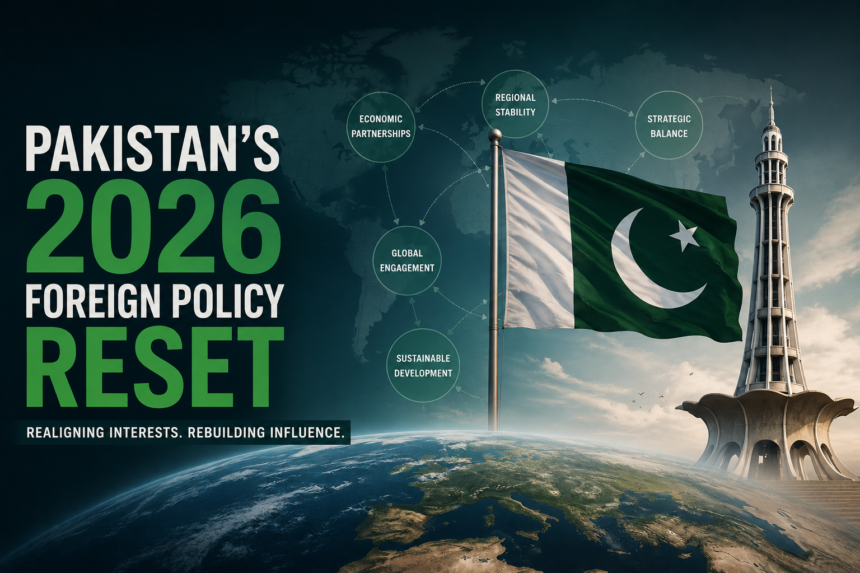
For much of the early 2020s, Pakistan’s foreign policy appeared paralyzed by a combination of domestic political volatility, systemic economic vulnerability, and an accumulating trust deficit with traditional Western partners. Caught in the intensifying geopolitical crossfire between Washington and Beijing, and severely constrained by structural financial crises, Islamabad frequently found itself on the defensive, struggling to articulate a coherent global posture. By early 2026, however, a discernible shift began to manifest. Driven by an urgent need for financial stabilization and catalyzed by systemic shifts in the Middle East and Central Asia, Pakistan has initiated a calculated foreign policy reset. This transition away from passive isolation toward a more assertive, multidimensional regional diplomacy reflects a fundamental realization that economic survival requires proactive strategic balancing.
The immediate backdrop of this realignment is defined by a highly volatile West Asian security landscape. The escalation of military hostilities between Iran and the United States earlier this year severely threatened global energy corridors and directly challenged Islamabad’s border security. Rather than retreating into safe passivity or taking a rigid side, Pakistan leveraged its unique geopolitical positioning to act as a discreet diplomatic conduit. The hosting of quiet bilateral engagements in Islamabad, followed by high-level diplomatic coordination with Beijing and London in May 2026, positioned Pakistan as an indispensable regional stabilizer. This neutral, mediation-driven posture has allowed Islamabad to restore critical diplomatic credit in both Western capitals and Tehran, successfully converting an immediate border crisis into a demonstration of strategic utility.
At the core of this policy reset is a shift from purely defense-centric doctrines to an integrated framework where economic statecraft underpins national security. Pakistan’s traditional reliance on transactional security alliances has yielded to a more calculated economic diplomacy aimed at anchoring regional states into its own economic stability. This is particularly evident in the recent regional envoys’ conferences in Islamabad targeting the Gulf Cooperation Council (GCC) states. By moving beyond historic, sentiment-driven appeals for fiscal lifelines, Pakistan’s diplomatic machinery is actively pitching structural investment opportunities, particularly in mineral infrastructure, corporate agriculture, and maritime logistics. The objective is to anchor Gulf capital into long-term domestic assets, thereby creating a shared stakeholder interest in Pakistan’s macroeconomic viability.
Simultaneously, Islamabad is re-engineering its multilateral engagement through the Shanghai Cooperation Organization (SCO). Preparing for its upcoming chairmanship of the SCO Council of Heads of State, Pakistan is attempting to shed its reputation as an isolated security actor by framing itself as a crucial bridge for regional connectivity. In recent high-level consultative sessions in Moscow, Pakistani diplomats aggressively advocated for coordinated regional mechanisms to combat transnational militancy while simultaneously pushing for integrated trade corridors linking Central Asian economies to the Arabian Sea. This dual approach serves a vital national interest: it universalizes Pakistan’s counterterrorism challenges, particularly concerning cross-border threats, while positioning its infrastructure as the natural maritime outlet for the landlocked Eurasian heartland.
However, this transition toward an active regional posture is fraught with structural contradictions and systemic risks. The primary challenge remains the deep polarization of the global order. As Pakistan deepens its dependency on Chinese technology and infrastructure under the next phase of bilateral cooperation, maintaining the necessary diplomatic equilibrium with a cautious Washington will become increasingly difficult. Furthermore, a proactive foreign policy cannot permanently outrun domestic structural weaknesses. The persistent threat of sub-national militancy along the western frontier, coupled with a fragile fiscal framework, continually threatens to undermine the credibility of Pakistan’s diplomatic assurances to international investors and regional allies alike. A state divided internally or facing perennial financial insolvency can rarely sustain an ambitious external pivot.
To ensure this diplomatic reset translates into permanent strategic capital, Islamabad must institutionalize its current ad hoc pragmatism into a disciplined, long-term doctrine. First, Pakistan must strictly maintain its posture of non-alignment in external major-power conflicts, explicitly resisting pressures to join exclusionary geopolitical blocs. The mediation track established during recent West Asian tensions should be formalized into a permanent diplomatic capability, ensuring that Pakistan remains a preferred neutral ground for regional crisis management. Second, the state must aggressively synchronize its domestic regulatory frameworks with its external economic diplomacy, ensuring that investment pledges from the GCC and Central Asia do not falter due to bureaucratic inertia. Ultimately, the foreign policy recalibration observed in 2026 demonstrates that strategic isolation is a choice, not an inevitability. By leveraging its geography for mediation rather than proxy competition, and by prioritizing regional economic integration over ideological posturing, Islamabad is beginning to sketch a more mature global identity. The durability of this reset will not be measured by the eloquence of its diplomatic rhetoric, but by the state’s internal capacity to sustain its commitments and maintain its institutional balance in an unpredictable global l