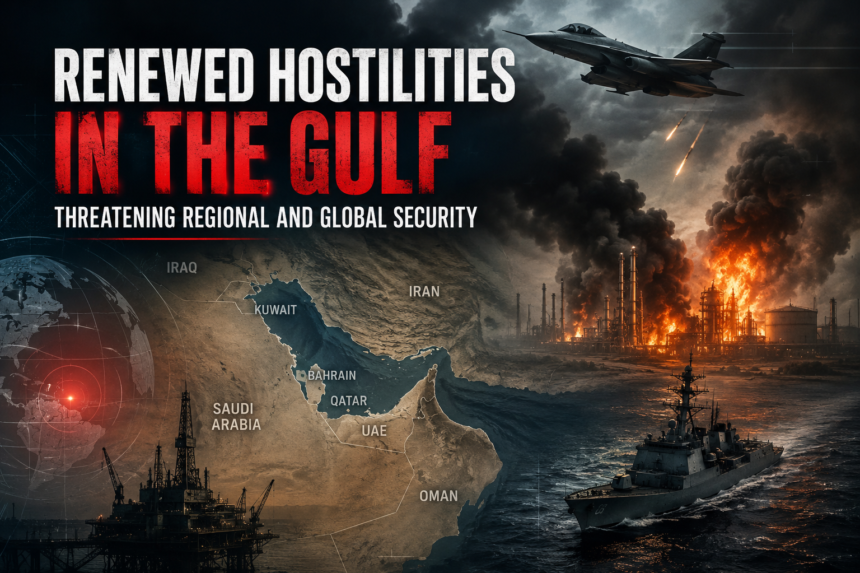

The renewed Gulf conflict is deepening political, military, and diplomatic divisions both within the Middle East and among major global powers. It contends that disagreements between the United States and Europe, divisions within the US, Israel, Iran, and the Gulf Cooperation Council (GCC), along with growing geopolitical competition, have made the crisis more complex and increased the risk of a wider regional conflict with significant global security and economic consequences. The article concludes by suggesting that the Gulf remains in a fragile standoff where any further escalation could trigger a broader war.
Part Two
Asif Haroon Raja
Widening Regional and Global Divisions
One of the most striking consequences of the renewed Gulf crisis has been the widening of political and strategic divisions, not only within the Middle East but also among the major Western powers.
Long-standing alliances are under strain, while internal disagreements are becoming increasingly visible within governments and political establishments.
The US-Europe Estrangement
Perhaps the first major casualty of the renewed conflict has been the transatlantic relationship that has underpinned Western security for more than seven decades.
During the Cold War, NATO functioned as the military arm of the United States in containing the Soviet Union. After the collapse of the Soviet bloc in 1991, the alliance redefined its role through out-of-area military interventions and crisis management.
Today, however, growing differences over the Middle East have exposed serious cracks within the alliance.
Several European countries have become increasingly critical of Israel’s military campaign in Gaza and its broader regional policies.
Some governments have publicly urged Washington to suspend arms deliveries to Israel, while others have imposed restrictions on the use of their airspace and ports for the transportation of military supplies.
The divergence that first surfaced during President Donald Trump’s first administration has deepened considerably.
The reluctance of several European governments and NATO members to participate in military operations against Iran or assist in reopening the Strait of Hormuz illustrates the growing strategic distance between Washington and many of its traditional allies.
Divisions Within Washington
The renewed conflict has also exposed differences within the American political establishment. Sharp disagreements have emerged in Congress, within both major political parties, and even inside the Trump administration itself over the direction of US policy towards Iran.
Vice President J.D. Vance has publicly questioned the wisdom of further military escalation, reportedly arguing that the era of American military interventions aimed at changing foreign governments should come to an end.
He has maintained that the United States should not determine the political future of other nations through force.
Vance has also argued that Israel does not favour a comprehensive US-Iran agreement and has criticised those opposing diplomacy for offering no viable alternative other than continued military action.
At the same time, he has reaffirmed that maintaining freedom of navigation through the Strait of Hormuz remains a vital American strategic interest.
Reports of disagreements within the administration over proposals for a ground operation against Iran or the possible seizure of strategically important islands in the Strait of Hormuz further highlight the absence of consensus in Washington.
The debate has also revived broader questions regarding the depth of US-Israel strategic integration and the scale of American financial and military assistance to Israel.
Critics increasingly argue that unconditional support for Israeli military operations has damaged America’s international standing and undermined its credibility as an impartial mediator in the Middle East.
The passage of the Fiscal Year 2027 National Defense Authorization Act (NDAA) by a narrow margin in the House of Representatives reflects these growing political divisions.
Although the legislation authorises substantial increases in defence spending, enhanced military cooperation with Israel, and expanded funding for ongoing military operations, its future in the Senate remains uncertain amid significant political opposition.
Meanwhile, President Trump’s simultaneous calls for peace and repeated warnings of military action against Iran have reinforced perceptions among critics that Washington’s policy lacks strategic consistency.
Public debate within the United States has also intensified, with growing sections of American society questioning the extent to which US Middle East policy is shaped by its close alignment with Israel.
Washington’s repeated use of its veto power in the United Nations Security Council to shield Israel from international censure has further fuelled these criticisms.
Growing Debate Within Israel
The prolonged conflict has also intensified debate within Israel itself. Political divisions between hard-line and more moderate factions have become increasingly pronounced.
While Prime Minister Benjamin Netanyahu and his coalition continue to advocate a military approach, many opposition politicians, civil society groups, and families of hostages have called for negotiated solutions and a reduction in regional tensions.
International criticism of Israel’s military operations in Gaza and allegations of disproportionate use of force have contributed to declining public support in several Western countries, including the United States, where debate over future assistance to Israel has become increasingly contentious.
Questions Surrounding Iran’s Leadership
Iran has likewise faced internal political uncertainty.
Following the death of Supreme Leader Ayatollah Ali Khamenei, observers believe that the Islamic Revolutionary Guard Corps (IRGC) has assumed an even more influential role in shaping Iran’s strategic decisions.
Some analysts contend that Brigadier General Ahmad Vahidi has emerged as one of the most influential figures within the Iranian security establishment.
At the same time, numerous claims and counterclaims have circulated regarding Iran’s leadership structure, the whereabouts and health of senior officials, and foreign intelligence penetration of Iranian institutions.
These allegations remain unverified and continue to be the subject of speculation.
Whatever the reality, Iran’s leadership faces the difficult challenge of preserving domestic unity while managing an increasingly dangerous confrontation with the United States and Israel.
Deepening Fissures Within the GCC
The Gulf Cooperation Council (GCC) also appears increasingly divided. The Abraham Accords of 2020 fundamentally altered regional alignments, with the United Arab Emirates and Bahrain normalising relations with Israel and significantly expanding their strategic cooperation with Washington.
The UAE has simultaneously strengthened its strategic ties with both Israel and India while pursuing an increasingly independent regional foreign policy.
Its involvement in regional theatres such as Yemen, Sudan, Somalia, and Libya has at times diverged from Saudi Arabia’s strategic priorities, creating new frictions within the Arab world.
Various analysts have also opined that regional rivalries have extended into South Asia, including claims regarding external support for militant organisations operating against Pakistan and efforts to undermine Gwadar Port and the China-Pakistan Economic Corridor (CPEC).
They see the consistent turmoil in Baluchistan as a possible part of the Great Game of the big powers. These allegations remain disputed and have not been independently verified.
The widening divisions within the Gulf have created opportunities for external powers, particularly the United States, Israel, and India, to pursue their strategic interests amid an increasingly fragmented regional landscape.
Latest Situation
While President Trump has projected the impression that Iran is seeking a ceasefire, reports emerging from the region present a markedly different picture.
According to these accounts, Tehran has firmly rejected a fresh ceasefire proposal reportedly conveyed by Washington, further intensifying tensions between Iran and the United States.
According to these reports, after twelve consecutive days of American strikes across the region, the White House quietly reached out through Qatar and other regional intermediaries, including Iraq’s President, seeking a temporary ceasefire and a return to the original nuclear agreement previously concluded between the two sides.
It is also reported that Tehran was asked to bring Yemen into the arrangement so that its allied forces would likewise suspend military operations.
Iran’s reported response was swift and unequivocal: No.
Behind the scenes, the situation appears far more complex than official statements from Washington suggest. According to the regional reports, several American military installations have sustained significant damage, with hangars and protective shelters destroyed and troop casualties reportedly mounting.
There are also claims that the US Central Command’s regional headquarters has been relocated to Israel, while indications suggest that American forces may be considering a drawdown from several military bases across the region.
Meanwhile, the economic repercussions are becoming increasingly apparent. With key maritime routes through the Strait of Hormuz and parts of the Red Sea reportedly disrupted, oil exports from major regional producers have slowed significantly, unsettling global energy markets and placing additional pressure on major importers, including China.
Adding to the uncertainty, Israel has reportedly refrained from direct military involvement, amid reports that Washington has cautioned against any action that could further widen the conflict.
For now, the region remains locked in a fragile, high-stakes standoff, with Iran seemingly convinced that time and strategic leverage are increasingly working in its favour.
As the world watches with growing concern, one critical question remains: How much longer can this precarious standoff endure before it escalates into a broader regional conflict?
To be concluded
About the Author
Brigadier (Retd) Asif Haroon Raja, SI (M) is a war veteran. He is Command and Staff Course and War Course qualified, holds an MSc in War Studies, and served as Defence Attaché in Egypt and Sudan, as well as Dean of the Corps of Military Attachés in Cairo.
He is a defence, security, and geopolitical analyst, columnist, featured columnist of IntelDrop magazine Washington, author of five books, former Chairman of Thinkers Forum Pakistan, Patron-in-Chief of Centre for Development Studies Think Tank, Director of Meesakh Research Centre; he regularly appears on media platforms.