
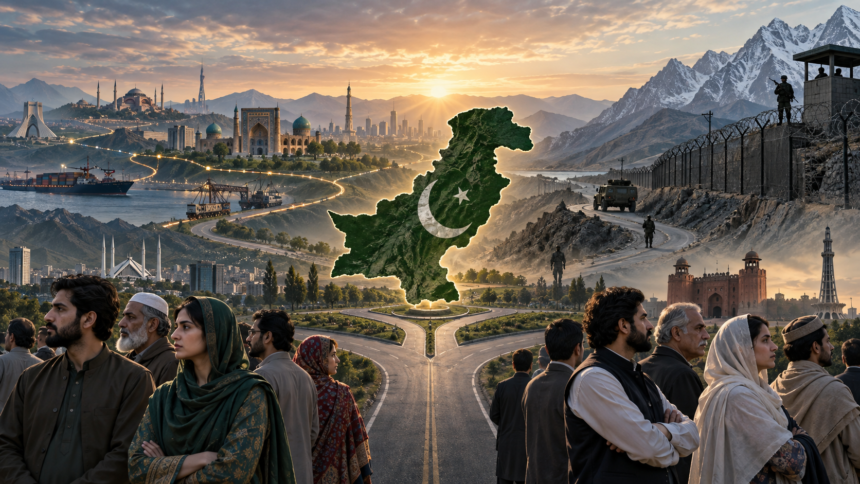

Pakistan faces terrorism, regional instability and deep political polarisation. New regional alliances are reshaping its security environment. Tensions in Balochistan and disputes involving PTI add to national challenges. Therefore, political unity and constitutional governance remain essential for stability.
Tense Geopolitical Environment
Pakistan is passing through an exceptionally challenging phase in which external security pressures, terrorism, regional instability, economic vulnerabilities and intense domestic political polarisation are converging simultaneously. Pakistan faces hostile activity from multiple directions. India remains its principal conventional adversary, while militant organisations operating from the region continue to pose a serious internal-security threat.
Pakistani authorities have repeatedly alleged that some of these groups receive external financing, training, weapons or facilitation. Credible evidence has been provided to all concerned. Pakistan occupies a strategically important position in the Muslim world. It is the only Muslim-majority nuclear-armed state and possesses ballistic missiles, drones and other military capabilities. Its armed forces have accumulated extensive operational experience through conventional wars, counterterrorism operations and prolonged engagement with asymmetric threats.
The May 2025 four-day conflict with India further demonstrated the importance of preparedness, deterrence, integrated air and missile defence, intelligence and professional military command. It changed the whole security dynamics of South Asia, which till then was centred on India.
Pakistan’s mediatory role in ending the war in the Persian Gulf has further enhanced its position. It is now respected and seen as a provider of security, a stabiliser, a bridge, and a mediator. At the same time, Pakistan’s security forces continue to confront terrorism, particularly in Khyber Pakhtunkhwa and Balochistan, where militant violence remains a serious challenge. Besides, Afghanistan has become a proxy of India and Israel, and the two strategic partners are using Afghan soil for a proxy war against Pakistan.
Balochistan: The Strategic Fault Line
Balochistan remains particularly vulnerable because of its geography, natural resources, proximity to Afghanistan and Iran, and its strategic location overlooking the Arabian Sea.
Separatist organisations have repeatedly attacked security personnel, infrastructure and civilians. The state has consequently treated the insurgency as a major national security challenge. Yet the problem cannot be reduced to the security dimension alone. Sustainable stability in Balochistan requires a combination of effective security operations, political engagement, economic development, better governance and addressing legitimate grievances.
The objective must be to prevent militant organisations and their external supporters from exploiting genuine grievances for separatist purposes while ensuring that ordinary Baloch citizens are not alienated from the national mainstream.
The Makkah Defence Arrangement and a Changing Strategic Environment
The Pakistan–Saudi Arabia Strategic Mutual Defence Agreement signed in September 2025 established that aggression against either country would be considered aggression against both and sought to strengthen defence cooperation and joint deterrence.
The subsequent Pakistan–Saudi Arabia–Türkiye Makkah Joint Defence Agreement of August 2026 has taken this defence cooperation into a broader trilateral framework. The agreement provides for collective defence cooperation, while the three countries have also begun establishing institutional mechanisms for implementation.
It is understandable that commentators describe this emerging arrangement as having some characteristics associated with collective-defence organisations. Whether it eventually develops into something resembling an “Islamic NATO”, however, remains a matter of interpretation rather than a fact.
Its immediate significance lies elsewhere: Pakistan, Saudi Arabia and Türkiye are signalling a greater willingness to coordinate their security policies and defence capabilities at a time of profound instability in the Middle East. This development has inevitably altered regional strategic calculations. It also places greater responsibility upon Pakistan.
Islamabad must ensure that the arrangement strengthens deterrence without becoming a mechanism for entering conflicts unnecessarily. Pakistan’s recent position regarding the Houthi–Saudi confrontation illustrates this dilemma. Islamabad has publicly stated that no immediate military response under the pact was being considered, while simultaneously urging restraint and pursuing diplomatic contacts.
That balance between treaty commitments, national interests and diplomatic mediation will be one of Pakistan’s most important foreign-policy tests.
The Bab al-Mandeb Question
The deteriorating situation around Bab al-Mandeb deserves particular scrutiny because instability there can affect Saudi security, global shipping, energy markets and Pakistan’s own economic interests. Some analysts have advanced the theory that the crisis is being exploited by external actors to place additional pressure on Saudi Arabia and complicate the emerging Pakistan–Saudi–Türkiye security framework.
Among the arguments cited are Saudi Arabia’s reluctance to join the Abraham Accords and its decisions regarding the use of its territory and airspace in the wider Iran conflict. These remain analytical propositions rather than facts. They nevertheless deserve examination because strategic competition frequently operates through indirect pressure rather than open confrontation.
There is also a legitimate concern that Pakistan could be placed in an unenviable position: either becoming directly involved in a conflict between Saudi Arabia and the Houthis or facing pressure to demonstrate the credibility of its new defence commitments.
Pakistan’s national interest requires avoiding both extremes. It must honour its commitments while making every effort to prevent the Makkah arrangement from becoming another theatre of regional confrontation. The real test of Pakistan’s diplomatic skills is to preserve the credibility of the Makkah Accord by defending Saudi Arabia, without getting involved in another war, and preserving its relationship with Iran.
China and Pakistan’s Diplomatic Space
Pakistan’s strategic relationship with China remains another important pillar of its external-security architecture. At the same time, Islamabad’s interests require a balanced foreign policy capable of maintaining working relationships with China, the United States, Saudi Arabia, Türkiye, Iran and the wider Arab and Muslim world.
Pakistan Cannot Afford Bloc Politics
The country’s traditional foreign-policy wisdom has been to maintain strategic relationships without unnecessarily converting them into permanent confrontation with other major powers. That principle is particularly important today because Pakistan’s economic recovery, energy security and regional diplomacy are inseparable from its external relationships.
The More Dangerous Battlefield: Internal Polarisation
External pressure becomes more dangerous when a country is internally divided. Pakistan’s most immediate vulnerability may therefore lie not only on its borders but also within its political and social landscape. The confrontation between Pakistan Tehreek-e-Insaf (PTI) and its political opponents has developed far beyond normal parliamentary rivalry.
Social media has transformed political disagreement into an increasingly personalised and sometimes hostile contest in which competing narratives are presented as absolute truths. PTI supporters accuse the government and state institutions of political victimisation, electoral manipulation and suppression of dissent. Government supporters, meanwhile, accuse PTI of political agitation, institutional confrontation and using social media campaigns to undermine state institutions.
Neither side benefits Pakistan by reducing every national question to the personality of Imran Khan. Political parties have every constitutional right to criticise the government, challenge policies, organise peaceful demonstrations and seek electoral change. But political competition must remain within the constitutional and legal framework.
Likewise, the State has the responsibility to enforce the law, but enforcement must be demonstrably lawful, proportionate and subject to judicial oversight.
The September 27 Question
The proposed PTI long march towards Islamabad on September 27 has already generated considerable political and legal controversy. PTI leaders have described the march as a means of pressing for the release of Imran Khan and addressing what they regard as political and constitutional grievances.
The Islamabad High Court has directed provincial chief ministers to ensure that government resources and official machinery are not used for the protest. This raises a fundamental question for every political party: At what point does legitimate political protest cease to be peaceful democratic mobilisation and become a threat to public order, economic activity and the functioning of the state? The answer should not depend upon which party is protesting. The same constitutional standard must apply to PTI, PML-N, PPP, JI, or any other political organisation.
The Imran Khan Question
Another question requires equal clarity. If Imran Khan or other PTI leaders face criminal proceedings arising from May 9 or other incidents, their fate should ultimately be determined through due process and the courts. The government cannot simply release or convict individuals at will where judicial proceedings are involved. The correct principle is therefore neither “release Imran Khan at all costs” nor “keep Imran Khan imprisoned at all costs”.
The principle should be: Let the courts decide according to law, evidence and due process. That principle would strengthen Pakistan’s democracy far more than political pressure from either side. Several questions being raised in the national debate merit serious examination rather than partisan dismissal.
Questions That Deserve Answers:
Why should political mobilisation be directed towards Islamabad rather than towards a negotiated political process?
If the objective is to highlight Kashmir, why not organise large-scale peaceful demonstrations internationally and at the Line of Control in support of the Kashmiri cause?
Why was the response to India’s August 2019 decision on Jammu and Kashmir centred on diplomatic and symbolic measures rather than sustained mass mobilisation?
Why should allegations of corruption or maladministration be selectively highlighted in one province, while similar allegations elsewhere receive comparatively little political attention?
Why are PTI and Pakistan People’s Party (PPP) supporting the Joint Awami Action Committee (JAAC) in Azad Jammu and Kashmir (AJK), which is connected to India, Afghanistan and Israel, and whose ulterior motives are well-known?
Why should every government policy automatically be opposed merely because it originates from a rival political party?
And, equally importantly, why should criticism of the government or the military automatically be equated with disloyalty?
A mature democracy must be capable of accommodating criticism without permitting violence, incitement or attacks on the constitutional order.
The Election Dispute
The controversy surrounding the February 8, 2024, elections remains one of the major sources of political polarisation. PTI and its supporters continue to allege that their mandate was manipulated, while the authorities and other political actors reject many of these allegations. Electoral disputes should be resolved through the Election Commission, election tribunals and courts on the basis of constituency-specific evidence rather than through competing narratives on social media.
The same standard should apply retrospectively to all elections. If there is credible evidence of irregularities, it should be investigated. If there is insufficient evidence, political actors should respect the constitutional institutions responsible for determining electoral outcomes.
The Responsibility of the Political Class
Pakistan’s political parties must recognise that the country cannot remain permanently trapped in a cycle of agitation, confrontation, arrests, counter-allegations and street mobilisation.
Therefore, every institution must fulfil its constitutional responsibility. The opposition must hold the government accountable, while the government must act transparently and lawfully. The judiciary must administer justice independently, and the military must focus on national defence and security. The media must inform the public rather than inflame political tensions, while citizens must distinguish evidence from propaganda. No political leader, institution or party should ever be placed above the state.
The Way Forward
Pakistan is facing an unusually complicated security environment: terrorism, regional wars, economic pressures, geopolitical competition and internal political polarisation are interacting with one another. The answer cannot be perpetual confrontation. Pakistan needs a national security and political consensus built around several principles:
- No compromise on Pakistan’s sovereignty and territorial integrity.
- Zero tolerance for terrorism and militancy, combined with constitutional political engagement.
- Rule of law and due process for every political leader and citizen.
- Freedom of peaceful political expression within constitutional limits.
- Protection of state institutions from partisan capture, while keeping them accountable under law.
- A balanced foreign policy that avoids unnecessary bloc politics.
- Greater political and economic integration of Balochistan and other peripheral regions.
- A national economic strategy insulated, as far as possible, from political cycles.
- Responsible use of social media and stronger resistance to disinformation from all sides.
- Political dialogue as the preferred alternative to street confrontation.
Pakistan’s adversaries do not need to defeat the country militarily if Pakistanis succeed in weakening one another politically, socially and institutionally. That is the real danger.
The country has demonstrated considerable resilience against conventional and unconventional threats. The greater challenge now is to convert that resilience into national cohesion. Pakistan does not need political uniformity. It needs political maturity. It does not need silence. It needs responsible dissent. It does not need personality cults. It needs institutions.
And above all, it needs its political class, security institutions, media and citizens to recognise that Pakistan’s national interest must remain greater than the interests of any individual party or leader. The external environment may be hostile, but Pakistan’s greatest strategic advantage remains its ability to remain united, resilient and constitutionally governed.
The ultimate battle, therefore, is not merely against those seeking to destabilise Pakistan from outside. It is also against the forces of division within.
Brigadier (Retd) Asif Haroon Raja, SI (M), is a war veteran. He is Command and Staff Course and War Course qualified, holds an MSc in War Studies, and served as Defence Attaché in Egypt and Sudan, as well as Dean of the Corps of Military Attachés in Cairo. He commanded the largest brigade in Kashmir. He is a defence, security, and geopolitical analyst, columnist, featured columnist of IntelDrop magazine in Washington, author of five books, former Chairman of the Thinkers Forum Pakistan, Patron-in-Chief of the Centre for Development Studies Think Tank, and Director of the Meesakh Research Centre; he regularly appears on media platforms.
